letters
pp. 9-10 · Read in the full issue
The travel industry strikes back
With reference to Jack Ovit’s letter (PIM Dec ’B4 p6O), I take exception to his critical view of travel agents as “pimply faced adolescents” whose understan ding of the world is limited to I.A.T.A. ticket writing, regularly invading the South Seas in self-protecting groups, and seeing the South Pacific from the air-conditioned sterility of a Travelodge, etc.
As a tour wholesaler who not only believes in the value of agents’ educational, or as he calls them “familiarisations”, I can produce factual evidence of their worth not only to the carrier, the hotel, and in my case this company, but also to those whom it is intended to help, the Pacific Islanders.
Whenever my company or ganises an educational, we send out a questionnaire asking for comments or views already held about the destination they are about to visit, and whether or not they have sold the country in the past.
Once we have received a reply, we evaluate the real worth in sending that particular person as part of the group. To follow up, they then receive a brief on the “dos and don’ts”, plus an itinerary (which I might add is always flexible) to allow them to find their own way around the local environs with out a push from a very biased operator, “me”.
Both I and my company take great pride in the Australian travel agents. Those that sell our product do so because they see we take a real interest in the South Pacific. They also know we have no intention of spoiling the islands, indeed we have been known to advise an agent that a certain client may be undesirable, if only for the reason their expectations may not be matched by the realities the islands have to offer.
I for one do not, and will not, encourage the “T-shirt and
thong brigade”. They can go elsewhere as our goodwill is worth a lot more than a few short-term dollars, and our agents and journalists are of the same opinion. Quite frankly, Mr Ovit, if it was not for those “pimply faced” agents, you, I and many others may not be employed today.
As for your attack on PIM, the travel journalists and Polynesian Airlines, I’m sure they could not give two hoots about your thoughts. As will be obvious to all except you, these particular individuals have pro duced excellent articles in Aus tralia’s national press pity you failed to see and read them. They actually understood what paradise was about, and they were written in such a way as to encourage only those who would want to preserve a way of life that could disappear in a few years time.
I often wonder who the real users are, or as you so nicely put it in your letter, “creeps”.
Indeed there are a number of expatriates from New Zealand, Australia and a number of other countries that would fit your
description perfectly; it is they that rip the islanders off. In fact if one hears a racist comment it in most instances comes from them. However, in the main the majority of the expats appreci ate their adopted culture and country.
To cap off, I think perhaps Mr Ovit may be a little jealous. He obviously does not have the opportunities that we have. As for Aggie, she does appreciate the value the travel agents and writers have provided by way of their visits.
Indeed, ask Allen Grey, or Robin Poole for that matter, or anyone in Samoa involved in tourism and economic deve lopment. Orient Pacific and other wholesalers who arrived there back in 1982, kept their promise to ensure that the destination would be marketed and sold in an orderly fashion, and we could only do this with the help of those you sought to condemn.
Fiji may be a different kettle of fish, I have no idea as we do not run famils to Fiji as yet. We have several planned for 1985.
If you care to drop me a line I will arrange for you to meet a cross section of the “pimply faced”, you could be pleasantly surprised. However, this I leave to you.
Colin Willett
Managing Director Orient Pacific Holidays Pty. Ltd.
South Melbourne,Vic.
Australia.
In error on
New Zealand
Your January 1985 issue con tained two articles on New Zealand which were notable for the errors they contained.
Arthur Blackstock’s review headed “Samoans as citizens NZ, U.S.-style” got off to a poor start by misspelling the name of the woman who was the central figure in the Privy Council case.
She was Falema’i Lesa not Falemi’l as the Law Lords cal led her.
The reviewer states that Sa moans have favored status by virtue of an “historical accident and does not relate to organ ised Samoan advocacy. ” This is nonsense. The case was taken to London by a well organised and very dedicated group of Wellington Samoans who raised over $30,000 to fund the matter. They recognised the validity of the legal argument long before the court system did. And once the Privy Council decision came out and the New Zealand Government reacted
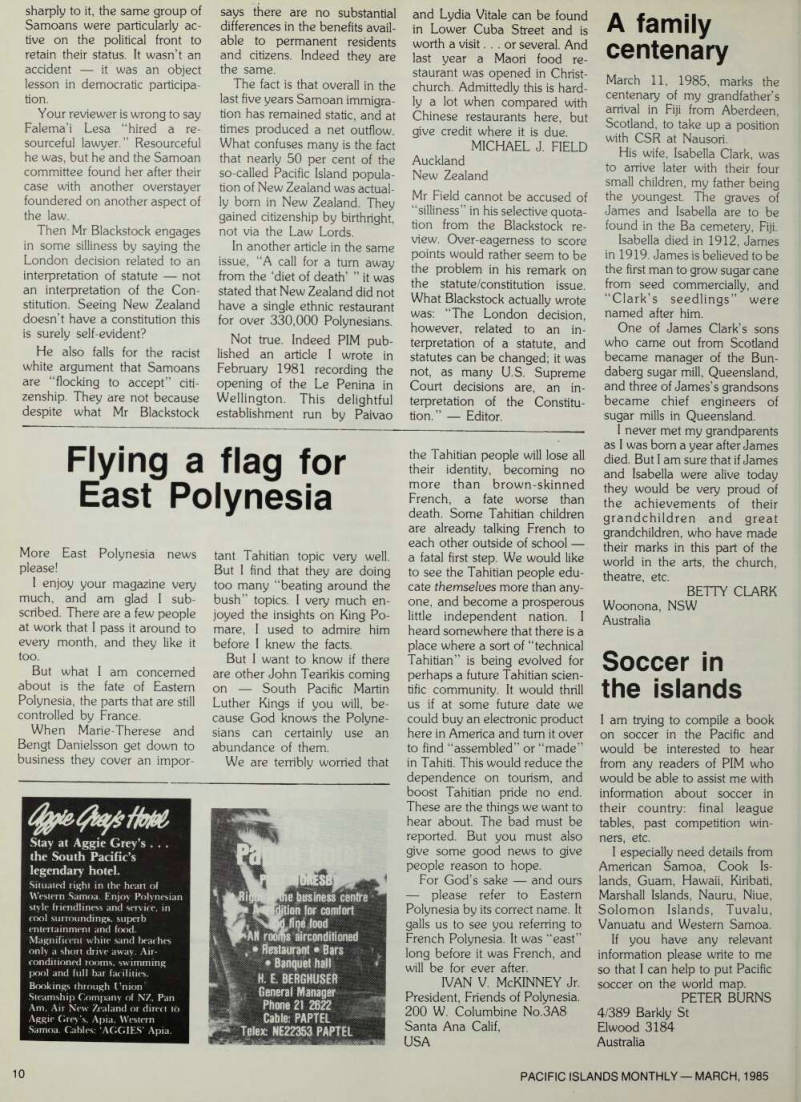
Not all tourist resorts are plush hotels full of uncaring, boozy, pleasure-seekers. These are the tropical “chalets” of the lovely and remote hotel on Ambrym, Vanuatu, recently visited by a party of travel writers seeking something different.
sharply to it, the same group of Samoans were particularly ac tive on the political front to retain their status. It wasn’t an accident it was an object lesson in democratic participa tion.
Your reviewer is wrong to say Falema’i Lesa “hired a re sourceful lawyer.” Resourceful he was, but he and the Samoan committee found her after their case with another overstayer foundered on another aspect of the law.
Then Mr Blackstock engages in some silliness by saying the London decision related to an interpretation of statute not an interpretation of the Con stitution. Seeing New Zealand doesn’t have a constitution this is surely self-evident?
He also falls for the racist white argument that Samoans are “flocking to accept” citi zenship. They are not because despite what Mr Blackstock
says there are no substantial differences in the benefits available to permanent residents and citizens. Indeed they are the same.
The fact is that overall in the last five years Samoan immigration has remained static, and at times produced a net outflow, What confuses many is the fact that nearly 50 per cent of the so-called Pacific Island population of New Zealand was actually born in New Zealand They
gained citizenship by birthright,
not via the Law Lords.
In another article in the same issue, “A call for a turn away from the ‘diet of death’ " it was stated that New Zealand did not have a single ethnic restaurant for over 330,000 Polynesians.
Nr>t , , , * , Not true - Indeed PIM published an article I wrote in February 1981 recording the opening of the Le Penina in Wellington. This delightful establishment run by Paivao
and Lydia Vitale can be found in Lower Cuba Street and is worth a visit... or several. And last year a Maori food re staurant was opened in Christ church. Admittedly this is hard ly a lot when compared with Chinese restaurants here, but give credit where it is due.
Michael J. Field
Auckland New Zealand Mr Field cannot be accused of “silliness” in his selective quota tion from the Blackstock re view. Over-eagerness to score points would rather seem to be the problem in his remark on the statute/constitution issue.
What Blackstock actually wrote was; “The London decision, however, related to an in terpretation of a statute, and statutes can be changed; it was not, as many U.S. Supreme Court decisions are, an in terpretation of the Constitu tion.” Editor.