letters
A long, long road for Solomon Islands women
Regarding Sandra Rennie’s ex cellent review of the proceed ings of the Women, Aid and Development Workshop (PIM Nov. ’B4, p 48): I presented two brief, chatty, informal addresses at this workshop which, like those by other speakers, aimed to elicit discussion by raising issues and examples of devel opment problems faced by women. Few speakers present ed papers; the proceedings were transcribed from tape re cordings.
Perhaps the major weakness of Melville’s book of the pro ceedings is that it does not convey the context of the work shop, the length and vigor of the discussion following each speaker, or further comments by the speakers themselves.
I was a bit alarmed by the headline of the review: “Learn ing From a Solomons Water Project”. If in my discussion I conveyed the impression that the Solomon Islands Rural Water Supply and Sanitation Project (RWSSP) was failing because women were cutting pipes with their bush knives, then I must correct that impression.
Most Solomon Islands women regard accessible clean fresh water as a labor-saving blessing. Many also recognise the potential of the project to reduce disease in their com munities.
Furthermore, on technical grounds, the RWSSP has been one of the most successful current projects in the devel oping world in relation to the World Health Organisation goal of “Water and Sanitation for All by the Year 2000”.
The problem of RWSSP has been one of human response to technical innovation. For exam ple, once installed, the water supplies were often poorly
maintained. Puddles of water created breeding grounds for mosquitoes. Latrines, if built at all, were often not used. The motivating requirement of the RWSSP project (that the com munity themselves raise part of the cost of installation) was often undermined when non government aid agencies sup plied these local costs.
The most socially and tech nically successful water and sanitation programs elsewhere in the South Pacific have been those in which women, as the major users and beneficiaries, have been involved in the plan ning, fund-raising and devel opment of the projects. Yet hardly any Solomons women are involved at any stage of the RWSSP at any level, from village, to province, to govern ment agency.
My associate, Judi Fisher, and 1 visited Solomon Islands on behalf of the Australian Women and Development Net work in 1982, and we discussed this problem with a number of Solomon Islands women. We read the proceedings of a RWSSP workshop at which there had been only one woman present (a senior health official) which spelt out the gap between the technical success and the human “failure”.
So we recommended to the Australian Overseas Service Bureau, the Australian Free dom From Hunger Campaign, and the Australian Devel opment Assistance Bureau’s Committee for Development Co-operation that the Solomon Islands Development Trust (SIDT) be funded to carry out a development education pro gram in support of the RWSSP.
In recommending this, we understood that SIDT would work out a strategy to involve women as active participants,
rather than as passive recip ients; that water, sanitation and primary health care would be the major concern; and that SIDT would work closely and co-operatively with the existing program. As a result of our efforts to link SIDT with Austra lian agencies, SIDT received a very considerable amount of Australian aid.
“Learning From a Solomons Water Project” is an apt head line for what happened, even before I gave my optimistic little talk at the WADNA workshop.
In April this year I was deeply disappointed to learn that what ever it is that SIDT has been doing, their project involves very few women and is not working with or in support of the RWSSP. It does, however, contribute funds to the RWSSP for technical purposes, which are received from the Australian Freedom From Hunger Cam paign.
The final irony is that the Solomon Islands National Council of Women’s Nius Blong Mere (No. 3, October 1984, p 5) contains an article criticising the absence of women participants at the fourth RWSS workshop in Honiara in August this year.
The article quotes the director of the workshop as saying “they would have liked to invite women representatives but their funding had been very limited”. Even after over a hundred thousand dollars had been given to SIDT from Aus tralia, which happened directly as a result of our concern over the lack of women participants at the RWSS workshop in 1982 , a few hundred dollars to sponsor women participants still could not be found.
(Dr) Penelope Schoeffel
Suva Fiji
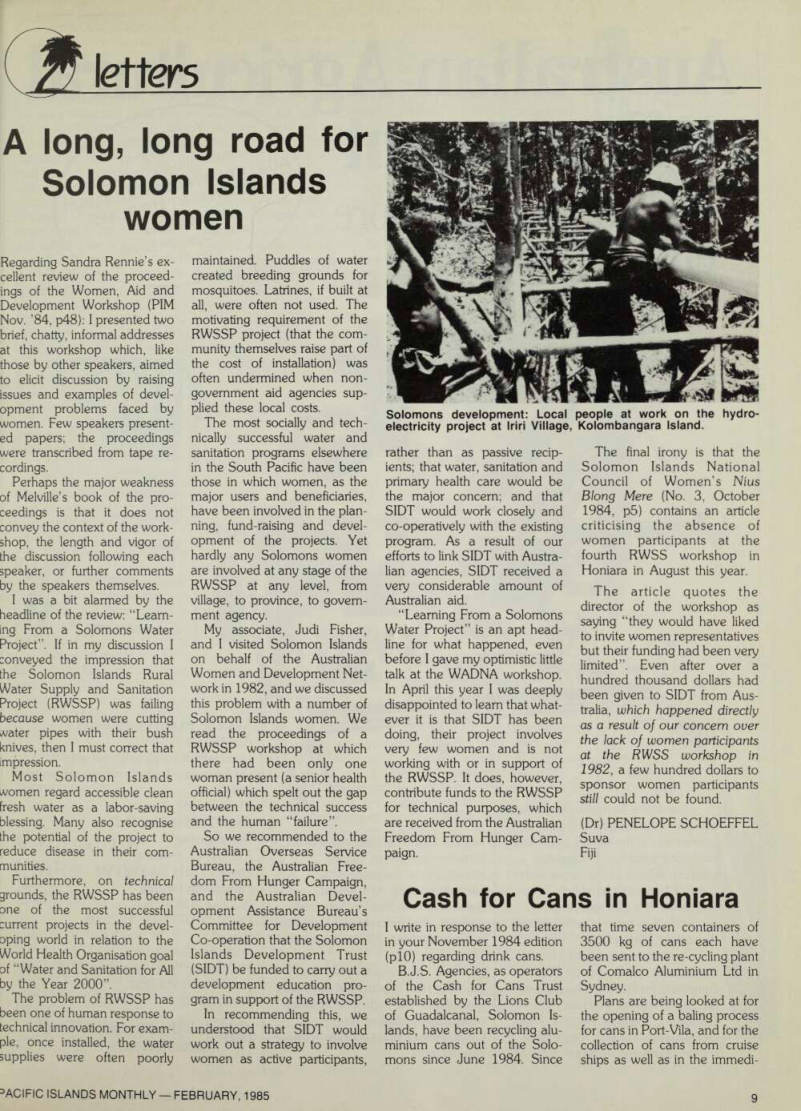
Solomons development: Local people at work on the hydro electricity project at Iriri Village, Kolombangara Island.