yachts
pp. 58-60 · Read in the full issue
Ian G. Menzies Re
ports from Darwin, Australia:
• NIKKI. If there is one feature about Nikki which makes her stand out in a crowd, it’s her masts. As Richard and Diane Molony, her owners, have come to learn, the comment “funny looking masts, mate!”, has now become a part of their cruising life. In fact so many comments have been made about Nikki’s unusual, but very practical, braced pipe masts, that Richard recently published an extremely well-written article on the subject in an Australian cruising magazine.
Nikki was built by David Jeanes, one of Australia’s leading technical writers on boating, and launched in 1980. A Cecil E. Boden Elizabeth design, she is a ketch-rigged steel vessel with LOA of 12.04 metres and a beam of 3.5 metres.
Nikki has a long keel, with two small bilge keels that allow her to take the ground relatively easily.
The only design change that Rich ard would make is to add a bowsprit of at least 0.67 metres.
This would not only improve the lines of the vessel, but also create more space for sail and anchor handling, and allow the use of larger foresails.
Richard and Diane purchased Nikki in January ’B3, sold up their home, horse and business in Mel bourne and set out on a leisurely circumnavigtion. With over 5000 miles now behind them, they have found Nikki to be a very steady and stable vessel and a delight to cruise.
Richard does admit, however, that as the vessel is all steel, including “those masts”, maintenance is a daily necessity. To ease this work load, Richard keeps a 240 volt generator on board, so that he can use a full range of power tools particularly for surface preparation.
After cruising the NSW and Queensland coasts, Nikki made her Papua New Guinea landfall at Samarai. For six months Richard and Diane cruised PNG, and have subsequently published an article on the joys of cruising this part of the world. Stopovers included Lae, Madang (whence they flew to the Highlands), and then the remote volcanic Vitu Islands. At Rabaul they found they had the yacht club to themselves. The current level of volcanic activity in the area is tending to discourage cruising yach ties. Regardless, Rabaul is still one of the prettiest ports in the south
Pacific, with a history well worth investigating.
From Rabaul they made passage south to Kieta via Buka Island, and thence to Budibudi in the Laughlin Group, one of the most remote and untouched islands off the Papuan coast. It was then back to Belesana Slipway near Alotau in Milne Bay. where for K4O up and down, and K2O per day, they cleaned up the hull and anti-fouled. Belesana Slip way has a capacity of 300 tonnes, a full workshop, with everything done on a “do-it-yourself” basis. What’s more, they encourage cruising yachties.
Richard and Diane used Alan Lucas’ Just Cmising series as their guide for their cruising passage up the NSW and Queensland coast and into PNG waters. The three relevant books in the series proved a useful guide on places to visit, as well as providing information on facilities available.
On the technical side, Richard has equipped Nikki with a Furuno FSN 80 SatNav. It has performed admirably, and Richard is now upgrading its program with some additions of his own. The Autohelm 300 installed is “doing well”, as is the Tamaya radar detector which has alerted them of shipping traffic on every occasion without fail.
They found this gave them real peace of mind while transiting the busy Torres Strait.
While in Darwin, Richard and Diane caught up on some of their correspondence and business affairs, and also hosted visitors on board from “down South”. Their next port of call is Christmas Island, and then it’s across the Indian Ocean to South Africa. They have
set themselves no time limit for their circumnavigation. • SUKA. When Ray Jardine de cided to “buy a boat and sail around the world”, he did just that sent for some catalogues, selected one that appealed to him and bought it. He chose a Taiwanese-built Gardner-designed ketch, a C.T. 41, which was laun ched in 1977, and is resgistered in Coos Bay, Oregon, USA. It is indeed a superb looking vessel, but seven years later, and a whole lot wiser, Ray admits that he regrets choosing the design he did. He says that a fast sloop, such as an S & S 39, would be more to his liking.
Regardless of any initial miscon ceptions they may have had, it is obvious that Ray and his wife Jenny have more than compensated for them by the way they have fitted out their vessel. Several years work was entailed before they eventually departed California in November ’B2.
They both admit that their depar ture was, in fact, the first time that they had really gone sailing in Suka.
A few days later saw them huddled below thumbing through sailing manuals, as they worked out what to do when they encountered their first storm. Now, with a Pacific passage under their belt, and three hurricanes ridden out in the pro cess, they are obviously relaxed, confident of their own abilities, and looking forward to the next leg of their passage to Bali and thence to Cape Town.
Ray and Jenny made their Aus tralian landfall at Bundaberg, a delightfully friendly centre in which they spent five months. Poking their
way up the Queensland coast, they decided to visit the township of Seventeen Seventy, so named after Captain Cook’s visit there in that year. The bar off Round Hill Head, however, proved to be unco-opera tive, and they were forced to sit out the tide until they they were able to lift clear. Luckily, as it is a sand bar, there was no damage.
When I asked Ray and Jenny what were the highlights of their Pacific passage, they both agreed on Moorea in French Polynesia, then the Tongan islands and also that they really enjoyed cruising the Queensland coast. More important ly, they said, “getting to know the people along the way”, was what cruising was all about. • SANPOI. Steve “Flash” Jan ney, was a likeable young American who obviously enjoyed the cruising lifestyle. From Auckland, where Steve had purchased Sanpoi, a Boden-designed steel cutter sloop, he and his three New Zealand crew made fast passages to Vanuatu and thence to Papua New Guinea.
While in Port Moresby, Steve was interviewed by a PIM cruising correspondent who reported that “Sanpoi is headed for Bali where she will undergo a major refit. Steve would like to have the interior fitted out in teak. With a new suit of sails, he plans cruising back to the States.” (PIM December, 1983.) Steve, his crew, and Sanpoi set
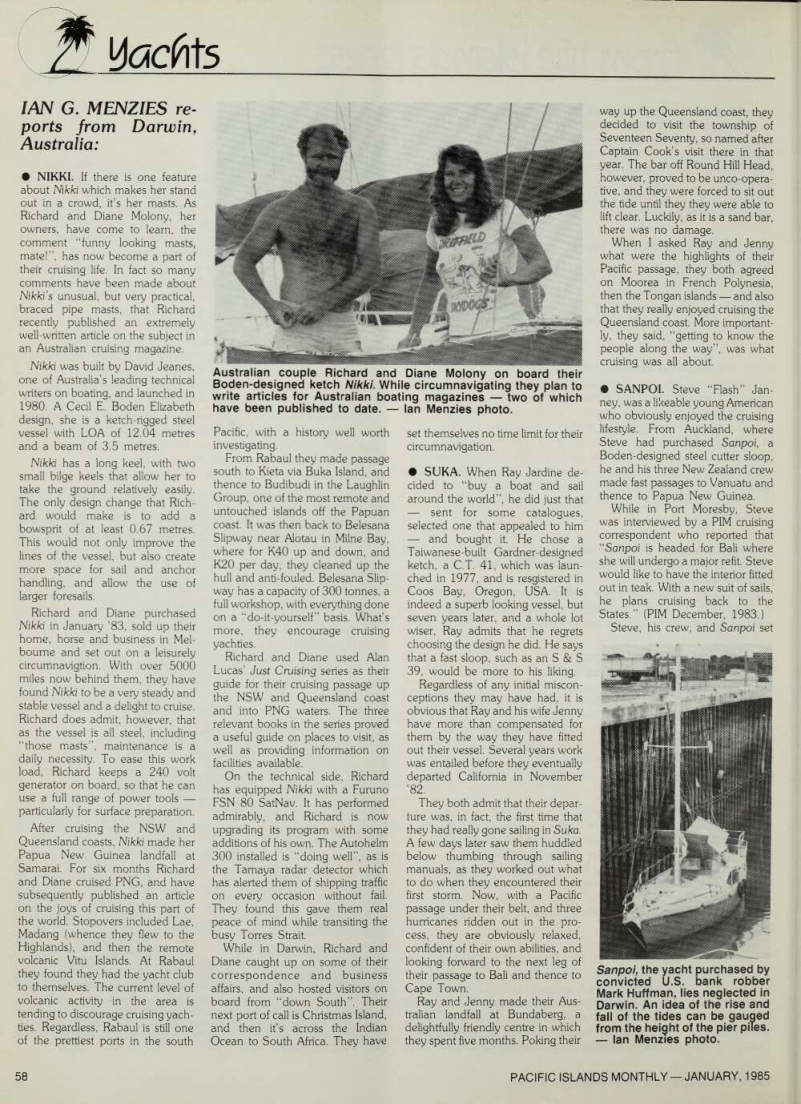
Australian couple Richard and Diane Molony on board their Boden-designed ketch Nikki. While circumnavigating they plan to write articles for Australian boating magazines two of which have been published to date. lan Menzies photo.
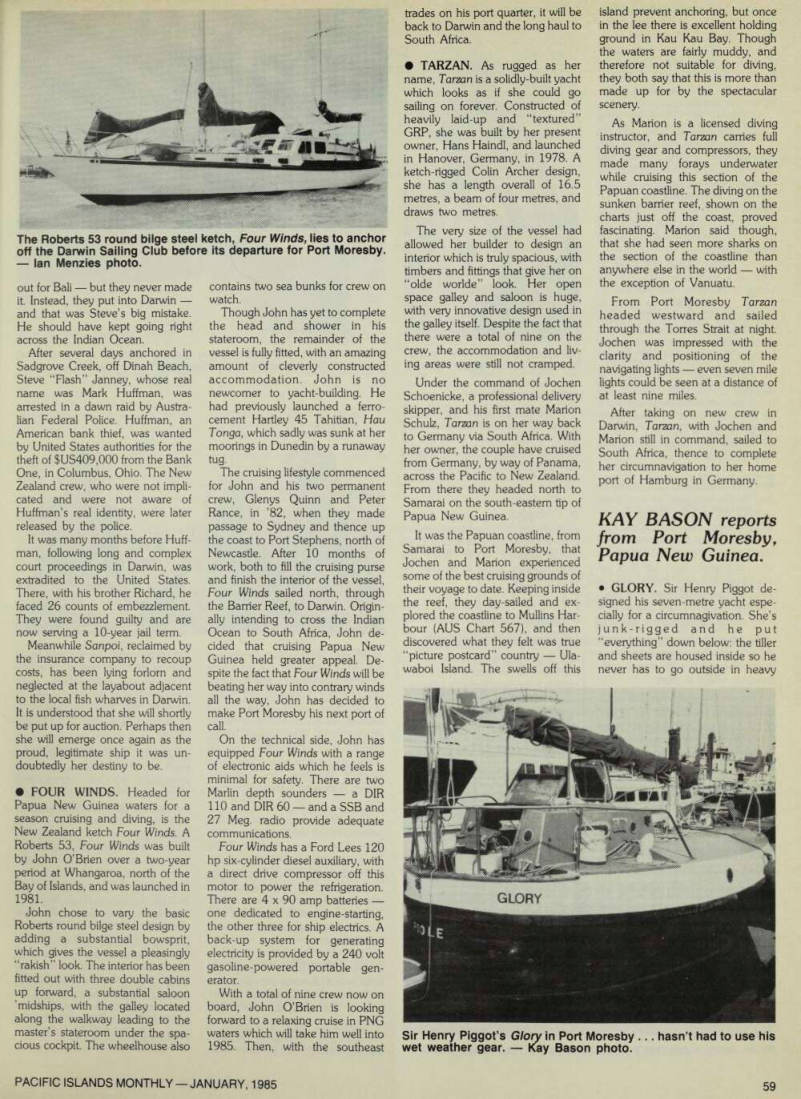
Sanpoi, the yacht purchased by
convicted U.S. bank robber Mark Huffman, lies neglected in Darwin. An idea of the rise and fall of the tides can be gauged from the height of the pier piles. -lan Menzies photo.
out for Bali but they never made it. Instead, they put into Darwin and that was Steve’s big mistake.
He should have kept going right across the Indian Ocean.
After several days anchored in Sadgrove Creek, off Dinah Beach, Steve “Flash” Janney, whose real name was Mark Huffman, was arrested in a dawn raid by Austra lian Federal Police. Huffman, an American bank thief, was wanted by United States authorities for the theft of $U5409,000 from the Bank One, in Columbus, Ohio. The New Zealand crew, who were not impli cated and were not aware of Huffman’s real identity, were later released by the police.
It was many months before Huff man, following long and complex court proceedings in Darwin, was extradited to the United States.
There, with his brother Richard, he faced 26 counts of embezzlement.
They were found guilty and are now serving a 10-year jail term.
Meanwhile Sanpoi, reclaimed by the insurance company to recoup costs, has been lying forlorn and neglected at the layabout adjacent to the local fish wharves in Darwin.
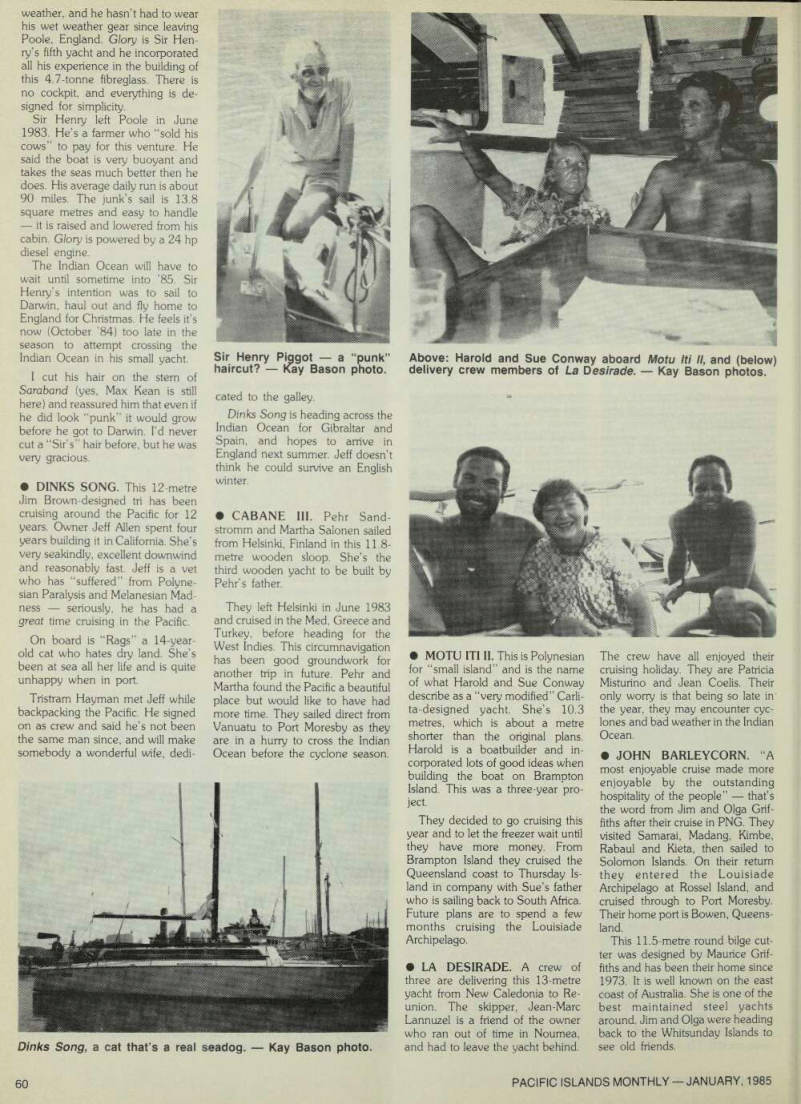
It is understood that she will shortly be put up for auction. Perhaps then she will emerge once again as the proud, legitimate ship it was un doubtedly her destiny to be. • FOUR WINDS. Headed for Papua New Guinea waters for a season cruising and diving, is the New Zealand ketch Four Winds. A Roberts 53, Four Winds was built by John O’Brien over a two-year period at Whangaroa, north of the Bay of Islands, and was launched in 1981.
John chose to vary the basic Roberts round bilge steel design by adding a substantial bowsprit, which gives the vessel a pleasingly “rakish” look. The interior has been fitted out with three double cabins up forward, a substantial saloon ’midships, with the galley located along the walkway leading to the master’s stateroom under the spa cious cockpit. The wheelhouse also
contains two sea bunks for crew on watch.
Though John has yet to complete the head and shower in his stateroom, the remainder of the vessel is fully fitted, with an amazing amount of cleverly constructed accommodation. John is no newcomer to yacht-building. He had previously launched a ferro cement Hartley 45 Tahitian, Hau Tonga, which sadly was sunk at her moorings in Dunedin by a runaway tug.
The cruising lifestyle commenced for John and his two permanent crew, Glenys Quinn and Peter Ranee, in ’B2, when they made passage to Sydney and thence up the coast to Port Stephens, north of Newcastle. After 10 months of work, both to fill the cruising purse and finish the interior of the vessel, Four Winds sailed north, through the Barrier Reef, to Darwin. Origin ally intending to cross the Indian Ocean to South Africa, John de cided that cruising Papua New Guinea held greater appeal. De spite the fact that Four Winds will be beating her way into contrary winds all the way, John has decided to make Port Moresby his next port of call.
On the technical side, John has equipped Four Winds with a range of electronic aids which he feels is minimal for safety. There are two Marlin depth sounders a DIR 110 and DIR 60 and a SSB and 27 Meg. radio provide adequate communications.
Four Winds has a Ford Lees 120 hp six-cylinder diesel auxiliary, with a direct drive compressor off this motor to power the refrigeration.
There are 4 x 90 amp batteries one dedicated to engine-starting, the other three for ship electrics. A back-up system for generating electricity is provided by a 240 volt gasoline-powered portable gen erator.
With a total of nine crew now on board, John O’Brien is looking forward to a relaxing cruise in PNG waters which will take him well into 1985. Then, with the southeast
trades on his port quarter, it will be back to Darwin and the long haul to South Africa. • TARZAN. As rugged as her name, Tarzan is a solidly-built yacht which looks as if she could go sailing on forever. Constructed of heavily laid-up and “textured”
GRP, she was built by her present owner, Hans Haindl, and launched in Hanover, Germany, in 1978. A ketch-rigged Colin Archer design, she has a length overall of 16.5 metres, a beam of four metres, and draws two metres.
The very size of the vessel had allowed her builder to design an interior which is truly spacious, with timbers and fittings that give her on “olde worlde” look. Her open space galley and saloon is huge, with very innovative design used in the galley itself. Despite the fact that there were a total of nine on the crew, the accommodation and liv ing areas were still not cramped.
Under the command of Jochen Schoenicke, a professional delivery skipper, and his first mate Marion Schulz, Tarzan is on her way back to Germany via South Africa. With her owner, the couple have cruised from Germany, by way of Panama, across the Pacific to New Zealand.
From there they headed north to Samarai on the south-eastern tip of Papua New Guinea.
It was the Papuan coastline, from Samarai to Port Moresby, that Jochen and Marion experienced some of the best cruising grounds of their voyage to date. Keeping inside the reef, they day-sailed and ex plored the coastline to Mullins Har bour (AUS Chart 567), and then discovered what they felt was true “picture postcard” country Ula waboi Island. The swells off this
island prevent anchoring, but once in the lee there is excellent holding ground in Kau Kau Bay. Though the waters are fairly muddy, and therefore not suitable for diving, they both say that this is more than made up for by the spectacular scenery.
As Marion is a licensed diving instructor, and Tarzan carries full diving gear and compressors, they made many forays underwater while cruising this section of the Papuan coastline. The diving on the sunken barrier reef, shown on the charts just off the coast, proved fascinating. Marion said though, that she had seen more sharks on the section of the coastline than anywhere else in the world with the exception of Vanuatu.
From Port Moresby Tarzan headed westward and sailed through the Torres Strait at night.
Jochen was impressed with the clarity and positioning of the navigating lights even seven mile lights could be seen at a distance of at least nine miles.
After taking on new crew in Darwin, Tarzan, with Jochen and Marion still in command, sailed to South Africa, thence to complete her circumnavigation to her home port of Hamburg in Germany.
KAY BASON reports
from Port Moresby,
Papua New Guinea .
• GLORY. Sir Henry Piggot de signed his seven-metre yacht espe cially for a circumnagivation. She’s junk-rigged and he put “everything” down below: the tiller and sheets are housed inside so he never has to go outside in heavy
The Roberts 53 round bilge steel ketch, Four Winds, lies to anchor off the Darwin Sailing Club before its departure for Port Moresby. -lan Menzies photo.
Sir Henry Piggot’s Glory In Port Moresby ... hasn’t had to use his wet weather gear. Kay Bason photo.
weather, and he hasn’t had to wear his wet weather gear since leaving Poole, England. G/ory is Sir Hen ry’s fifth yacht and he incorporated all his experience in the building of this 4.7-tonne fibreglass. There is no cockpit, and everything is de signed for simplicity.
Sir Henry left Poole in June 1983. He’s a farmer who “sold his cows” to pay for this venture. He said the boat is very buoyant and takes the seas much better then he does. His average daily run is about 90 miles. The junk’s sail is 13.8 square metres and easy to handle it is raised and lowered from his cabin. Gloiy is powered by a 24 hp diesel engine.
The Indian Ocean will have to wait until sometime into ’B5. Sir Henry’s intention was to sail to Darwin, haul out and fly home to England for Christmas. He feels it’s now (October ’B4) too late in the season to attempt crossing the Indian Ocean in his small yacht.
I cut his hair on the stem of Saraband (yes, Max Kean is still here) and reassured him that even if he did look “punk” it would grow before he got to Darwin. I’d never cut a “Sir’s” hair before, but he was very gracious. • DINKS SONG. This 12-metre Jim Brown-designed tri has been cruising around the Pacific for 12 years. Owner Jeff Allen spent four years building it in California. She’s very seakindly, excellent downwind and reasonably fast. Jeff is a vet who has “suffered” from Polyne sian Paralysis and Melanesian Mad ness seriously, he has had a great time cruising in the Pacific.
On board is “Rags” a 14-year old cat who hates dry land. She’s been at sea all her life and is quite unhappy when in port.
Tristram Hayman met Jeff while backpacking the Pacific. He signed on as crew and said he’s not been the same man since, and will make somebody a wonderful wife, dedi-
cated to the galley.
Dinks Song is heading across the Indian Ocean for Gibraltar and Spain, and hopes to arrive in England next summer. Jeff doesn’t think he could survive an English winter. • CABANE 111. Pehr Sand stromm and Martha Salonen sailed from Helsinki, Finland in this 11.8metre wooden sloop. She’s the third wooden yacht to be built by Pehr’s father.
They left Helsinki in June 1983 and cruised in the Med, Greece and Turkey, before heading for the West Indies. This circumnavigation has been good groundwork for another trip in future. Pehr and Martha found the Pacific a beautiful place but would like to have had more time. They sailed direct from Vanuatu to Port Moresby as they are in a hurry to cross the Indian Ocean before the cyclone season.
• MOTU ITIII. This is Polynesian for “small island” and is the name of what Harold and Sue Conway describe as a “very modified” Carli ta-designed yacht. She’s 10.3 metres, which is about a metre shorter than the original plans.
Harold is a boatbuilder and in corporated lots of good ideas when building the boat on Brampton Island. This was a three-year pro ject.
They decided to go cruising this year and to let the freezer wait until they have more money. From Brampton Island they cruised the Queensland coast to Thursday Is land in company with Sue’s father who is sailing back to South Africa.
Future plans are to spend a few months cruising the Louisiade Archipelago. • LA DESIRADE. A crew of three are delivering this 13-metre yacht from New Caledonia to Re union. The skipper, Jean-Marc Lannuzel is a friend of the owner who ran out of time in Noumea, and had to leave the yacht behind.
The crew have all enjoyed their cruising holiday. They are Patricia Misturino and Jean Coelis. Their only worry is that being so late in' the year, they may encounter cyc lones and bad weather in the Indian Ocean.
• John Barleycorn. “A
most enjoyable cruise made more enjoyable by the outstanding hospitality of the people” that’s the word from Jim and Olga Grif fiths after their cruise in PNG. They visited Samarai, Madang, Kimbe, Rabaul and Kieta, then sailed to Solomon Islands. On their return they entered the Louisiade Archipelago at Rossel Island, and cruised through to Port Moresby.
Their home port is Bowen, Queens land.
This 11.5-metre round bilge cut ter was designed by Maurice Grif fiths and has been their home since 1973. It is well known on the east coast of Australia. She is one of the best maintained steel yachts around. Jim and Olga were heading back to the Whitsunday Islands to see old friends.
Dinks Song, a cat that’s a real seadog. Kay Bason photo.
Sir Henry Piqgot a “punk” haircut? Kay Bason photo.
Above: Harold and Sue Conway aboard Motu lti ll, and (below) delivery crew members of La D esirade. Kay Bason photos.