People
p. 56 · Read in the full issue
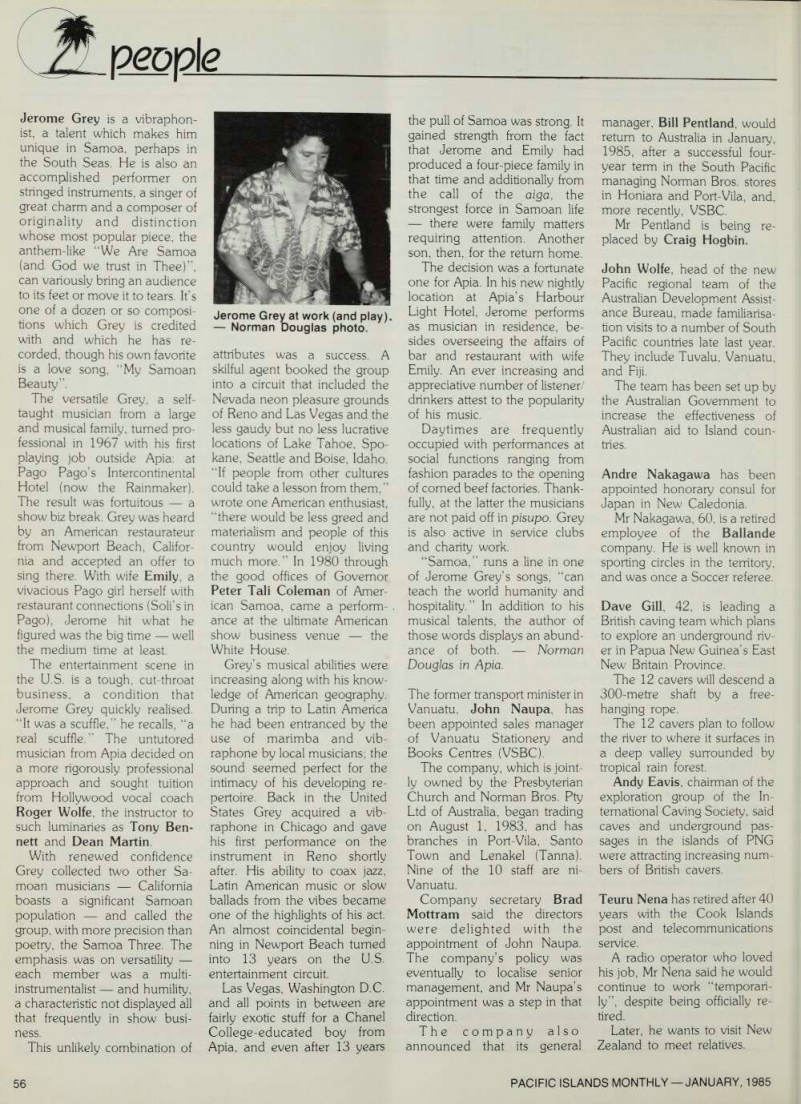
Jerome Grey is a vibraphon ist, a talent which makes him unique in Samoa, perhaps in the South Seas. He is also an accomplished performer on stringed instruments, a singer of great charm and a composer of originality and distinction whose most popular piece, the anthem-like “We Are Samoa (and God we trust in Thee)”, can variously bring an audience to its feet or move it to tears. It’s one of a dozen or so composi tions which Grey is credited with and which he has re corded, though his own favorite is a love song, “My Samoan
Beauty”.
The versatile Grey, a self taught musician from a large and musical family, turned pro fessional in 1967 with his first playing job outside Apia: at Pago Pago’s Intercontinental Hotel (now the Rainmaker).
The result was fortuitous a show biz break. Grey was heard by an American restaurateur from Newport Beach, Califor nia and accepted an offer to sing there. With wife Emily, a vivacious Pago girl herself with restaurant connections (Soli’s in Pago), Jerome hit what he figured was the big time well the medium time at least.
The entertainment scene in the U.S. is a tough, cut-throat business, a condition that Jerome Grey quickly realised.
“It was a scuffle,” he recalls, “a real scuffle.” The untutored musician from Apia decided on a more rigorously professional approach and sought tuition from Hollywood vocal coach Roger Wolfe, the instructor to such luminaries as Tony Ben nett and Dean Martin.
With renewed confidence Grey collected two other Sa moan musicians California boasts a significant Samoan population and called the group, with more precision than poetry, the Samoa Three. The emphasis was on versatility each member was a multi instrumentalist and humility, a characteristic not displayed all that frequently in show busi ness.
This unlikely combination of
attributes was a success. A skilful agent booked the group into a circuit that included the Nevada neon pleasure grounds of Reno and Las Vegas and the less gaudy but no less lucrative locations of Lake Tahoe, Spo kane, Seattle and Boise, Idaho.
“If people from other cultures could take a lesson from them,” wrote one American enthusiast, “there would be less greed and materialism and people of this country would enjoy living much more.” In 1980 through the good offices of Governor Peter Tali Coleman of Amer ican Samoa, came a perform- . ance at the ultimate American show business venue the White House.
Grey’s musical abilities were increasing along with his know ledge of American geography.
During a trip to Latin America he had been entranced by the use of marimba and vib raphone by local musicians; the sound seemed perfect for the intimacy of his developing re pertoire. Back in the United States Grey acquired a vib raphone in Chicago and gave his first performance on the instrument in Reno shortly after. His ability to coax jazz, Latin American music or slow ballads from the vibes became one of the highlights of his act.
An almost coincidental begin ning in Newport Beach turned into 13 years on the U.S. entertainment circuit.
Las Vegas, Washington D.C. and all points in between are fairly exotic stuff for a Chanel College-educated boy from Apia, and even after 13 years
the pull of Samoa was strong. It gained strength from the fact that Jerome and Emily had produced a four-piece family in that time and additionally from the call of the aiga, the strongest force in Samoan life there were family matters requiring attention. Another son, then, for the return home.
The decision was a fortunate one for Apia. In his new nightly location at Apia’s Harbour Light Hotel, Jerome performs as musician in residence, be sides overseeing the affairs of bar and restaurant with wife Emily. An ever increasing and appreciative number of listener drinkers attest to the popularity of his music.
Daytimes are frequently occupied with performances at social functions ranging from fashion parades to the opening of corned beef factories. Thank fully, at the latter the musicians are not paid off in pisupo. Grey is also active in service clubs and charity work.
“Samoa,” runs a line in one of Jerome Grey’s songs, “can teach the world humanity and hospitality.” In addition to his musical talents, the author of those words displays an abund ance of both. Norman Douglas in Apia.
The former transport minister in Vanuatu. John Naupa. has been appointed sales manager of Vanuatu Stationery and Books Centres (VSBC).
The company, which is joint ly owned by the Presbyterian Church and Norman Bros. Pty Ltd of Australia, began trading on August 1, 1983, and has branches in Port-Vila, Santo Town and Lenakel (Tanna).
Nine of the 10 staff are ni- Vanuatu.
Company secretary Brad Mottram said the directors were delighted with the appointment of John Naupa.
The company’s policy was eventually to localise senior management, and Mr Naupa’s appointment was a step in that direction.
The company also announced that its general
manager. Bill Pentland. would return to Australia in January, 1985. after a successful four year term in the South Pacific managing Norman Bros, stores in Honiara and Port-Vila, and, more recently, VSBC.
Mr Pentland is being re placed by Craig Hogbin.
John Wolfe, head of the new Pacific regional team of the Australian Development Assist ance Bureau, made familiarisa tion visits to a number of South Pacific countries late last year.
They include Tuvalu, Vanuatu, and Fiji.
The team has been set up by the Australian Government to increase the effectiveness of Australian aid to Island coun tries.
Andre Nakagawa has been appointed honorary consul for Japan in New Caledonia.
Mr Nakagawa, 60, is a retired employee of the Ballande company. He is well known in sporting circles in the territory, and was once a Soccer referee.
Dave Gill, 42, is leading a British caving team which plans to explore an underground riv er in Papua New Guinea’s East New Britain Province.
The 12 cavers will descend a 300-metre shaft by a free hanging rope.
The 12 cavers plan to follow the river to where it surfaces in a deep valley surrounded by tropical rain forest.
Andy Eavis, chairman of the exploration group of the In ternational Caving Society, said caves and underground pas sages in the islands of PNG were attracting increasing num bers of British cavers.
Teuru Nena has retired after 40 years with the Cook Islands post and telecommunications service.
A radio operator who loved his job. Mr Nena said he would continue to work “temporari ly”, despite being officially re tired.
Later, he wants to visit New Zealand to meet relatives.
Jerome Grey at work (and play).
Norman Douglas photo.