of Norfolk
pp. 27-29 · Read in the full issue
The noble nosh of Norfolk
Take a bunch of Scots, Welsh and Englishmen (including a Manxman) nurtured on the less than gourmet cuisine of weevil ly biscuits and salt port of the 18th century navy; give them a free rein in affluent and idyllic Tahiti; run them ashore, with their Polynesian ladies, on the most remote and inhospitable island of the British Empire (Pitcairn) visited by less than a dozen ships in as many years; remove them to a failed penal settlement which (at the time) was part of Van Diemen’s Land, where they could engage in trade or barter with American whalers, New Zealand, Austra lia and the French Melanesian islands; expose them to two world wars, economic integra tion with Australia, invasions of settlers seeking a tax haven and visitors obsessed with duty-free shopping; given so variegated a series of cultural influences, it might be expected that the food of Norfolk Island would be “tourist cosmopolitan”, lacking any local identity.
And, indeed, there are re staurants which aspire to in ternational standards (including one, Barney Duffy’s named after an escaped convict who is said to have lived seven years in a hollow tree. . . What is surprising, however, is that so much remains on the island of earlier food influences (pre -1880, when the population was 403, nearly all of them direct decendants of the nine Euro peans and 18 Tahitians who landed on Pitcairn in 1790).
Norfolk Island was first set tled in 1788 and was confident ly expected to support a penal colony of 3000 people to grow food for export to other such colonies in Australia. In this, it failed dismally, remaining throughout the colonial era a net food importer despite an abundance of seafood (includ ing turtles) and birdlife, and a wide range of edible plants either native or introduced. The latter included maize, wheat, guavas, oranges, cabbage, cof fee, peas, beans as well as potatoes, arrowroot, onions, bananas, lemons and passion
fruit, which later became export crops.
Early vegetable crop failures were ascribed by the first Su perintendent and Commandant (Philip Gidley King) to “ye grubs”, and “ye ratts”. To protect the crops, he experi mented with ash and urine, and tried to feed a mixture of oatmeal and powdered glass to the rats. But “ye parroquets” followed and the harsh (even by the standards of the day) penal regimes did not encour age dedicated husbandry. In June 1856, the last convicts left for Hobart only a few days after the arrival of 193 Pitcair ners, to whom Norfolk was “a goodly land”, fertile and boun teous compared with the pre cipitous terrain and primitive conditions they had aban doned. It needed, wrote George Hunn Nobbs in 1858, “nothing but a contented mind, a persevering spirit, and a grate ful heart, to render it productive and pleasant”.
On arrival, the Pitcairners looked in vain for their staple foods yams, taro and sweet potatoes but before the end of the year they were provided with seed yams and taro from Tonga. The multiple-purpose coconut, however, failed to transplant and many of the older people found difficulty in adapting to a non-vegetarian diet. Nevertheless, subsequent returns to Pitcairn (two families in 1859 and four families in 1864) owed more to dissatisfac tion over land tenure than to difficulties in adjusting to the physical environment.
Despite more recent expo
sure, Norfolk Island has so far avoided the worst excesses of the junk food culture white rice, potato chips and tinned fish which is destroying the health of so many Pacific Islan ders. The inevitable Chinese Takeaways and Pizza Parlors have arrived, but they have not yet displaced the old cuisine.
Tahitian influence is evident in the number of banana and kumera dishes served often modified by European and North American tastes. Bana nas are baked or boiled in the skin and eaten as a vegetable; they are made into puddings, pickles, tarts, jam, savories (with cayenne and beaten egg), dumplings (“banana mudda”), pancakes, and fritters. Kumeras and yams are candied or baked with grated coconut (imported) in a “pilhi” sometimes in a banana leaf but more frequent ly nowadays in a pie dish.
Similarly, yam and taro are cooked as a pilhi and may be served cold.
The predominantly vegeta rian culture of Pitcairn Island is reflected in the fact that there are no traditional recipes for meat or poultry. Whalebirds (Sooty terns) are caught and smoked, and eggs are taken, but fish recipes are generally recent imports, as is the so called “Tahitian” marinated fish. Trumpeter (Red Emperor) is a modem speciality but, despite the explosion of intro duced goats and rabbits on Phillip Island (which has turned it into a highly colored desert), and the early introduction of quail, pigeon, snipe and pheasant, beef is the only local ly produced meat readily avail able.
North America’s pre-eminent contribution to Norfolk Island cuisine is the pie an essential component of all celebrations.
It may be a cooked pastry shell filled with raw fruit, or a deep dish pie filled before cooking with fruits persimmon or passionfruit pulp, mulberry, lo quats, guava, coconut, pump kin, pineapple, orange, lemon, or china pear. Typical of Nor folk’s adaptive facility is the Hi-hi pie periwinkles lightly boiled in their shells, covered with a white sauce after shell ing, then cooked in a true pie; the hi-hi, like flummery, is typi cal west country (the Bounty had a Bristol crew) but the pie is North American, brought by the whalers. (A more modern and allegedly Australian adaptation is that of home brew, in which a bottle of hotel beer is extended by adding it to a kerosene tin of water, with brown sugar and malt, and fermenting it!) To the European visitor, perhaps the most exciting aspect of Norfolk Island cook ery is the variety of home-made jams, relishes and chutneys available prepared from every conceivable fruit. Bana na, guavas (red and yellow), apple, pear, pineapple, paw paw, lemon, orange, passion fruit, grapefruit, etc., make jams, jellies or curds and are served with meat and poultry; so too are relishes or chutneys of cucumber, tomato, watermelon rind (pickled with alum, cinnamon, cloves and vinegar), roselle (seeded with chilli, garlic, ginger and raisins), paw-paw (with ginger, mustard, chilli, treacle and onion), china pear and choko (with cloves and onions), banana and zuc chini (marinated with mustard seeds and turmeric).
As in most tourist haunts in the Pacific, it is not easy to sample Norfolk Island cuisine in hotels or unless one knows what ingredients to buy and where to buy them when staying in one of the many apartments which serve the accommodation needs of visi tors. Fortunately, a few estab lishments organise special meals which feature traditional dishes. “Marie’s Island Dinner” is served at Bishop’s Court Restaurant near the airport; and “Aunt Em’s Guesthouse” offers lunch and dinner in an old colonial house set in a beautiful garden close to the main shop
ping area.
Dennis Rich-
ardson.
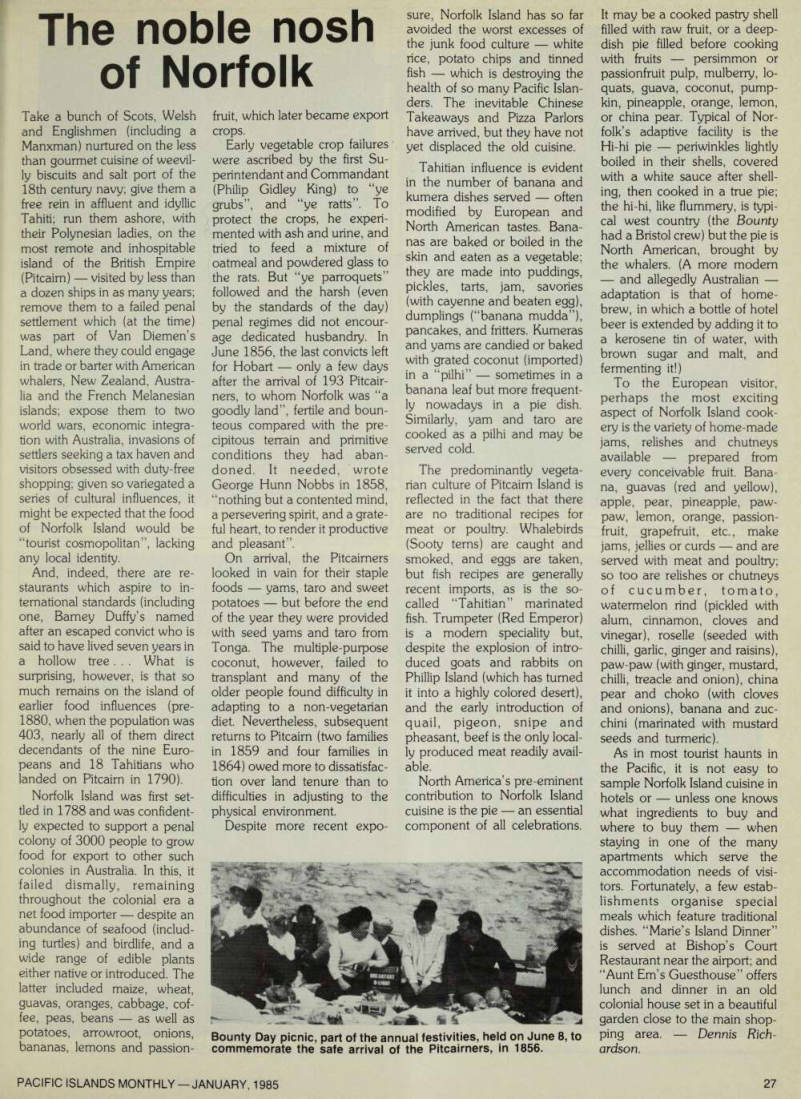
Bounty Day picnic, part of the annual festivities, held on June 8, to commemorate the safe arrival of the Pitcairners, in 1856.
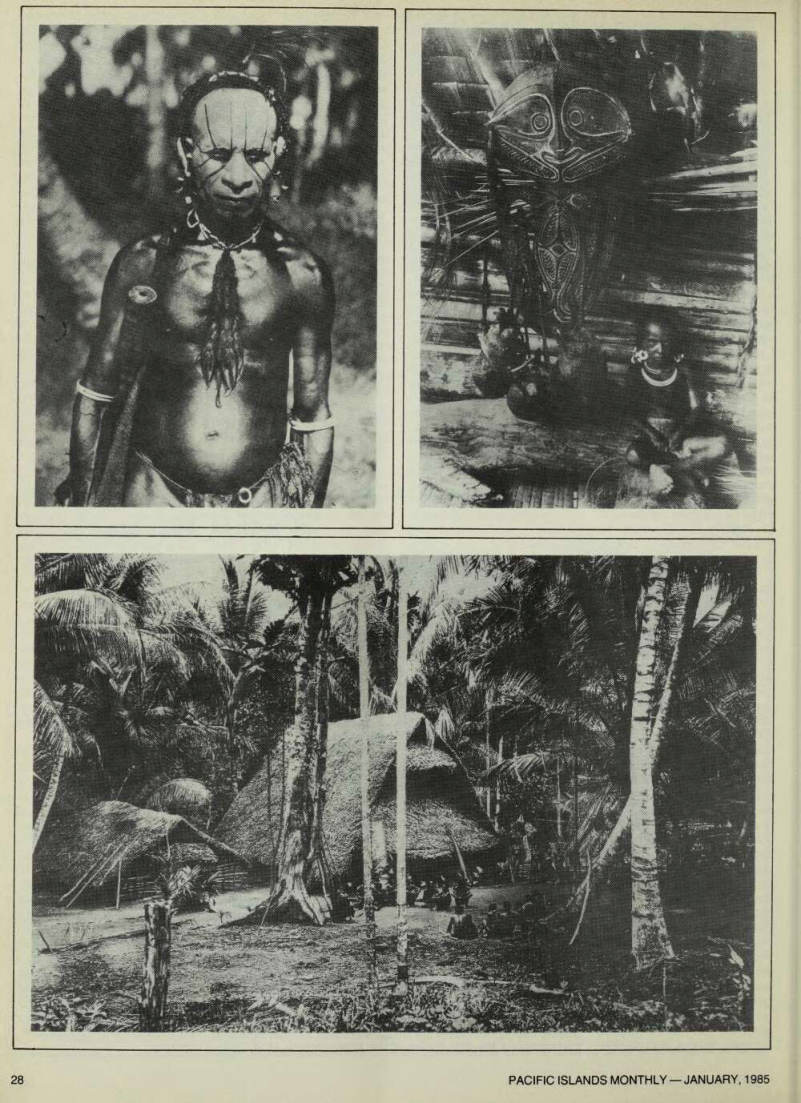
Magnificent historic photographs: Top left, Man from Lower Sepik River, circ 1884. Top right, Skull rack, Goaribari Island, Gulf of Papua; Bottom, Village near Madang, 1884.