head off crisis
pp. 14-16 · Read in the full issue
Implacable Meets Immovarie
French scramble to head off crisis
New Caledonia
On the eve of the arrival from Paris, on November 27, of Mr Charles Barbeau, spe cial envoy of Minister Georges Lemoine. the President of the Kanak Provisional Govern ment, Jean-Marie Tjibaou, announced he was "ready to meet all people who have deci sion-making powers sent by the government"
"All our actions have been to obtain discussions with the gov ernment," he told Helen Fraser in an exclusive interview at a heavily-protected meeting place.
"We’ve heard on the radio that France proposes to bring forward self-determination but for us this is not the question the question is self-determina tion for the Kanak people alone and if everyone is going to have a say on the destiny of the Kanak people, we will boycott such referendums."
Referring to the future politi cal rights of other ethnic groups in New Caledonia, where the .
Kanak people have become a minority (43 per cent) Mr Tjibaou said: “Our position hall never changed. We claim inde pendence for our people, which ■ concerns just the Kanaks. For the rest, that is the political status of Europeans, of colons I (established settlers), that con- j cerns the French Government and Georges Lemoine, the. minister for overseas territor ies. " c L”
He said the FLNKS could not consider rights of other groups within New Caledonia "while we don’t have political power. ”
"For the moment it is up to
New Caledonia has had a place in world news headlines since the November 18 elections for a new Territorial Assembly.
The elections were the target of an ’’active boycott” by the newly-formed Kanak Socialist National Liberation Front (FLNKS), made up of four of the five parties of the former Independ ence Front.
The boycott led to the burning down of several town halls, houses and shops in the country side, and clashes between FLNKS demonstra tors and gendarmes.
In electoral terms the boycott cut voter participation from 75 per cent in the last assembly elections in 1979, to 50.12 per cent.
The anti-independence Rassemblement pour la Caiedonie dans la Republique (RPCR) party was a clear victor in the election, winning 34 of the 42 seats.
With the FLNKS campaign of disruption continuing in the days following the poll, Its proclamation of a ’’provisional government,” and the New Caledonia Issue at last beginning to make political waves In Paris, the French Government seemed set to change course: first, a special envoy of Minister Georges Lemolne, Charles Barbeau, arrived on November 27; then former French Government minister, Edgard Pisanl, was despatched to the territory on December 3. He was to take over administrative control of New Caledonia with a two-months deadline to work out a plan for self-government Australia was vocal In expressing concern at developments, and, although Its stand was generally In support of French Government I proposing a slow, but steady, progre wards Independence, Its statements lowing article has been compiled from iled by PlM’s Noumea correspondent, aser, newsagency bulletins and other Ed.
the government and we can only start discussions as leaders when self-determination is or ganised or sovereignty given back to the Kanak people.
Then the Kanaks can start to welcome people who accept the Kanak nationality and con stitution.”
As he spoke, the FLNKS campaign of destabilisation was continuing. A gendarme station was occupied in the north-east, a French Administrator was being held hostage on Lifou Island, and six road-blocks were still in place. But, Mr Tjibaou said: "We envisage cal p ming the situation. our determination for our claim for self-determination and to obtain discussions with the gov* ernment.”
Mr said the unrest; was a consequence of "colonial relations (New Caledonians) have had with each other, that of dominator and of domin ated. It is a consequence of that "Now we are trying to man find odrselves and to endure until the government opens dls- On JthJ attitude of Sou* Pacific Forum countries, Mr Tjibaou said: "Our Relations with countries of the region are zero for the moment With no s support except that of Vanuatu, which is an unconditional sup port whic| has alwayl been there. The relations with other countries are at a deal point - I think they’re afraid of suppor ting ’terrorists/ Thafs their poli
cy; we’re working for the mo ment with Vanuatu, to obtain discussions with the French Government.” • •• It is estimated that only about 15 per cent of eligible Kanak voters took part in the Novem ber 18 poll.
Police used stun grenades and tear gas as rock-throwing Kanak extremists attacked poll ing stations in several towns, destroying ballot papers and intimidating voters, police said.
In one of the most violent clashes, about 200 Kanaks stormed the polling station at Canalaf 100 km north-east of Noumea, and tore up ballot papers.
Police threw up roadblocks to stop tie mob from reaching other polling stations.
Some reports claimed dozens of people around the island had been injured, including some gendarmes. One woman lost a hand in an explosion during the violence.
On the east coast island of Lifou officials confiscated ballot boxes to ease the tension be tween rival groups. Gendarmes had earlier moved in to clear road blocks around six of the Lifou’s mayor, Edouard *** , , Wapae, was one of several local officials arrested on public dis order charges, police said.
But the troubles did not end with polling day. |bn November 20. about 200 Kanak militants seized the French gendarme station lat Thio on the south-east coast and raised the Kanak indie-, FLNKS militants policemen hostage for five hours before surrendering.
Police, armed with tear gas hostages were freed. No arrests were made. takeover at Thio, 150 km west of Noumea, said the action was intended to (put further
’ pressurljj : on
te At°Nenghene on the
east' coasif of'gen
darmes was ambushed on the
The massacre of 10 FLNKS militants by white settlers at Hlenghene on December 5 turned the screws still tighter on the tension now gripping New Caledonia.
Two of the dead were brothers of Jean-Marie TJlbaou, president of the self-styled provisional government of Kanaky set up shortly before. Indicating the gravity of the situation as seen by the French government, President Mitterrand wrote a personal letter of condolence to Mr Tjlbaou.
The tension was Immediately obvious to Australian visitors arriving on Qantas flights in mid-December when they found Noumea’sTontouta airport guarded by French riot police armed with automatic weapons.
At press time, the FLNKS still held control of the Important east coast mining town of Thlo which they ‘ liberated’’ to the wake of the November elections. ’’
Several thousand anti-Independence Europeans, gathered on December 7 at the airport to welcome home from Paris Senator Dick Ukeiwe, waved ban ners demanding French Intervention in Thlo to restore the authority of Paris.
Despite everything, the way was being cleared for talks on December 15 between new High Commis sioner, Edgard Plsanl, and representatives of all political groups. As preconditions, 17 FLNKS mili tants arrested in the November disturbances were released, and throughout the territory - with the exception for the time being at least of Thlo - FLNKS barricades were dismantled.
night of November 19 by FLNKS groups, with exchanges of rocks, bottles and tear.gas taking place. One gendarme was slightly injured.
' At Oundjo, on the north-west coast, roadblocks set up by militants were removed by the gendarmes after a reported clash. However, the roadblocks were quickly reinstalled by the FLNKS. Further south, at Voh.
Europeans set up protection for business equipment.
A leader of the independence movement claimed the group’s violent disruption of the elec tions was only a first step in its campaign to end French rule.
Yeiwene Yeiwene told repor ters the boycott of the election
been completelyuccessful.
28, the Foreign Affairs Depart ment warned Australian tourists safe enough.
"While the situation in
H Iik
Noumea remains calm, this could change.** the department said. "Care should be taken to avoid demonstrations or disturbances."
The Australian Government had urged the French Govern to negotiate a peacefd settle- Caledonia after the failure of the election to attract majority The Foreign Minister, Mr ; , , '' , , , twcHmc rA m fKo region.
He said Australia believed
y 1/4 a tl vw-il’H j 4 «'.:•* ♦ ♦ * -i . wimm 3 snorter tinie scsle ' lit t «♦ * tr l ♦} // , i 4k |ii I Uli v between the indigenous Kanak However, white the mam ly Australia's unhappiness about the elections and said France would have to take the FLNKS into account as "a significant political force" in fu ture dialogue.
Mr Hayden's reference to "colonialism” in his statement led to a "please explain” sum mons from the French foreign ministry in Paris ambassador, Peter Curtis, To this, obviously with, the concurrence of Mr Hayden, Mr Curtis is reported to have made ”a robust response." However, the precise terms of the Austra lian reply have not been made The issue also Intruded slight ly into the Australian election campaign when the Liberal accused Mr Hayden of r> l|s « , . , , in trying to soothe the situation. ' Ik fL ... f■ ■ J„ . 1 t i Earlier, Mr Hayden had de of the problems which would Speaking in Hobart on resort to viotenc? by Kanak . . , < .1 1
ground in an independent New Caledonia.
He described the events of November 18 as ”a fairly sub stantial demonstration of di saffection on behalf of the Kanak movement.”
He also said Australia was advising the French to speed up self-determination, planned to culminate in a 1989 referen dum on independence. ’Very few Kanak people are trained, qualified, or experi enced in key fields like public or private administration,” he said. ’’That means, very simply, that they will have to depend on others come independence. ”If there were to be a savage or nasty eruption coming to independence it could easily be that they will lose ground rather than gain it. ”Our view is that, while we have enormous sympathy for the independence claims of the Kanaks, they have got to realise it is a multi-racial society and a settlement must accommodate a multi-racial community. ”We have also been counselling the French, how ever, that there is a need to expedite the processes towards self-determination. ”
On the question of Australia recognising the provisional gov ernment, Mr Hayden said ”No” and added: ”1 reckon that would under mine our capacity to have a productive contribution to make with the French in respect of the future of New Cale donia.”
Mr Hayden said that if the French quit New Caledonia that
would pose ’’very serious eco nomic problems” for the terri tory. France gave a great deal of aid to New Caledonia, he said.
This is reported to be of the order of US$3OO million equivalent in French francs.
Some is given directly, but the bulk goes to pay for virtually the entire infrastructure of New Caledonia its education sys tem, its roads, communications, health services, and so on.
But Mr Hayden’s was not the only Australian-accented voice pronouncing on the New Caledonian situation The president of the Austra lian Council of Trade Unions (ACTU), Cliff Dolan, said in Melbourne on November 28 that the union movement had already sent ’’messages of sup port to the Kanak Liberation Front. ”
In Noumea the Pacific Trade Union Forum, representing un ions of 14 countries and terri tories, in a message of support to the president of the Kanak
provisional government, Mr Tjibaou, called for ”an immedi ate end to French occupation” in New Caledonia.
The PTUF telegram, sent by convener, Bill Richardson, assistant-secretary of the ACTU, reaffirmed the 14 mem bers’ ’’support for the struggle of the Kanak people towards the exercise of their innate and active right to independence and expresses solidarity with the new provisional govern ment. ”
The PTUF sent its ’’total and unreserved support for the FLNKS and demanded an im mediate end to French occupa tion of Kanaky (the FLNKS name for New Caledonia) through socialist Kanak inde pendence.”
Meanwhile, adding further tingles to the tale, the Australian government was reported on November 28 to be looking into press reports that a Soviet freighter, believed to be a spy ship, had been cruising near New Caledonia’s territorial
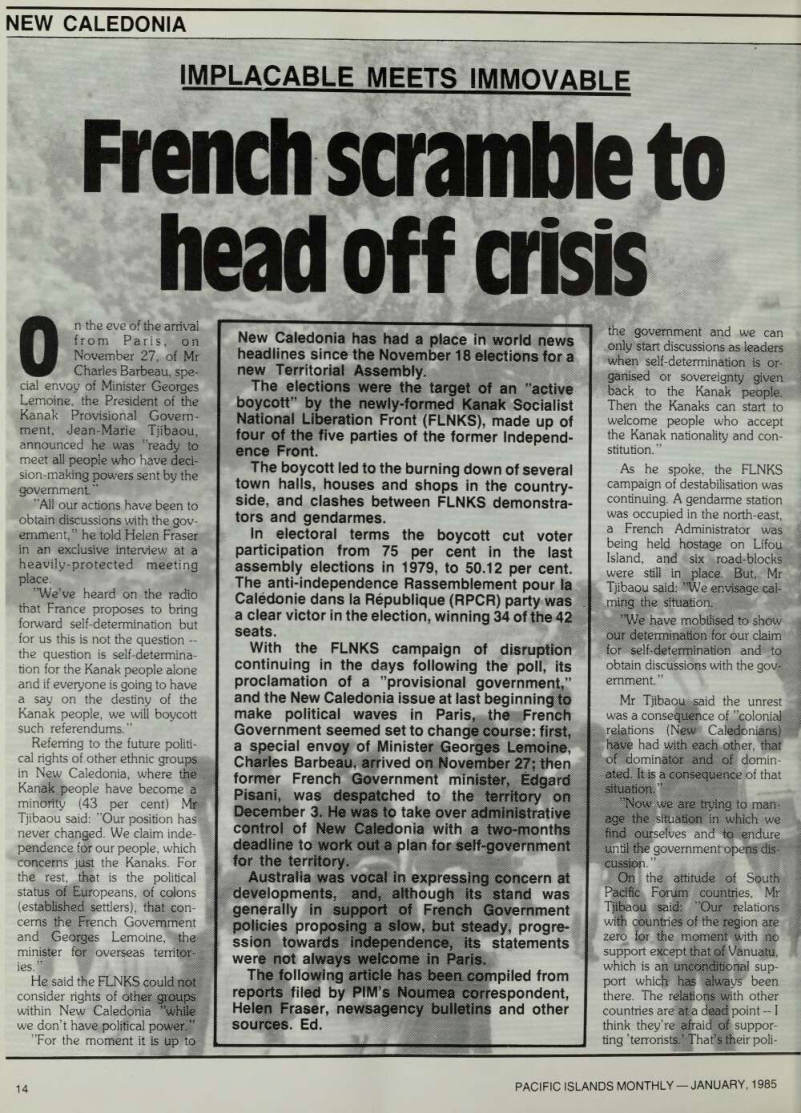
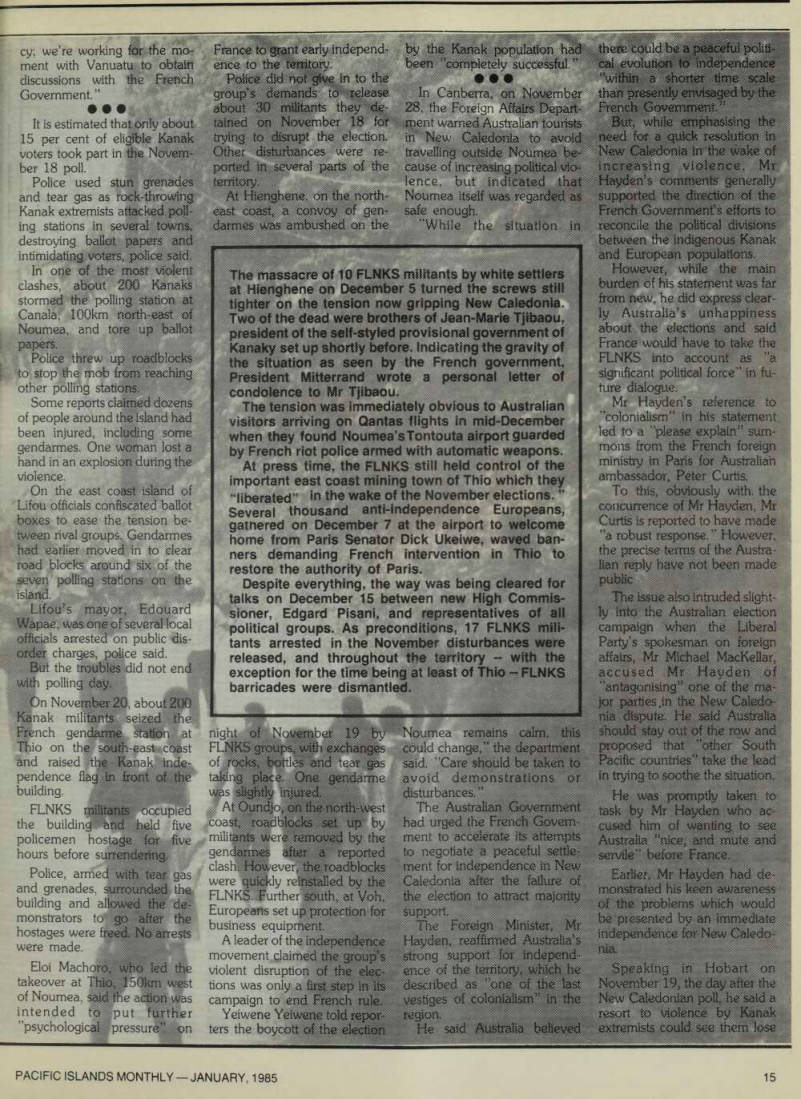
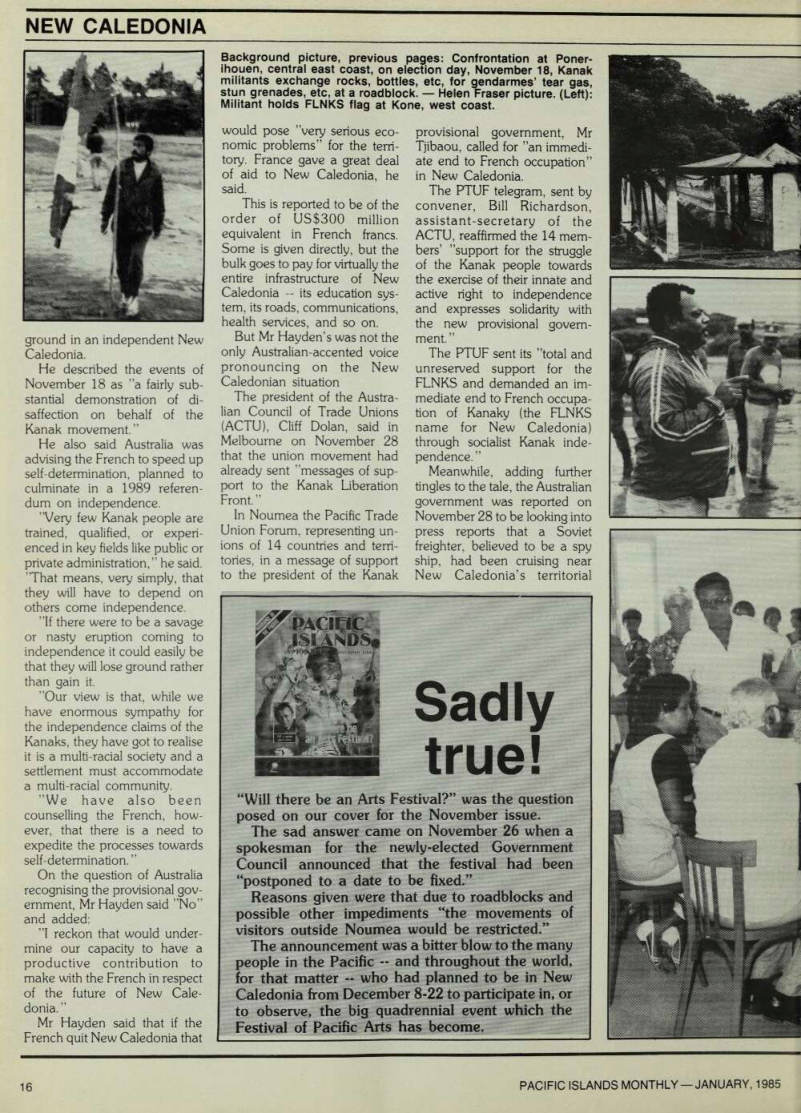
Background picture, previous pages: Confrontation at Poner ihouen, central east coast, on election day, November 18, Kanak militants exchange rocks, bottles, etc, for gendarmes’ tear gas, stun grenades, etc, at a roadblock. Helen Fraser picture. (Left): Militant holds FLNKS flag at Kone, west coast.