letters
pp. 10-11 · Read in the full issue
Too late for a recycling monopoly
We read with interest David S.
North’s article (PIM August 1984) regarding the bonanza awaiting entrepreneurs willing to sail the Pacific collecting used aluminium cans.
Whilst the dream of being first in on a monopoly may come true in some Pacific coun tries, the dreamer is too late in American Samoa, Western Samoa, Fiji, Vanuatu, Solomon Islands, Papua New Guinea, Kiribati, Guam and Truk, to name some countries where organised recycling of used alu minium cans has been in exist ence for some years.
Simsmetal serves the Pacific from Tonga and Tahiti to Tara wa, Nauru and New Guinea to Noumea and points between and beyond. We purchase cans and other non-ferrous metals from numerous government, service club and private or ganisations in many Pacific countries.
All metal markets, including aluminium, are subject to world forces which dictate the price for scrap from time to time. We believe the price paid for used cans by U.S.A. mills is now around 25c per pound we certainly pay more here in
Brisbane.
Mr North is correct in stres sing the importance of recycling of these cans. Apart from the obvious clean-up of the en vironment, the energy saving of 95 per cent by recycling against manufacturing aluminium me tal from bauxite is a major contributor to the saving of oil and coal.
Also, considerable cash is generated and circulated amongst the ordinary people who, in some areas, have no other access to cash from sale of labor or goods.
R.L. Walters
Operations Manager, Qld.
Simsmetal Ltd.
South Brisbane, Qld.
Australia
Tribute to
R.W. Robson
My family and I knew “Robbie”
Robson over 50 years in Papua New Guinea and later in Syd ney and London.
Because of his sincere in terest in the South Pacific and its peoples he will be sadly missed in many places. His profound knowledge of Pacific
affairs made him eminently suit able to be proprietor of PIM and other regional publications.
R.G. (“Bob”) Clark
Strathfield NSW Australia
Widen N-free
zone project
The South Pacific Forum deci sion on a nuclear-free zone in the Pacific will do little to challenge key aspects of nuc lear activity in the region.
The zone is being presented as a major part of the Australian Government’s campaign for arms control. But the govern ment is trying to impose a discriminatory nuclear-free zone on the region: one aimed at discouraging French nuclear activities, but leaving American, Russian and Australian activities unscathed.
The current Australian plan will not limit uranium mining or export, the presence of nuclear related bases in the region, nor the transit and port visits of nuclear armed warships. As the U.S. navy is currently arming its Pacific fleet with cruise missiles, strategic nuclear weapons will be introduced into our harbors for the first time.
The Australian prime minis ter, in advancing the zone prop osal, suggests that there is an increasing Soviet naval build up in the region. But in spite of increases in the region (eg. 60 per cent of American nuclear submarines are on station at any one time, compared to only 15 per cent of Soviet sub marines; the three American Trident submarines based in the Pacific are each armed with 192 nuclear warheads; and the homeports of the Soviet Pacific fleet are icebound for three months of the year, unlike American facilities in Hawaii, the Philippines, Australia and the South Pacific!).
It is vital that we challenge nuclear activity by any nuclear power in the region. But in promoting the current proposal, the Australian prime minister
and foreign minister are under mining the efforts of other Paci fic governments (New Zealand, Papua New Guinea and Vanuatu) aimed at achieving a comprehensive nuclear-free zone one that would limit all nuclear activity in the region, be it French, American or Russian.
Michael Hamel-Green,
Nic Maclellan
Nuclear Free and Independent Pacific Campaign Fitzroy, Vic, Australia.
So many
Pacifies ...
Every month I read PIM with great interest. In the September ’B4 edition. I paid special atten tion to the interview with the French Minister of External Affairs, Claude Cheysson, re garding the role of France in the Pacific.
The minister distinguishes between the North Pacific and the South Pacific. In the first he speaks of Japan, Canada and the United States, leaving Mic ronesia to the side, meaning to say the “North Pacific Rim”.
When he refers to the South Pacific however, he points to the “South Pacific Islands”, in addition to Australia and New Zealand, pertaining rather to the “South Pacific Rim”, but forgetting to mention Chile, Peru, Colombia and Ecuador.
It seems to me this proves the need for a new terminology in discussion of the Pacific region.
I would like to suggest the “Pacific Basin” as a whole, wherein you can distinguish the “Pacific Rim” and the “Pacific Islands” and also, the “North Pacific” and the “South Paci fic”, considering in each case the rim as well as the islands.
Therefore, we could speak of the “North Pacific Rim” (from Indonesia to the Soviet Union and from Alaska and Canada to Panama); “South Pacific Rim” (from New Zealand to Australia and from Colombia to Chile and Antartica); “North Pacific Islands” (from Palau to
Hawaii); and “South Pacific Islands” (from Papua New Guinea to Easter Island).
You could also talk about the “West Pacific” or “Asian Paci fic”, distinguishing within it the “Northwest Pacific,” the “ASEAN Pacific” and the “Au stralasian Pacific”. Lastly, it would be possible to speak about the “East Pacific” or “American Pacific”, differentiat ing within it the “North Amer ican Pacific”, the “Central American Pacific”, and the “South American Pacific” or, finally, the “Anglo-American Pacific” and the “Latin-Amer ican Pacific”.
Absalon M. Menares
Makati Metro Manila Philippines
Yacht fees in
Kiribati
Another island nation has suc cumbed to the temptation to levy high fees on visiting over seas yachts. The government of Kiribati has recently imposed a fee of $3 per day on yachts anchoring in the Fanning Island lagoon. Perhaps they will re consider this decision when re minded of the fact that often in the past foreign yachts have willingly and freely helped to provide essential services such as inter-island transportation, communication, emergency medical aid and technical ex pertise which the government of Kiribati itself was unable to supply to these remote islands.
Charles A. Ciszek
Line Islands Kiribati
What about
Mick Leahy?
I was mildly surprised to read your reviewer’s comment that the film First Contact was “in spired” by the making of an other film concerning the Papua New Guinean Angels of World War 2 (PIM October
1984, p. 49).
Certainly the same producer, Andrew Pike, was involved in each project, but the films were made during the same period, and First Contact would have appeared anyway had the other film not been put together. First Contact mixes old footage with interviews of survivors most effectively, but this is not a new technique and has been used many times earlier. I under stand that the two films were essentially independent of each other as Peter Munster, involved in First Contact’s early stages, and Robin Anderson, one of the two people responsi ble for the film, have each attested.
Surely, if credit is due for inspiring First Contact it should properly go to the makers of the film and to the late Michael Leahy.
David Wetherell
School of Social Sciences Deakin University Waurn Ponds, Vic.
Australia
“Distressed”
at TV plan
I was very distressed to hear today on a Suva radion station part of an interview with a Mr Taylor, an executive of Kerry Packer’s Australian media group, concerning Packer’s plans to introduce television services to three Pacific Island nations, Fiji, Tonga and West ern Samoa. 1 can think of no single event since the arrival of Europeans in the Pacific that has had a more devastating effect on the culture and lifestyle of Pacific Islanders than this proposal potentially would have.
Together with the Fairfax, Murdoch and Herald and Weekly Times groups in Austra lia, the Packer group dictates 75 per cent of all TV programming in Australia, as well as dominat ing a staggering 99 per cent of our supposedly “free” press.
The result, in terms of television alone, is a banal fare of soap
operas and imported produc tions interspersed with so-called “current affairs” programs hav ing a sensationalist, misleading and politically biased content.
Truth and accountability in Australian commercial televi sion are subordinated to the needs of the advertisers, who in turn are directed by a closed cartel of trans-national corpora tions and local vested interests.
A television “service” con trolled by Packer in any of the above-named Pacific Islands countries would introduce to the homes of their peoples this same culturally debilitating hash of schmalz, arrant rubbish and senseless depiction of violence which characterises Western commercial television, together with its advertising content urging viewers to buy an array of needless consumer goods.
Any local content would be cunningly directed to subver ting the influence of concerned and progressive local politicians and community leaders whose objectives were at variance with these vested interests.
I urge all persons in the three targeted countries who are an xious to avoid a repetition of Australia’s television folly to strongly lobby your respective governments to block this alien incursion into your societies.
These latter-day blackbirders are coming to abduct your unique culture and lifestyle.
Michael Mcauley
Trinity Beach, Qld.
Australia
Self-inflicted
injury?
I wonder what PlM’s opinion is on self-inflicted injury. The Danielssons (PIM September 1984 pi 1), in a letter “Jousting with French Nuclear Admiral”, mention “the extent to which the civilian population as a whole has been contaminated” . . . and they have, of their own free will, remained there . . . subject to this horrible (so they feel) contamination.
Jacques A. Salzani
Sydney NSW Australia
Micronesia
penpal wanted
I am a student of Japanese high-school. Since I have read a book concerning to Micronesia some days ago, I have been interesting your islands. It is very difficult to know and to get information for me how Micronesian students, like those who are same age as I am, think and do their life.
So, I want to have penpal.
Please write me and let’s ex change different culture each other.
(Miss) Chika Hattori
2-D Apt. Miraku 2-10-14 Shin Kitano, Yodo gawa-ku Osaka-shi Japan 532
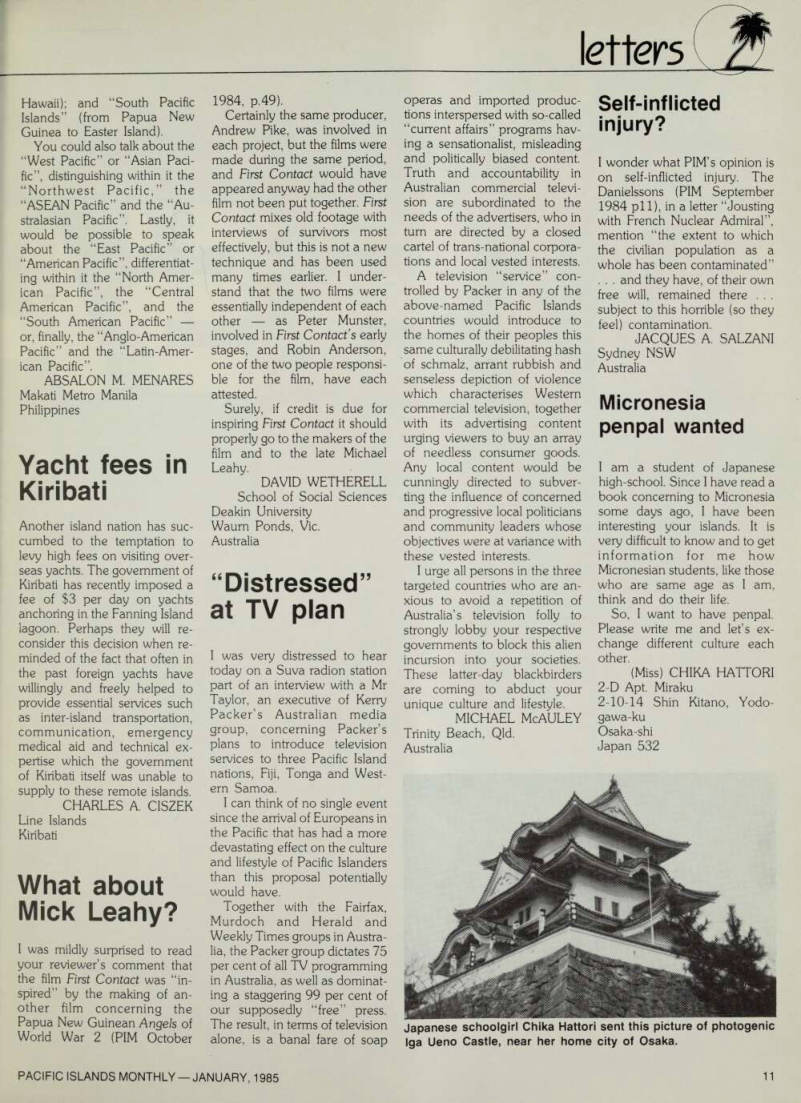
Japanese schoolgirl Chika Hattori sent this picture of photogenic Iga Ueno Castle, near her home city of Osaka.