Yachts
pp. 65-67 · Read in the full issue
KAY BASON reports
from Port Moresby,
Papua New Guinea:
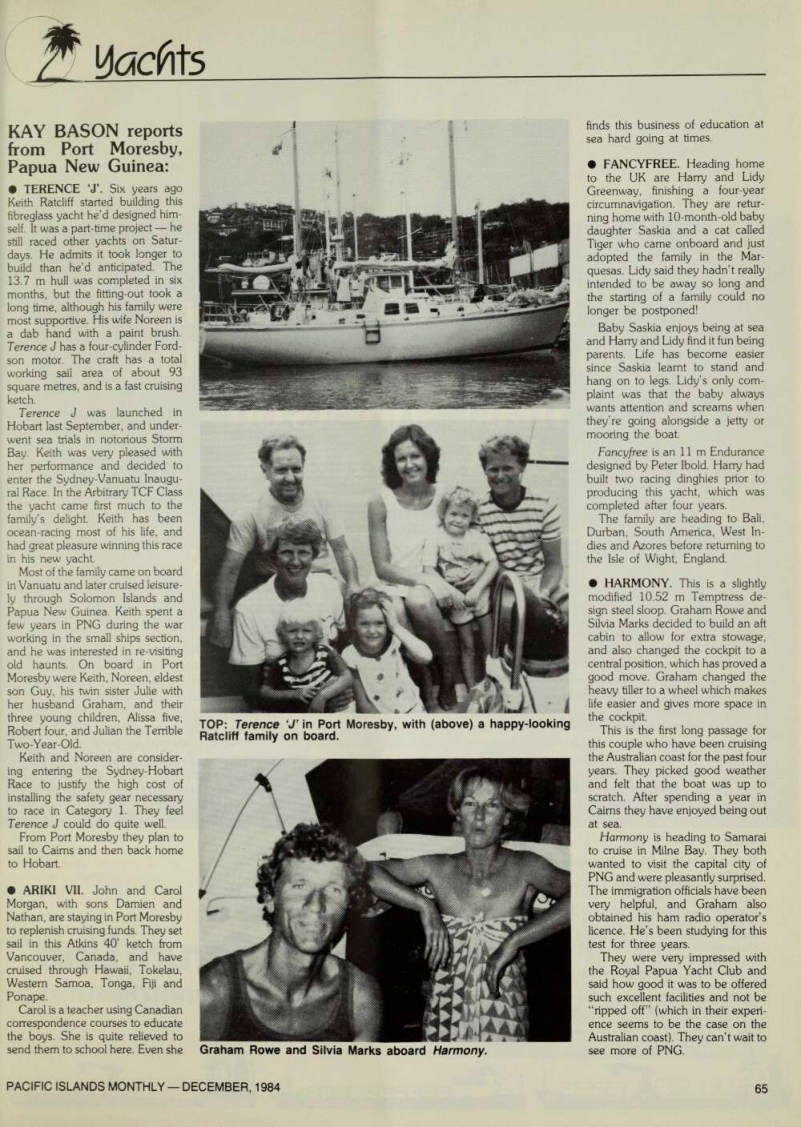
• TERENCE ‘J’. Six years ago Keith Ratcliff started building this fibreglass yacht he’d designed him self. It was a part-time project — he still raced other yachts on Satur days. He admits it took longer to build than he’d anticipated. The 13.7 m hull was completed in six months, but the fitting-out took a long time, although his family were most supportive. His wife Noreen is a dab hand with a paint brush.
Terence J has a four-cylinder Ford son motor. The craft has a total working sail area of about 93 square metres, and is a fast cruising ketch.
Terence J was launched in Hobart last September, and under went sea trials in notorious Storm Bay. Keith was very pleased with her performance and decided to enter the Sydney-Vanuatu Inaugu ral Race. In the Arbitrary TCF Class the yacht came first much to the family’s delight. Keith has been ocean-racing most of his life, and had great pleasure winning this race in his new yacht.
Most of the family came on board in Vanuatu and later cruised leisure ly through Solomon Islands and Papua New Guinea. Keith spent a few years in PNG during the war working in the small ships section, and he was interested in re-visiting old haunts. On board in Port Moresby were Keith, Noreen, eldest son Guy, his twin sister Julie with her husband Graham, and their three young children, Alissa five, Robert four, and Julian the Terrible Two-Year-Old.
Keith and Noreen are consider ing entering the Sydney-Hobart Race to justify the high cost of installing the safety gear necessary to race in Category 1. They feel Terence J could do quite well.
From Port Moresby they plan to sail to Caims and then back home to Hobart. • ARIKI VII. John and Carol Morgan, with sons Damien and Nathan, are staying in Port Moresby to replenish cruising funds. They set sail in this Atkins 40’ ketch from Vancouver, Canada, and have cruised through Hawaii, Tokelau, Western Samoa, Tonga, Fiji and Ponape.
Carol is a teacher using Canadian correspondence courses to educate the boys. She is quite relieved to send them to school here. Even she
finds this business of education at sea hard going at times. • FANCYFREE. Heading home to the UK are Harry and Lidy Greenway, finishing a four-year circumnavigation. They are retur ning home with 10-month-old baby daughter Saskia and a cat called Tiger who came onboard and just adopted the family in the Mar quesas. Lidy said they hadn’t really intended to be away so long and the starting of a family could no longer be postponed!
Baby Saskia enjoys being at sea and Harry and Lidy find it fun being parents. Life has become easier since Saskia learnt to stand and hang on to legs. Lidy’s only com plaint was that the baby always wants attention and screams when they’re going alongside a jetty or mooring the boat.
Fancyfree is an 11 m Endurance designed by Peter Ibold. Harry had built two racing dinghies prior to producing this yacht, which was completed after four years.
The family are heading to Bali, Durban, South America, West In dies and Azores before returning to the Isle of Wight, England. • HARMONY. This is a slightly modified 10.52 m Temptress de sign steel sloop. Graham Rowe and Silvia Marks decided to build an aft cabin to allow for extra stowage, and also changed the cockpit to a central position, which has proved a good move. Graham changed the heavy tiller to a wheel which makes life easier and gives more space in the cockpit.
This is the first long passage for this couple who have been cruising the Australian coast for the past four years. They picked good weather and felt that the boat was up to scratch. After spending a year in Caims they have enjoyed being out at sea.
Harmony is heading to Samarai to cruise in Milne Bay. They both wanted to visit the capital city of PNG and were pleasantly surprised.
The immigration officials have been very helpful, and Graham also obtained his ham radio operator’s licence. He’s been studying for this test for three years.
They were very impressed with the Royal Papua Yacht Club and said how good it was to be offered such excellent facilities and not be “ripped off” (which in their experi ence seems to be the case on the Australian coast). They can’t wait to see more of PNG.
TOP: Terence ‘J’ in Port Moresby, with (above) a happy-looking Ratcliff family on board.
Graham Rowe and Silvia Marks aboard Harmony.
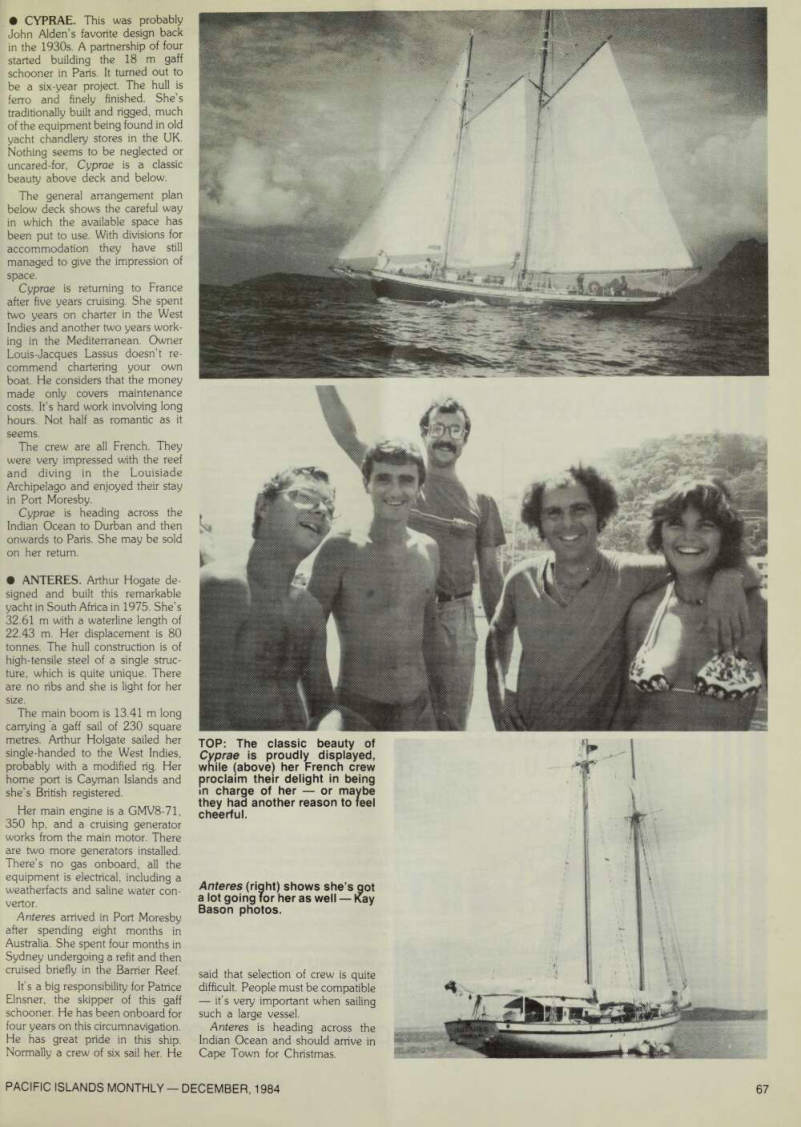
• CYPRAE. This was probably John Alden’s favorite design back in the 19305. A partnership of four started building the 18 m gaff schooner in Paris. It turned out to be a six-year project. The hull is ferro and finely finished. She’s traditionally built and rigged, much of the equipment being found in old yacht chandlery stores in the UK.
Nothing seems to be neglected or uncared-for, Cyprae is a classic beauty above deck and below.
The general arrangement plan below deck shows the careful way in which the available space has been put to use. With divisions for accommodation they have still managed to give the impression of space.
Cyprae is returning to France after five years cruising. She spent two years on charter in the West Indies and another two years work ing in the Mediterranean. Owner Louis-Jacques Lassus doesn’t re commend chartering your own boat. He considers that the money made only covers maintenance costs. It’s hard work involving long hours. Not half as romantic as it seems.
The crew are all French. They were very impressed with the reef and diving in the Louisiade Archipelago and enjoyed their stay in Port Moresby.
Cyprae is heading across the Indian Ocean to Durban and then onwards to Paris. She may be sold on her return. • ANTERES. Arthur Hogate de signed and built this remarkable yacht in South Africa in 1975. She’s 32.61 m with a waterline length of 22.43 m. Her displacement is 80 tonnes. The hull construction is of high-tensile steel of a single struc ture, which is quite unique. There are no ribs and she is light for her size.
The main boom is 13.41 m long carrying a gaff sail of 230 square metres. Arthur Holgate sailed her single-handed to the West Indies, probably with a modified rig. Her home port is Cayman Islands and she’s British registered.
Her main engine is a GMVB-71, 350 hp, and a cruising generator works from the main motor. There are two more generators installed.
There’s no gas onboard, all the equipment is electrical, including a weatherfacts and saline water con vertor.
Anteres arrived in Port Moresby after spending eight months in Australia. She spent four months in Sydney undergoing a refit and then cruised briefly in the Barrier Reef.
It’s a big responsibility for Patrice Elnsner, the skipper of this gaff schooner. He has been onboard for four years on this circumnavigation.
He has great pride in this ship.
Normally a crew of six sail her. He
said that selection of crew is quite difficult. People must be compatible it’s very important when sailing such a large vessel.
Anteres is heading across the Indian Ocean and should arrive in Cape Town for Christmas.
TOP: The classic beauty of Cyprae is proudly displayed, while (above) her French crew proclaim their delight in being in charge of her or maybe they had another reason to feel cheerful.
Anteres (right) shows she’s got a lot going for her as well Kay Bason photos.