“Words were a part of him .."
p. 26 · Read in the full issue
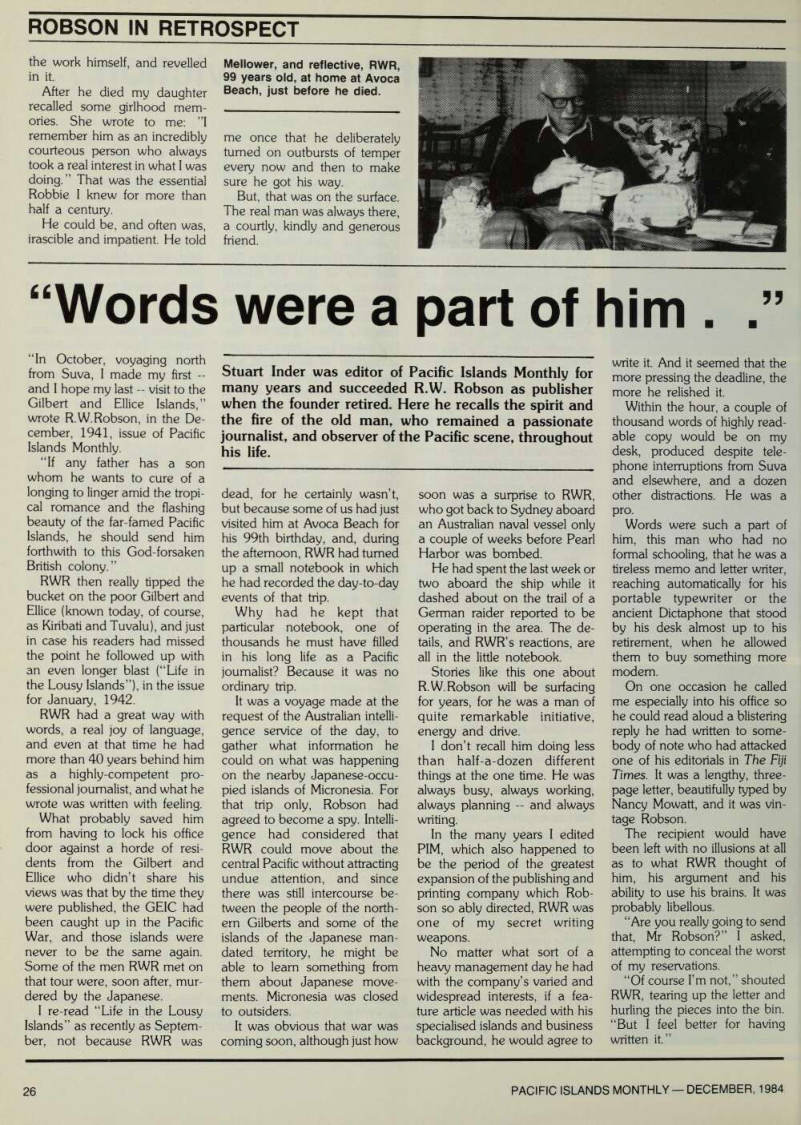
Stuart Inder was editor of Pacific Islands Monthly for many years and succeeded R.W. Robson as publisher when the founder retired. Here he recalls the spirit and the fire of the old man, who remained a passionate journalist, and observer of the Pacific scene, throughout his life.
“In October, voyaging north from Suva, I made my first and I hope my last - visit to the Gilbert and Ellice Islands,” wrote R.W.Robson, in the De cember, 1941, issue of Pacific Islands Monthly.
“If any father has a son whom he wants to cure of a longing to linger amid the tropi cal romance and the flashing beauty of the far-famed Pacific Islands, he should send him forthwith to this God-forsaken British colony.”
RWR then really tipped the bucket on the poor Gilbert and Ellice (known today, of course, as Kiribati and Tuvalu), and just in case his readers had missed the point he followed up with an even longer blast (“Life in the Lousy Islands”), in the issue for January, 1942.
RWR had a great way with words, a real joy of language, and even at that time he had more than 40 years behind him as a highly-competent pro fessional journalist, and what he wrote was written with feeling.
What probably saved him from having to lock his office door against a horde of resi dents from the Gilbert and Ellice who didn’t share his views was that by the time they were published, the GEIC had been caught up in the Pacific War, and those islands were never to be the same again.
Some of the men RWR met on that tour were, soon after, mur dered by the Japanese.
I re-read “Life in the Lousy Islands” as recently as Septem ber, not because RWR was
dead, for he certainly wasn’t, but because some of us had just visited him at Avoca Beach for his 99th birthday, and, during the afternoon, RWR had turned up a small notebook in which he had recorded the day-to-day events of that trip.
Why had he kept that particular notebook, one of thousands he must have filled in his long life as a Pacific journalist? Because it was no ordinary trip.
It was a voyage made at the request of the Australian intelli gence service of the day, to gather what information he could on what was happening on the nearby Japanese-occu pied islands of Micronesia. For that trip only, Robson had agreed to become a spy. Intelli gence had considered that RWR could move about the central Pacific without attracting undue attention, and since there was still intercourse be tween the people of the north ern Gilberts and some of the islands of the Japanese man dated territory, he might be able to learn something from them about Japanese move ments. Micronesia was closed to outsiders.
It was obvious that war was coming soon, although just how
soon was a surprise to RWR, who got back to Sydney aboard an Australian naval vessel only a couple of weeks before Pearl Harbor was bombed.
He had spent the last week or two aboard the ship while it dashed about on the trail of a German raider reported to be operating in the area. The de tails, and RWR’s reactions, are all in the little notebook.
Stories like this one about R.W. Robson will be surfacing for years, for he was a man of quite remarkable initiative, energy and drive.
I don’t recall him doing less than half-a-dozen different things at the one time. He was always busy, always working, always planning and always writing.
In the many years I edited PIM, which also happened to be the period of the greatest expansion of the publishing and printing company which Rob son so ably directed, RWR was one of my secret writing weapons.
No matter what sort of a heavy management day he had with the company’s varied and widespread interests, if a fea ture article was needed with his specialised islands and business background, he would agree to
write it. And it seemed that the more pressing the deadline, the more he relished it.
Within the hour, a couple of thousand words of highly read able copy would be on my desk, produced despite tele phone interruptions from Suva and elsewhere, and a dozen other distractions. He was a pro.
Words were such a part of him, this man who had no formal schooling, that he was a tireless memo and letter writer, reaching automatically for his portable typewriter or the ancient Dictaphone that stood by his desk almost up to his retirement, when he allowed them to buy something more modem.
On one occasion he called me especially into his office so he could read aloud a blistering reply he had written to some body of note who had attacked one of his editorials in The Fiji Times. It was a lengthy, three page letter, beautifully typed by Nancy Mowatt, and it was vin tage Robson.
The recipient would have been left with no illusions at all as to what RWR thought of him, his argument and his ability to use his brains. It was probably libellous.
“Are you really going to send that, Mr Robson?” I asked, attempting to conceal the worst of my reservations.
“Of course I’m not,” shouted RWR, tearing up the letter and hurling the pieces into the bin.
“But I feel better for having written it.”