Water Project
pp. 48-49 · Read in the full issue
Learning From A Solomons
Women, Aid & Development Proceedings of a Workshop.
Edited by Lyn Mehill. Price: SAIO, SAS to the unem ployed. Available from: Women & Development Net work, P.O. Box 151, Colling wood, 3066, Australia On July, 15-17, 1983, a work shop on “Women, Aid and Development” was held in Canberra sponsored by the Women and Development Net work of Australia (WADNA), the Australian Council for Over seas Aid, and the Development Studies Centre of the Australian National University. The pro ceedings of that workshop have now been published. As women, and men, from all over the world were invited, the issue of women and modern development was seen from a global perspective. Participants in the workshop, however, also broke into small groups to discuss particular issues related to specific geographical areas.
Certain key concepts emerged. One of these was that Western women needed to lis ten to the women of the deve loping world as to what they themselves perceived as their needs. The assumption could not be made that what Wester ners thought was important or proper would neatly fit into all social systems of the world.
Another central point, deline ated by Barbara Rogers, was that development must acknowledge women as both decision-makers and as econo mic beings. In the past, women have been regarded as mere consumers rather than contri butors to the cash economy and hence have been alienated from progress. Issues as diverse as non-government organisa tions’ programs for women, handicrafts, and the problem of prostitution, were discussed in rational terms.
Over 30 papers were given so I will restrict my comments to the problems of women and
development in the Pacific areas as enunciated by both Western and Pacific Island women.
Irene Davies illustrated Ms Rogers’ argument with exam ples from Papua New Guinea and Solomon Islands. Planta tions in these islands, often run by Australians, absorbed men into the cash economy while women were left to do subsist ence work. Women’s work load was therefore increased as they no longer had the assistance of their menfolk. Women are ex pected to provide food for the entire family from their subsist ence gardens although the land allocated to these gardens is often minimal in both area and quality. The cash income of males is often squandered. Fur ther, land which was once regarded as communally held, including both male and female, was either blatantly appropriated or became the property of the male head of the household.
Penelope Schoeffel furthered
this theme with her paper “Women’s Work and Deve lopment in the South Pacific”.
She claimed that women in Melanesia perform 80 per cent of all work, and 60 per cent of this is agricultural work. In Micronesia and Polynesia, women were traditionally con cerned with manufacturing (mats, thatch etc.). The im portation of Western goods eroded this role: women were pushed itno a subsidiary econo mic role. The reversal of women’s roles, however, went back further. The early mis sionaries had harbored set ideas on the sexual division of labor and women were dele gated to “domestic” duties in cluding cooking, washing and sewing. Yet in many parts of the Pacific, cooking and food pro duction were tradtitionally male tasks.
It was emphasised that the issue of involving women in development is not the result of a trendy fashion, but is essential to the proper functioning of the development process. To illus trate this, an example was given of a multi-million dollar water and sanitation project in Solo mon Islands which went askew.
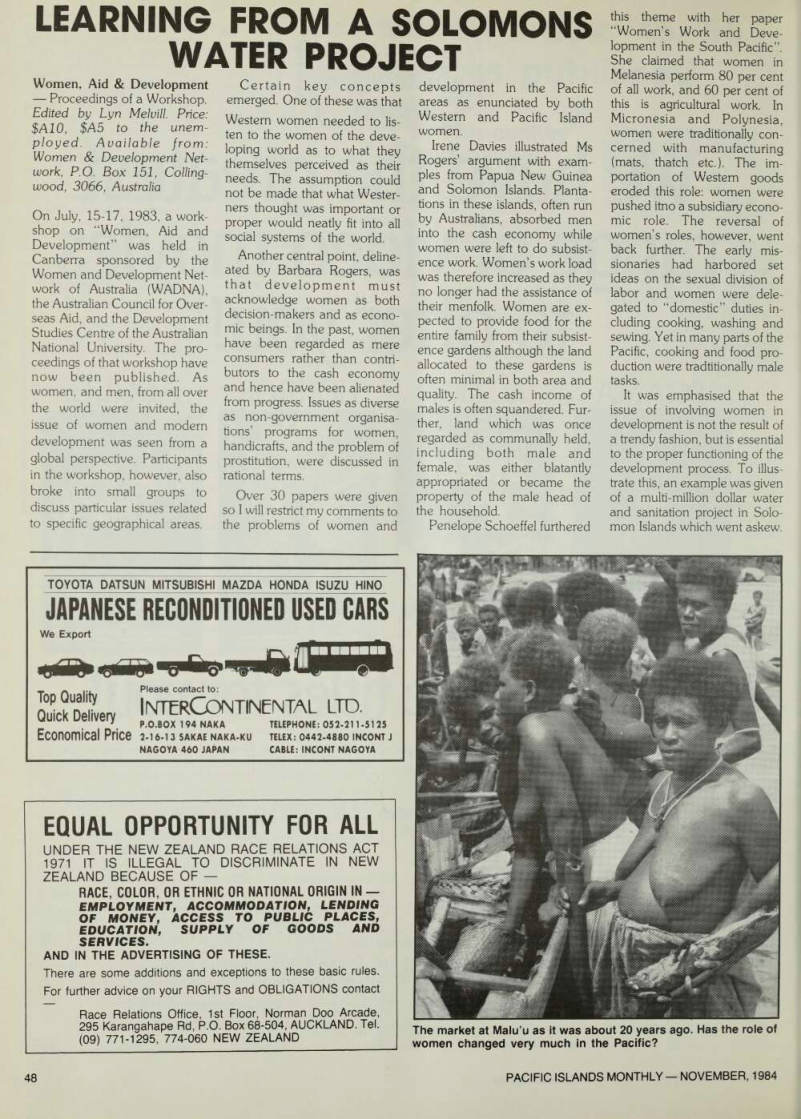
The market at Malu’u as it was about 20 years ago. Has the role of women changed very much in the Pacific?
The project was failing because women were cutting the water pipes with their bush knives, people were not repairing the tanks when they broke down, and people refused to build lavatories. The project had been completely organised, de signed and carried out by men.
It was later discovered that in some villages the only privacy and time women had away from men and children occur red at the bathing pool. This venue represented a valued space in their lives.
The new water system had robbed women of this and they perceived the project as a male plot to extinguish their one small' area of private space.
Women had never been con sulted about the project at any stage. The suggestion was made to the implementing agency to involve women in planning and discussions. The suggestion was taken in and the project is progressing much bet ter now.
Nerrie Tololo of Papua New Guinea gave a paper on “Or ganisations and Services for Rural Women” in her country.
She said that Papua New Guinea women, like most women in third world countries, especially in the Pacific, were disadvantaged. Both in traditio nal and colonial society, women’s roles had differed from men. Not until the 1970 s was distinct recognition
accorded women. As a result of this, however, seven of the eight points of the “National Strategy for Papua New Guinea” contain calls for in creased participation of women in all forms of national, econo mic and social activities. Nerrie Tololo applauded non-govern ment organisations for their work in leadership roles, health, family planning and self employment.
The workshop was not just a venue for rhetoric. It closed with recommendations to both aid agencies and the Women and Development Network.
Among them were the following: • aid agencies must respond to women’s clearly express ed desire for training in community mobilisation, political skills, rural deve lopment, consumerism, marketing, appropriate technology, trade unionism, cummunication and various other aspects of leadership; • women should be involved in evaluating aid program mes, policy-making, project
planning, decision-making
and project-indentification; • that WADNA prepare a directory of women’s or ganisation in Australia and the Asian and Pacific regions to be distributed for networ king throughout the Asia
and Pacific region.
San-
dra Rennie.
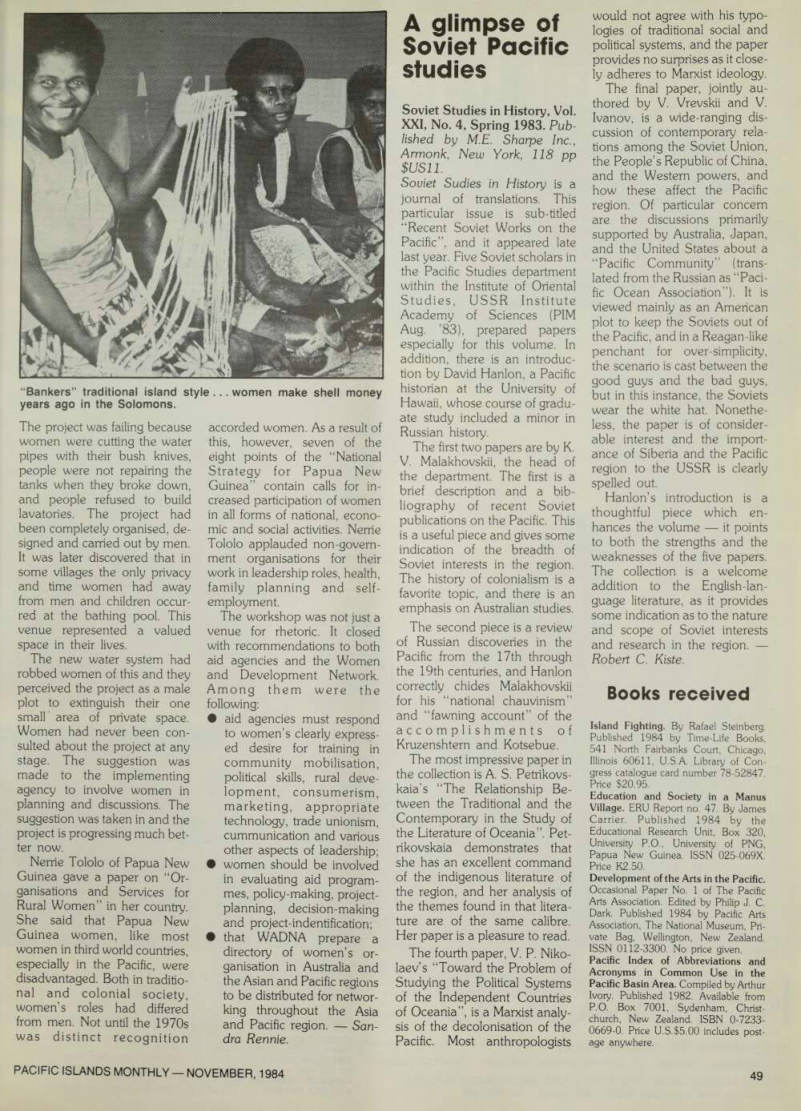
“Bankers” traditional island style . . . women make shell money years ago in the Solomons.