planned it
pp. 22-23 · Read in the full issue
As the organisers planned it
More than 2000 delegates from 27 Pacific countries will join with a Kanak delegation of 1500 in December for the Fourth South Pacific Festival of Arts, hosted by New Caledonia.
The festival, which is held every four years, was first held in Fiji in 1972, then in Rotorua, New Zealand, in 1976, and, most recently, in Port Moresby in 1980.
Jacques lekawe, festival director, says the four festivals had many common features, but with each one offering a particular original aspect. The emphasis of the first three festi vals was on the quality and authenticity of the artistic dis plays, the festival’s role in each country’s cultural development, the fostering of cultural ex
change between countries, and the major role of people in cultural creation. •* The orientation of the fourth festival will be the encourage ment of encounters between the people of different countries and between individuals, to stress the importance of artistic creation, particularly for the young, for wage-earners, and for the technically trained, and, lastly, to investigate how the festival, and more generally, cultural activities, can contrib ute to the overall development of Pacific countries.
Festival organisers point out that during the 19th Century, most Pacific countries were col onised by European and Amer ican countries, bringing impor tant social changes, especially
with regard to art and culture there were the negation of certain traditional values, appropriation and export of art objects, destruction of social groups, and the introduction of new values, new techniques and new languages.
Said** Mr lekawe; whatever the constitutional sta tus of our countries, indepen dent or associated states, trust territories or dependencies our nations question their identity and their presence at all levels; how to integrate with scientific and technical progress of the modem world, how to help our traditions to live again.
“These questions are all the more important today, since on top of the crisis of values caused by colonialism, there is an eco nomic crisis occurring in many countries. Most of us live in conditions of under-develop ment. ”
Some of the questions to be posed in 1984 concern the new
economic conditions of artistic activity, artistic rights, new cultural means (such as musical instruments), the role of radio and TV, the effects of indus trialisation and urbanisation, new cultural needs such as in architecture, and the recogni tion of cultural rights for example, in the workplace.
The fourth festival has three phases.
The first is the welcome, and the installation of the delega tions, with Custom and open ceremonies.
The second phase is of 10 days of spectacle and various demonstrations.
The third is two or three days duration during which the festi val will be welcomed in eight Kanak regions outside Noumea. The regions represent songs, dances, craftwork, traditional sports, and tradition al means of food preparation.
The foreign delegations will offer traditional dances, theatre, music and singing, craft demon strations painting, sculpture, weaving, basket-making and displays on various aspects of their local cultural life.
The festival committee is also responsible for organising seve ral exhibitions the Imaginary Museum of the Pacific, with pieces brought especially from various parts of the world; and the Inventory of Kanak Herit age. There will also be a sym posium on monumental sculp tures, and contemporary plastic arts.
Other planned features will deal with a Kanak Historical Re-enactment, Scientific and Technical Exchange, an Exhibi tion and Sale of Oceanic Books, a Day of Oceanic Films, Traditional Sports, a Children’s Village, and, lastly, Traditional Food Preparation.
In relation to scientific and technical exchange, the festival organisers have decided to set up a dialogue between scien tists and the Oceanic peoples
on subjects of common interest.
The dialogue will cover the scientific content and tech niques of traditional cultures, the need to adapt science to the specific realities of Oceania, and the utility of science in the evolution of cultures.
Seminars will be held on four themes; • Pacific Arts conserva tion, change, possibilities. This will cover influences on traditional arts, techniques and problems of preservation and transmission, and technology in the service of arts promotion. • Architecture private dwellings as a reflection of culture, the traditional Kanak case and modem technology, and the problems of moving towards a contemporary Oceanic architecture. • Traditional cultures and the environment science in sorcery, traditional agriculture and development, and know ledge of plants. • The sea and its resources
marine technology pirogues and fishing, knowledge and traditional management of
fishing, and development of marine resources, especially by handicraft means.
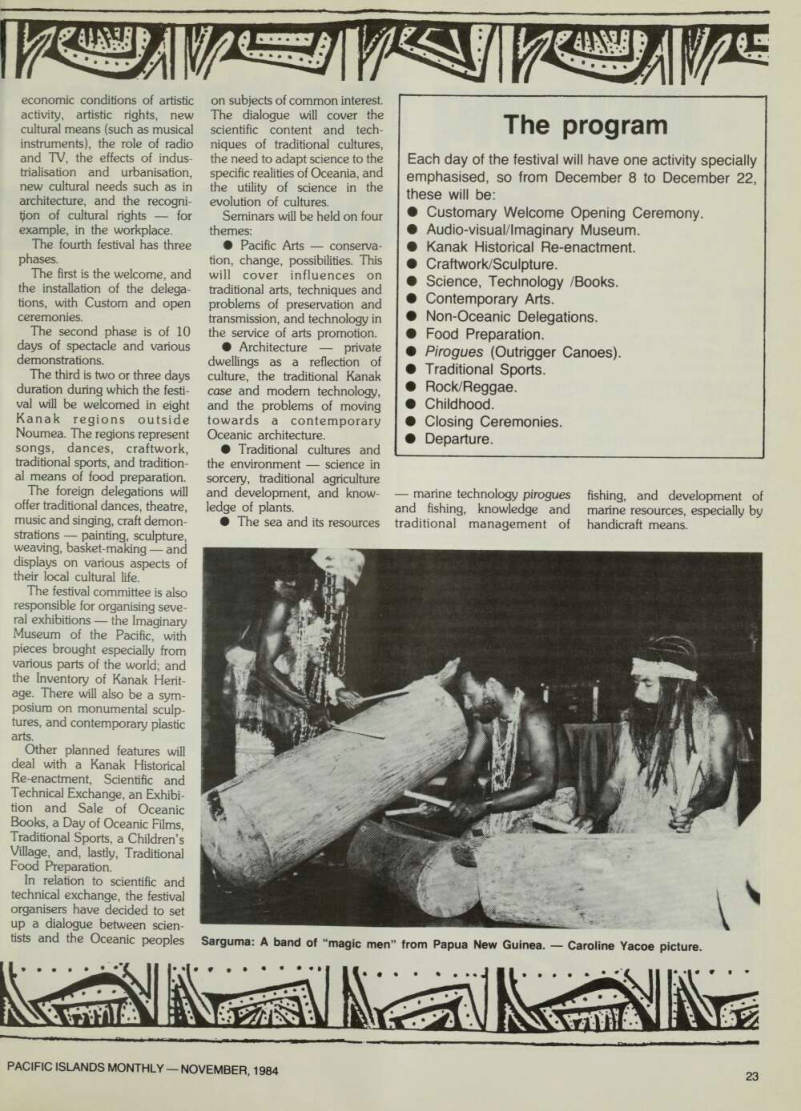
Sarguma: A band of “magic men” from Papua New Guinea. - Caroline Yacoe picture.