Giancarlo’s story: From Rome
pp. 50-53 · Read in the full issue


to Malaita Island
It’s already a whole year since we arrived in Papua New Guinea. It has taken us 12 months to learn “lik lik 4asol” (just a little) about the people and their way of life in some of the hundreds of inhabited is lands in this extraordinary na tion. Heaven alone knows how long it will take us altogether to go right across the Pacific.
However, we can’t stay here any longer and also ... we now feel even more fascinated by, and also more prepared for, the idea of continuing slowly to wards other groups of islands and discovering more similar ities, more differences, between them.
We also feel that the time has come for us to realise one of our fondest dreams; to share part of this journey with Gian carlo, our father. We phone
A dream comes true for PETTINI brothers, ROBERTO and MARCO, as their father GIANCARLO flies out from Rome to join them in a new voyage of discovery on the island of Malaita, Solomon Islands.
him in Rome from Port Mores by. After a few days he rings back to tell us the exact date of his arrival in Honiara, the capi tal of Solomon Islands. None of us knows anything about this country, so we are all the more fascinated by the fact that the next will be a “story” which all three of us will start together.
We are beside ourselves with delight, we can’t talk about anything else, and we count the days, which pass so slowly.
Then, only a few days before our rendezvous, disaster strikes:
as we are swimming in Idlas Bay, a stretch of coral reef half an hour’s drive from Port Moresby, I, Roberto, get stung by a very poisonous stone fish.
We rush to the hospital and only 12 hours before the depar ture of our plane for Honiara, and 36 before Giancarlo’s arri val in the Solomons 1 am operated on to clear out the infection that has caused my foot to swell up like a balloon.
The doctors can’t tell me when I’ll be able to walk again, Giancarlo has already left
Rome, and we can’t postpone our meeting him. So I hop on the plane on one foot, hoping against hope that fate won’t compromise this dream which has almost come true.
Giancarlo, too, wrote a diary during the two months he spent with us. This time it will be up to him to tell the story, until he takes off for Europe again. • • • A total of 32 hours of flying, and here we are in Honiara.
Marco and Roberto are at the airport to meet me, and I can hardly believe it. Cries of joy and hugs . . .
We go to David’s house. He is a young English archeologist, working for Honiara’s museum, and God only knows how the two boys who arrived know ing no one the day before
yesterday found hospitality in his home. In the little sitting room of David’s wooden house we spend the rest of the day, eating papayas and bananas and talking non-stop, crowding together at random the thousand things we have to tell each other . . . Through the mosquito net, beyond the win dows, we can see the Ocean.
We go to bed late, but it’s hard to go to sleep.
Sunday: We all eat together in the candle-light. Me, Marco, Roberto, David, Batie (David’s Micronesian wife), and Merere’, a little Gilbert Islander with two enormous eyes, who is already playing on my lap.
After dinner David tells us about the three years that he has spent here; the slides of his trips around the archipelago open up for me the first glimpse of a new and incredible world We are already dreaming of a thousand projects. The main idea is to go to Malaita Island and to find someone there ready to help us meet the people of the interior, who seem to be the most isolated of the Solomon Islanders.
During this night-time chat ting I try to get into some sort of order all the conversations I’ve had with the boys over the last couple of days. They are very happy, very enthusiastic about the thousand adventures they have lived; they have met lots of interesting people, have vi sited lost islands, have mixed closely with indigenous tribes, have-looked with them at tropi cal dawns and sunsets in the forest. They have thrown away Western clothes and shoes and have consciously crossed the Great River; then they have laid their packs on the grass and sunk the canoe which could have taken them back . . .
The State of the Solomon Islands numbers about 240,000 inhabitants in all, scattered over the large and small islands of the archipelago. Honiara more or less consists of one long sealed road; on each side, scattered under the palms in the grass, there are many small prefabricated houses, made of timber with sheet-iron roofing.
We cross the full length of the town to get to the hospital at the
other end of the road.
Here the doctor, a very cour teous Solomon Islander, allows us to be present at the treat ment. On the sole of his foot, Roberto has a round opening, at least 5 cm in diameter, a porthole through which you can see inside, including the tendon, and which resembles one of those wedges cut into watermelons to see if they are red. The infection on the out side of the wound is not getting any better, and Dr Roger wants to strip the flesh under a general anaesthetic. Then he says Roberto still won’t be able to move for quite some time and the risk of a new infection must be absolutely avoided.
We discuss the problem at length, and eventually we de cide that Roberto will stay in hospital and Marco and I will go to Malaita for a shorter visit while we wait for better times, in the hope that the purpose of my trip, and the boys’ expecta tions, won’t be completely shat tered.
After entrusting Roberto to Dr Roger’s care, and then a whole day of rushing about town buying the last provisions, Marco and I late at night sailed on board the Solomon Prin cess, which in the course of the night ferried us to Auki in the island of Malaita.
We find hospitality at once in Ambu, the first village, situated a short distance from Auki. We are still on the outskirts, and among the typical huts of leaves we can see some “modern’’ buildings there is even a water pipe with various taps for washing and showers. About 15 boys are around us at once, and soon they are taking us in a canoe to play with them and bathe on the little island in the middle of the lagoon; the girls on the other hand look at us and smile, but don’t dare approach. If you stare at them. especially the older ones, they run away and hide.
Later we return to Auki to meet Jonathon Fifi’i. We would like to visit the Kwaio people who live in the central part of the island, and cross their area on foot from coast to coast.
Jonathon Fifi’i is one of their chiefs, as well as being a representative of National Independence, and a member of the Regional Council; so it’s him that we ask for permission to cross Kwaio territory. We explain the peaceful purpose of our trip, and that it is entirely non-commercial: we ask for information and help.
Fifi’i seems reluctant, but then he becomes convinced of our sincerity and gives us a letter of introduction to take to a
“big man” in Maoa, the village on the southern coast from which we will set off to enter the Kwaio area. We’re happy when we return to Ambu. It’s night and the village is asleep, inside the contours of the vast black shadows of the palms. Some one has left a lighted petrol lamp at the entrance to our hut. • • • After having breakfast and saying goodbye to our friends in Ambu, we put our packs into one of those light open lorries that do the passenger run be tween Auki and the south. It’s a one-and-a-quarter hour trip, sit ting in the back of the truck, as we follow the coast along a white road that continually climbs and descends through a greenness which is sometimes more dense, sometimes less so, sometimes allowing us to see blue ocean through the trees, We cross narrow bridges without railings, sometimes the truck even fords the water.
Every now and then, at some house or village, someone alights and someone else gets on, and whenever we pass someone we wave and ex change greetings, as is always the custom here, in town as well as in the villages, At the end of the road there is Maoa, stretched along the edge of a gentle cove a line of huts
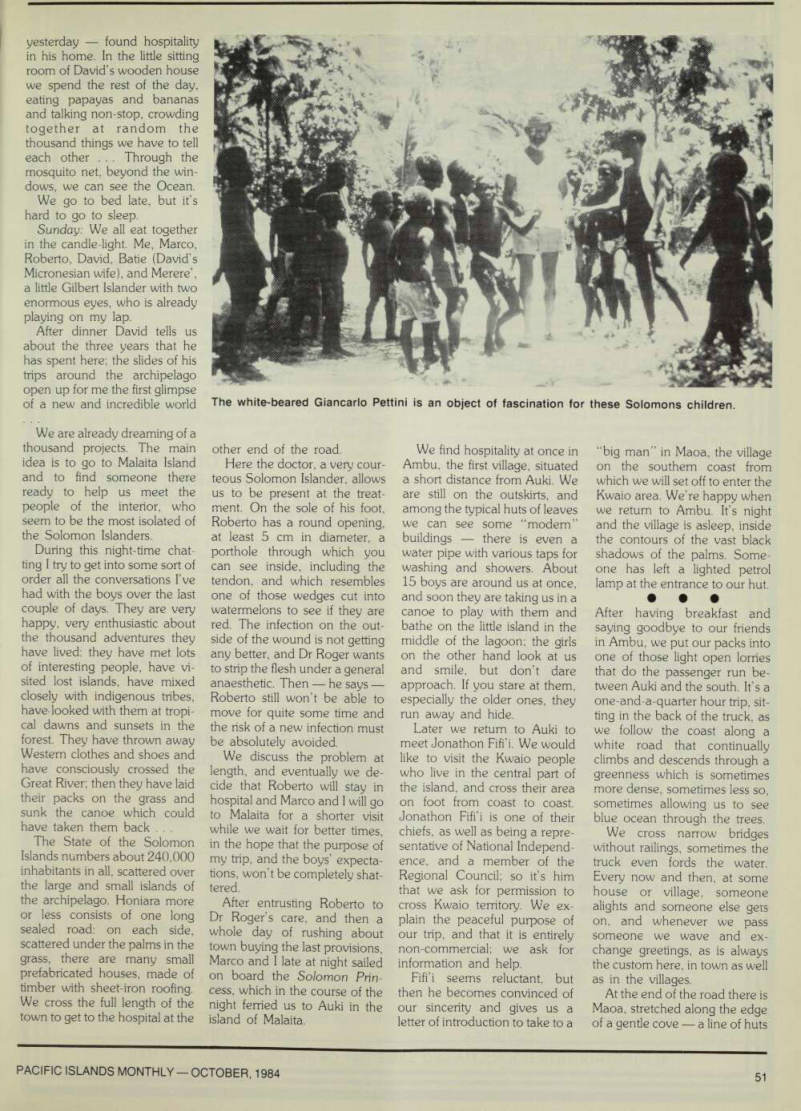
The white-beared Giancarlo Pettini is an object of fascination for these Solomons children.
made of leaves, under a forest of very tall thin palms.
Sifanaboo is a sort of spiritual chief of the Kwaios who live on this side of the island. He lives in the bush but was called out on our behalf and has come to Maoa to listen to us. In a hut which soon fills with people, we offer him presents, give him the letter from Fifi’i, and through an interpreter explain to him who we are, what we want to do, and where we want to go. He nods, smokes our tobacco, asks a few questions. His mouth is red with betel, he has sparse curly hair and an enigmatic and distant expression. After a time, he too is in agreement. We’ll leave tomorrow, accompanied by two porter-guides.
We enter the forest early in the morning and proceed at a fast pace. First Ben, with a pack with the provisions on his shoulders, then me with my blue rucksack, then Marco with his yellow one, and finally Edi with another pack of food. Ben and Edi are both Kwaio boys who left their native villages as children to attend the mission school in Maoa. Ben is a big guy, taller than average, with square shoulders, tattooed nose and cheeks, a beard, an iron wire earring, and a worn-out pipe which is never out of his mouth. Edi is younger, smaller in size but equally sturdy, with very expressive eyes; he is the one who knows the area best, talks more easily, and therefore becomes spokesman for our whole group.
We walk onwards through the greenness. It is sparse at first and then becomes thicker and thicker. We keep our eyes on the ground, being careful not to trip on roots, or to slip where the ground is soft and muddy.
Then the road gets tougher, we cross a river, and now the damned ground gets softer and softer, and we start climbing up and slipping like hell on the mud. Here’s another water course and to cross it there is an old log resting on the two banks: Marco and I straddle it to cross.
Right on midday we get to Ewaitolo, the first of the villages marked on the map. It consists of just three houses. From one of them, two children and an
old woman with a pipe in her mouth look at us in silence.
We’re all dripping like foun tains.
Again we are on our way, towards Makari, but my weari ness is starting to show. We climb rapidly, using exposed roots as steps whenever we can; the path is now only a slippery track, and the pack on my shoulders is growing heavier by the minute. Ben cuts a branch and makes a stick to help me keep my balance. We start going downhill now, but it’s even worse sweat mists my glasses, but weariness is fogging up my reflexes even more.
It’s obvious that at this rate we’ll never get to Makori before nightfall, and the best idea is to camp in the empty hut that Edi knows in this area. Marco and Ben cut large leaves to make a floor and bed and put the mosquito nets up; Edi cooks the rice and pours a couple of cans of fish into it. With spoons made from bamboo, we all eat from the pot until we are full. • • • At dawn there’s breakfast (same as the night before) and we’re on our way again. It takes us almost four hours, with more and more frequent stops, to get to Makori. Several families live here. The dwellings are rather small, in a variety of shapes, and almost all are built on the
ground. We are escorted to the house which young Tile (the chief’s son) has kindly put at our disposal. It’s on the top of a small hill at one end of the village, and has been chosen for us out of respect because it boasts a floor strips of tree bark.
Then we go into the bush for a wash, at a place where fresh water conveyed by bamboo pipe runs down from a rock wall into a pool, and thence downhill. We all get nicely refreshed, and so do the most enterprising of the young men, who soap themselves one after the other until a good part of our soap is gone.
We stop at a house to chat.
The parents are away, and the older girls are looking after the little ones, smoking pipes and spitting; the boys smoke cigarette butts rolled in news paper, laugh, chew betel, and suck plenty of lime. Some of the little ones have those great swollen bellies, but the older boys and girls have healthy features and lively eyes. They all seem happy and excited about our visit.
In the evening the village chief returns: he’s been away all day trying to solve the legal issue of the compensation due to be paid by a guy who “made trouble’’ with an unmarried girl but in the meantime the Don Juan has cleared off into the
bush, and Amen. We tell the chief that we intend leaving the village tomorrow morning to try to reach Kuainaisi. We tell him that tonight, if he allows us, we would like to celebrate our farewell and to offer an ex change for their hospitality with a dinner for everyone together, prepared with our rice and fish.
When five big pots of rice are taken off the fire, when the sweet potatoes have been cooked on the red hot stones, and the whole village has fore gathered, an endless discussion starts over who’s allowed to eat the fish and who is not, over the order of seating, over I don’t know what else, and everybody is talking at once. Then finally we start eating, men, women, children, and us Pettinis, with the food laid out on broad banana leaves, in silence . . .
As well as all the palaver, there’s been an opening speech by the chief, and at the end of the meal I get up and give thanks; Marco translates into Pidgin and Edi into the Kwaio language. The evening then continues with traditional songs long rigmaroles sung while bodies swing to the rhythm, accompanied by the synchro nised beat of many bamboo sticks, the “bina-bina”.
Next month: On through Malaita, as Giancarlo amazes himself.
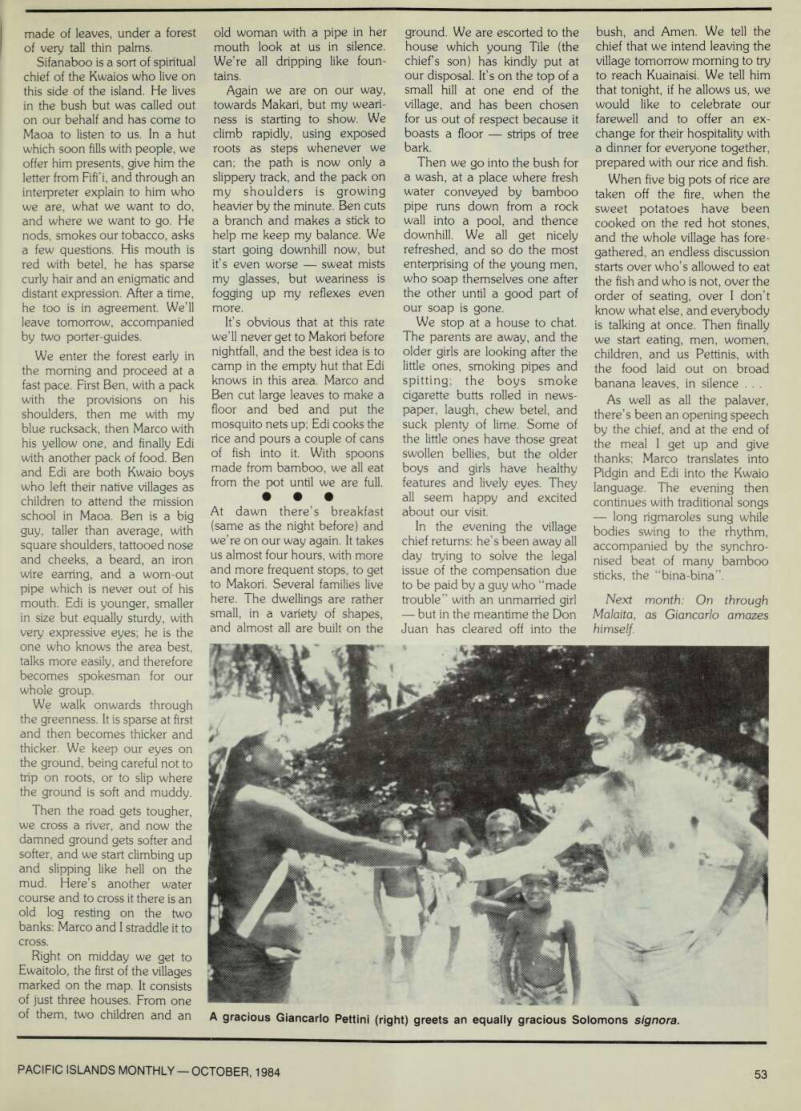
A gracious Giancarlo Pettini (right) greets an equally gracious Solomons signora.