Meet the ‘Aqua City’
p. 37 · Read in the full issue
31,000 t, sail-assisted
Vancouver-based Australian journalist ALAN MER RIDEW reports on the big new Japanese-built mer chant ship, Aqua City, which is designed to use wind as a back-up to her diesel propulsion.
Big-ship cargo-carrying under sail returned to the Pacific, after a fashion, in July when the brand new Aqua City motored and sailed from Yokohama to Vancouver, British Columbia, in ballast.
The 31,000 deadweight ton vessel took on 28,400 tonnes of rapeseed, flax and rye and returned to Japan in August.
Aqua City is no trans-oceanic greyhound, no romantic spid er’s web of masts and rigging.
She looks, overall, like just another modern black-hulled freighter with superstructure and funnel aft. That’s basically what she is, with a high techno logy sailing supplement in breezy weather.
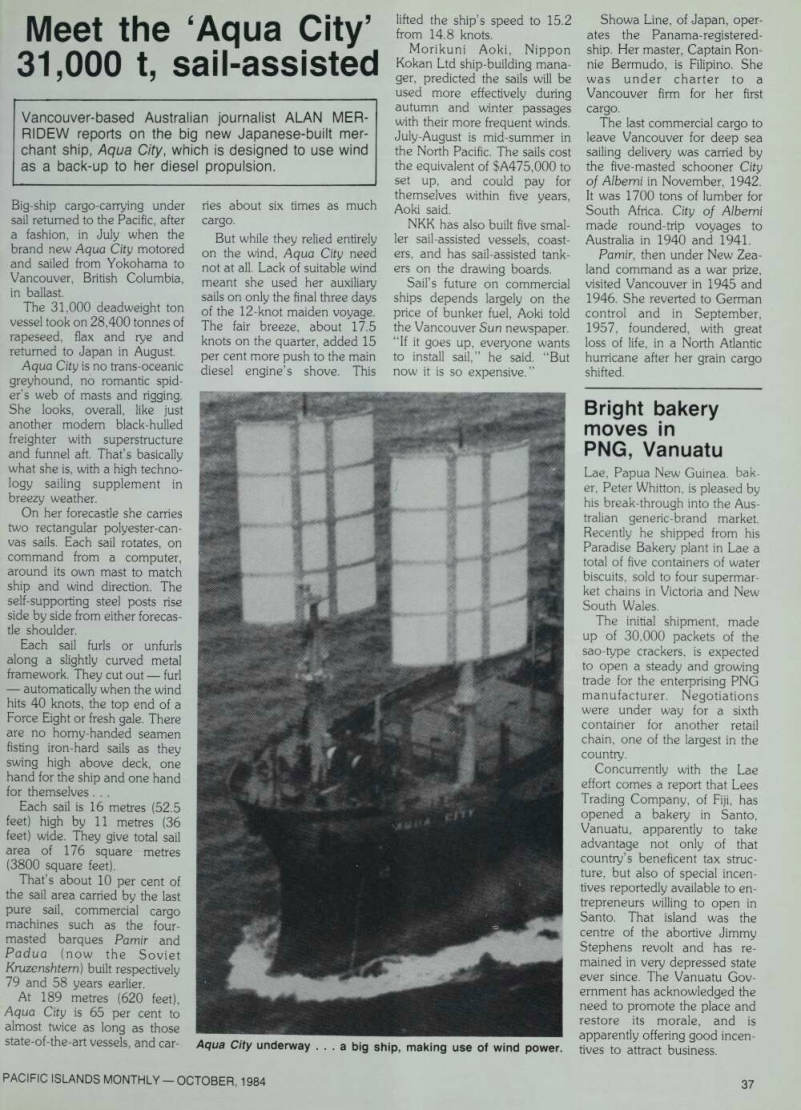
On her forecastle she carries two rectangular polyester-can vas sails. Each sail rotates, on command from a computer, around its own mast to match ship and wind direction. The self-supporting steel posts rise side by side from either forecas tle shoulder.
Each sail furls or unfurls along a slightly curved metal framework. They cut out furl automatically when the wind hits 40 knots, the top end of a Force Eight or fresh gale. There are no horny-handed seamen fisting iron-hard sails as they swing high above deck, one hand for the ship and one hand for themselves . . .
Each sail is 16 metres (52.5 feet) high by 11 metres (36 feet) wide. They give total sail area of 176 square metres (3800 square feet).
That’s about 10 per cent of the sail area carried by the last pure sail, commercial cargo machines such as the four masted barques Pamir and Padua (now the Soviet Kruzenshtem ) built respectively 79 and 58 years earlier.
At 189 metres (620 feet), Aqua City is 65 per cent to almost twice as long as those state-of-the-art vessels, and car
ries about six times as much cargo.
But while they relied entirely on the wind, Aqua City need not at all. Lack of suitable wind meant she used her auxiliary sails on only the final three days of the 12-knot maiden voyage.
The fair breeze, about 17.5 knots on the quarter, added 15 per cent more push to the main diesel engine’s shove. This
lifted the ship’s speed to 15.2 from 14.8 knots.
Morikuni Aoki, Nippon Kokan Ltd ship-building mana ger, predicted the sails will be used more effectively during autumn and winter passages with their more frequent winds.
July-August is mid-summer in the North Pacific. The sails cost the equivalent of $A475,000 to set up, and could pay for themselves within five years, Aoki said.
NKK has also built five smal ler sail-assisted vessels, coast ers, and has sail-assisted tank ers on the drawing boards.
Sail’s future on commercial ships depends largely on the price of bunker fuel, Aoki told the Vancouver Sun newspaper.
“If it goes up, everyone wants to install sail,” he said. “But now it is so expensive.”
Showa Line, of Japan, oper ates the Panama-registered ship. Her master, Captain Ron nie Bermudo, is Filipino. She was under charter to a Vancouver firm for her first cargo.
The last commercial cargo to leave Vancouver for deep sea sailing delivery was carried by the five-masted schooner City of Alberni in November, 1942.
It was 1700 tons of lumber for South Africa. City of Alberni made round-trip voyages to Australia in 1940 and 1941.
Pamir, then under New Zea land command as a war prize, visited Vancouver in 1945 and 1946. She reverted to German control and in September, 1957, foundered, with great loss of life, in a North Atlantic hurricane after her grain cargo shifted.
Aqua City underway ... a big ship, making use of wind power.