'N-policy is not anti-
pp. 12-17 · Read in the full issue

Nz Pm Talks To Pim
'N-policy is not anti- American, its anti nuclear'
Few people, and probably least of all the redoubt able Sir Robert Muldoon himself, were surprised when David Lange and his Labor Party won New Zealand’s recent general election. But Mr Lange was not even installed in office before he had become the centre of a considerable international upset involving the future of the ANZUS defence alliance between N.Z., Australia and the United States. It arose through Mr Lange’s manful adher ence to his party’s long-standing opposition to visits by nuclear-powered and armed warships. Mr Lange is known himself not to favor the total blanket ban with which Labor Party policy has saddled him. But neither that, nor considerable pressure exerted by the Americans and the Australians, has changed his tune. He does not wish to walk out of ANZUS, nor yet have ANZUS walk away from him. He says he thinks it can all be talked through to a jointly satisfactory conclusion. Most observers have so far had difficulty in seeing quite how this might be done.
At the same time he has shown great willingness to cooperate with Australia in its anti-nuclear proliferation strategy, and in urging steady, careful, progress on the achievement of independence for New Caledonia.
If they currently, publicly, disagree on ANZUS matters, Lange and Australia’s prime minister Bob Hawke look like firm and closely-cooperative allies on most matters of moment to the Pacific, a point which has given the leaders of South Pacific Forum countries a deal of relief and satisfaction.
In this exclusive interview, conducted with Pacific Islands Monthly publisher, Garry Barker, on the eve of the Forum meeting in Tuvalu, Mr Lange explains his policies and sets out his goals for his own country and for the island nations of the Pacific. In it he foreshadowed much which, later, was embodied in the Forum’s communique.
PIM: You hurled yourself on to the world political stage within hours of your election by firmly stating your government’s deci sion not to allow nuclear-po wered or armed ships to enter New Zealand ports. Given the pressure which the Americans and the Australians then appeared to bring upon you, many people expected you to temporise a bit. But you did not, despite clear notice that implementation of the policy could endanger the ANZUS alliance. You have continued this stand. Why?
MR LANGE; The fact is that it is not an argument of the hard left. It is an argument of the centre and the centre right and left. So that you have a very main stream of concern in New Zealand against nuclear arma ments. It is compounded by our unique position as a country where we have an abundance of renewable energy resources.
So we do not have to go into that generation of technology where nuclear energy is the power source. So, therefore, there is a concern that we don’t touch it at all. And that is the argument against nuclear prop ulsion.
With respect to nuclear arma ments there is a long-held view that New Zealand ought not to give itself the status of target, and there is a different structure to our defence arrangements to other countries.
I can well understand the
Australian position because it has an infrastructure of defence bases, strategic minerals, and in fact a totally different back ground in terms of visits.
I can understand the Amer ican position. The U.S. is perfectly entitled to say that if you want in the end to be rescued by the cavalry you should be prepared to see the horses from time to time.
But that is the background against which we go further with our policy and I have been amazed at the number of peo ple who have such a debased view of politicians that they expect them to completely re verse their policies after elec tion. We are on course with our policies after the election, and that apparently creates some sort of a world record. I am happy about that.
PIM: Did you expect the Americans to be tough on
Anzus?
LANGE: I think the Amer icans have been quite reason able in what they have said.
They have not engaged in any form of open unfair or political ly-slanted pressure at all. I have an admiration for the United States which I hope will persist, and be enhanced, given their handling of the situation.
PIM; Do you think your ban on the ships has contributed to a nuclear-free Pacific? Do you think a nuclear-free Pacific is possible?
LANGE: I don’t think it is
possible. We are going to work to see that it becomes so. That is part of a four-pronged strategy on nuclear matters which we in the Labor Party have as policy.
First is to see an end to the French testing in the South Pacific.
Second is to see that a regime of nuclear waste dum ping is never started in the Pacific.
Third is to see that there is a South Pacific nuclear weapons free zone.
Fourth is to have within our territories no presence of nuc lear weaponry.
Now, quite simply, to have a nuclear weapons free zone in the South Pacific is a credible goal because there is no nation that I know of in the South Pacific which seeks to embrace nuclear weapons technology.
The difficulties that arise are the standard ones of having an international acceptance of that regime so that the limitations are known, the rules of naviga tion and usage of the high seas respected...the common pledge not to instal, deploy, use or test on it, and then for each country to determine its own sovereign, territorial rules about the prin ciples of transit. That is an achievable goal.
PIM: You believe it is achiev able even given that the Pacific is used as a highway by the nuclear ships of the Americans and the Russians?
Lange; Yes
PIM: And also given that the Russians are still building up a nuclear navy and have in con struction an aircraft carrier at least as big as the USS Enter prise?
LANGE: Well, the policy is not anti-American. It is anti nuclear. And if it is to be pursued and won, then of course it will affect the Russians.
If the argument is that the Russians have now got the edge in armaments, then it will affect the Russians more than the Americans.
PIM: Are you getting support from the small Pacific nations?
Did you get any indication of that in the recent CHOGRM meeting in Port Moresby?
LANGE; There was a mea sure of support in Port Moresby
from principal speakers before and after the CHOGRM confer ence. But there are also, I should report, obviously state ments of concern from people who have not considered the position and have not had the opportunity of speaking to me; in particular, the prime minister of the Cook Islands who ex pressed some view in Auckland while I was at the CHOGRM conference the burden of which seemed to be that Sir Thomas Davis felt he was more than competent to decide, unaided by Mr Lange, which ships would be entertained in Cook Islands harbors. I will be speak ing to him about that.
RIM; Do you think ANZUS is threatened by your policy?
Lange: Anzus Is An
arrangement ... it is an honest expression of the naturalness of the defensive alliance between America, Australia and New Zealand. It is a third of a century old. It has worked in the past without New Zealand ports being involved, and it has con tinued and trade with the Un ited States has prospered.
I certainly won’t be declaring any withdrawal from ANZUS.
PIM: You expect the alliance to continue?
LANGE: I think you would have to work very hard indeed
to stop it from continuing.
PIM: Could we now talk about New Zealand’s position in the Pacific? Obviously over the years, and more in recent years, NZ has drifted away from its traditional links with the UK and Europe and is now seeking a more prominent, or positive, position in the Pacific. Where would you like to take NZ in relation to, first, the islands, and, further, the rim countries?
LANGE: Let’s start with the Pacific generally. Now, two thirds of our exports, 64 per cent of our imports, go to Pacific rim countries. Our major trading partners, save one, the EEC bloc, are in the Pacific.
Therefore, we have achieved a re-orientation; I think some times without realising it. And
that will continue. That will escalate. And we will lock into the growth economies of the region, and we will spin further back into Asia through the ASEAN grouping.
I am telegraphing New Zea land’s intention to position itself much more firmly with the developing countries and with emerging countries because in the last 15 years of this century we are going to see a further shift in wealth, and I want New Zealand to be in a position to be respected and able to move
into that which we now so patronisingly call the third world but which actually are stirring giants. So that we will have by our diplomacy in India and Africa a whole new raft of contacts and goodwill.
More immediately we have a very novel thing with respect to our foreign and trade affairs... I suppose Britain experienced it because of the migration which occurred to the UK from former colonial territories. But in New Zealand we have a rare thing ... we have foreign affairs actually becoming part of the domestic political currency, if you like. So that, because of the large com munities of people from the Pacific in our New Zealand electorates ... and in particular my electorate, where there is a substantial Samoan, Cook Is land, Niuean and Tongan rep resentation... we will inevitably have the immediate forward stance of our foreign policy in the near Pacific, the Southwest Pacific. It will be heavily oriented towards those coun tries with which we have direct population links, and that means Niue, Fiji, Samoa, Ton ga, the Cooks. We still have the dependency of the Tokelaus and then, in broader trade terms, we will be moving beyond that because Melanesia is a growth economy area. We have a distinctive relationship with people from Kiribati and Tuvalu which we must expand because they ought to be very much higher in our thoughts, I believe, than they are now, and the Tokelaus will continue to be a part of the world moving at its pace, unfettered by the strident claims of those who would seek to have some artificial sovereignty imposed but it is our intention to respect their pace and their style as much as we can.
We will undoubtedly be re viewing, and I read in the newspapers, but not directly, the proposals in the Cook Is lands for further changes. We will await them with some in terest.
New Zealand has enjoyed very close relations with Papua New Guinea, and those were cemented further by the visit there for the opening of their parliament house, and the
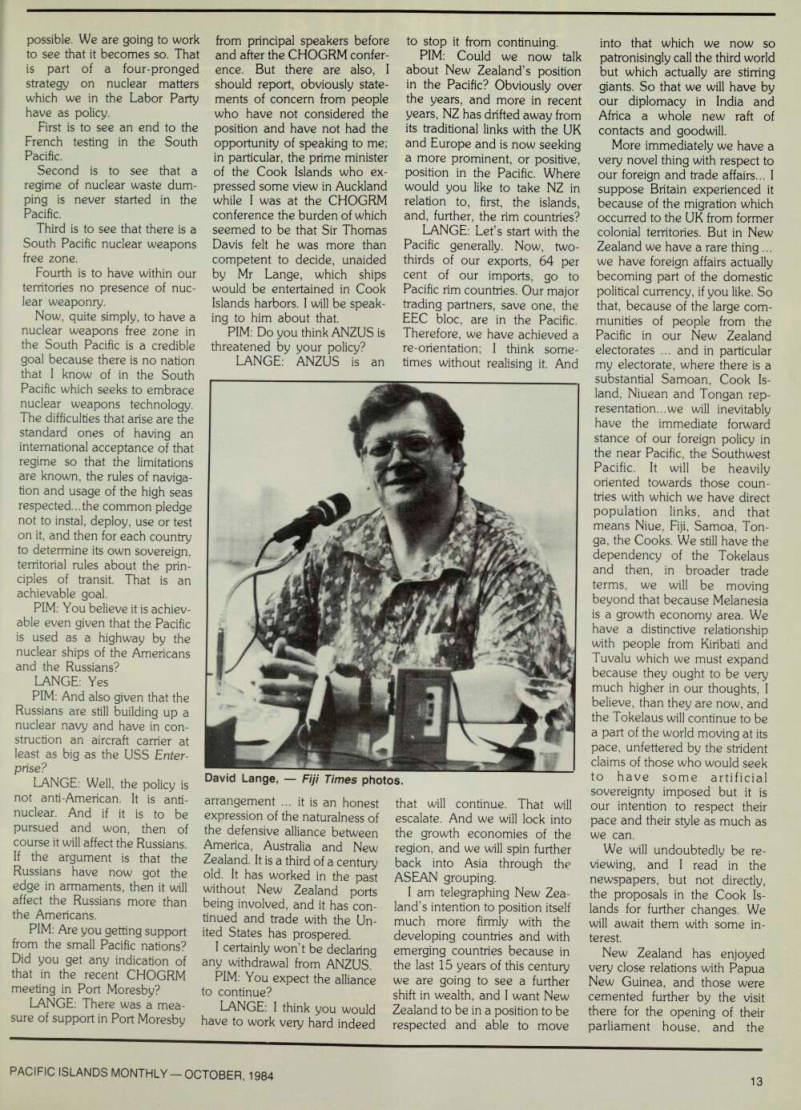
David Lange, - Fiji Times photos.
CHOGRM meeting.
As well, we have the peculiar historical fact that a lot of leaders in the Pacific were edu cated in New Zealand. Walter Lini in Vanuatu is one such. We will be developing our posts but not increasing the range of them abroad, and we will be moving to target our aid, focus sing on the Pacific and Melanesia as we have as a matter of attrition, actually, since the last Labor govern ment was in power. So we will continue to have that aid association.
PIM: Many Pacific econo mies are not viable in the accepted sense and I read the other day the remarks of Young Vivian saying he felt that Niue had become independent much too early. I think the phrase he used was that they had ’’been had.”
LANGE: I don’t know about being had. There is very clear evidence that that was achieved with great goodwill... that it did not involve the government of New Zealand handing over the key of the door and allowing everyone else to pay the rates and meet the mortgage and the insurance; there was no such thing. The patrimony of the New Zealand government on the event of Niuean independ ence, in its particular style, was a continuing close economic
relationship, and one of the good things about Niue is that it is formidably self-assertive.
People there do things which people in other countries would not dream of doing. Their capa city for toil, and enterprise, would be an inspiration to people in my electorate, let alone people in other parts of the Pacific. That will continue to be a feature of the alliance.
There will be further deve lopments because the skills of their people might be used through, say, the right of access through SPARTECA, or the Pacific Islands Industrial Deve lopment Scheme, so that there could be more employment. I hope so.
But my government’s view of Pacific countries is not to suc cumb to the inevitability of economic dependence, but to so position our people that they are prepared to accept on an open basis products from the Pacific ... to enhance SPARTE CA to see that they do get the chance to have that sort of trade ... to as sensitively as we can, in conjunction with host governments, position manu facturing or processing re sources in those countries so that they might have access to Australian and New Zealand markets.
We have a responsibility in the transport infrastructure to see that they are not left holding their product to rot on the wharf or to wither in the air terminal while the hold is full.
But I believe there is still a substantial measure of econo mic viability capable of being extracted from those countries.
Some countries are making ex traordinary progress. Others have had reversals of one form or another. Others are subject to a sort of recurring balance of think-big, and abandonment of projects, and then new ideas being started.
But, I see within SPEC, and the regionally-based advice agencies, substantial possibili ties for economic independence and ... Lome Convention, ADB, all of that ... still holds out, with other bilateral aid, the prospect of proud economic self-assertiveness.
I don’t imagine that some countries will ever be viable in the sense of being totally self supporting. Why should they be? We have conditioned them not to be. What has the world to say to Kiribati when every criterion for concessionary len ding cannot be met because the terms are set in a way which makes it impossible to qualify?
PIM; Will large-scale emigra tion from the Pacific continue?
You already have a very large Pacific Island population in New Zealand, can such reci pient countries continue to absorb the numbers if they try to keep coming?
LANGE; Let us go through it. We have, by reason of the peculiar relationship which ex ists between New Zealand and the Cook Islands, the right for anyone in the Cook Islands to come to New Zealand to live permanently. They are New Zealand citizens. Similarly with Niue.
Then we have with respect to Western Samoa, a quota system which enables up to 1100 peo ple a year who are assured of employment to come to New Zealand, subject to scrutiny, and to settle here and to be come citizens on arrival.
Then we have the family reunification pattern of ad hoc applications which are made in respect of Fiji and Tonga.
That is the pattern which will continue, although it is my view that the special relationship which exists between New Zea land and Tonga ought to have a degree of regularisation brought into the immigration arrangements. We will be tal king to the Tongan people about that, although not as a matter of urgency, but when it is convenient.
PIM: How do you see the French view of independence for New Caledonia?
LANGE: There are clear signs that France is moving very much more positively towards having some sensible resolution of the matter. There are many difficulties with it. If you had, for instance, a plebiscite based on universal franchise ... because the place is so heavily popu lated with recent-comers with
very major emotional and busi ness ties to metropolitan France, the result of a plebiscite could mean that you set back the independence clock by a considerable period and cre ated another well of resent ment. Therefore, some finesse is required.
My own view is that the finesse will come with the in creasing sensitivity of the French government to the issue, and the growing strength of the understanding of the basically New Caledonian peo ple. I believe it is possible to work through to the point where you have a genuine form of independence.
Precipitate steps to impose things on the basis of, say, one major poll on independence would not procure that result.
PIM: On the New Zealand scene you seem to have, by consensus, quite a large job ahead of you. You are also very popular at the moment, which seems to mean that a lot of people are putting a heavy burden upon you. What do you seek for New Zealand?
LANGE; The word consen sus is a problem. It is capable of being debased into some sort of soggy word which implies a lack of resolution. What we are doing in the short term is telling the people what the state of the economy is. We are telling them the truth.
[A few days later Mr Lange produced a sheaf of very som bre documents from the New Zealand Treasury and Reserve Bank, providing figures indicat ing great damage to the coun try’s economy. He said then that a period of considerable austerity, perhaps as long as five years, lay before New Zea land. The documents, which had been given to Sir Robert Muldoon’s government before the recent election, included recommendation of a floating exchange rate and of reduction of wage rates in real terms.] We are saying to the New Zealand people: “These are our objectives. Now let us, as a matter of consensus, work out the steps which will be required from you ... the sacrifices which will be needed from whomsoever, and let us then work out how the objective is to be reached, and then help us to determine how the gains are to be shared.”
Consensus in that sense is not an easy word ... it is not a lowest common denominator word. It is a word which says: “Look we are really facing a crunch and we want to make sure that we come through from this present pit into some sort of good economic shape, and then, in the medium-long, three to five years, term see some prospect of some prosperity.”
And so, for the short term what we are going to do is make sure that those people who have been screwed to the floor and haven’t had a chance to really go ahead, do get that chance.
One of the crazy things about this country is that the wage freeze has been on so long that there are some people who actually work for a living who are now falling behind the income social welfare benefits which have been subject to inflation adjustment over the
last three years. I don’t know of any civilised country in the world where that actually hap pens, but it is happening right here. We have to redress that.
We have to transfer some of the moneys which the state traditionally used to subsidise the productive, or formerly pro ductive, and entrepreneurial classes, and we have to shift that to the people who really need it. And that is the lower income family. That is our immediate, first-term, goal. To put ourselves in shape to fight, to stop taking the pain-killers, to reptile the house and then, after that, set about recognising that this is a country which has to have growth.
PIM; Growth where? Still agriculture and primary indust rial products, or into high
technology?
LANGE: We have to stop being the quarry which exploits only the basic material. The farm-quarry approach has
taken New Zealand through now about 120 years. It’s when we stop selling a carcass and sell a chop ... stop selling trees and sell a match stick ... that’s when this country will make a few bob.
Arriving in Fiji on his way to the South Pacific Forum meeting in Tuvalu, New Zealand Prime Minister David La nge is welcomed by Fiji's Deputy Prime Minister Ratu David Toganivalu (second from right), and Civil Aviation Minister Jonati Mavoa (right).