deaths
p. 73 · Read in the full issue
James Ategan Bop In Melbourne on July 12, aged 62.
Mr Bop was deputy speaker of Nauru’s Parliament, and chairman of the board of directors of the Nauru Phos phate Corporation.
Before World War II he was among the first contingent of Nauruan Boy Scouts who went to Australia to attend a jam boree. He stayed on in Geelong, Victoria, for further education sponsored by the late Harold Hurst. When war broke out, Mr Bop, with four other Nauruan lads from the original group, remained in Geelong and were able to continue their studies.
Returning to Nauru after the war, he worked with the Nauru Co-operative Society, where he is credited with significant con tributions to the rehabilitation and reorganisation of the so ciety’s affairs.
In 1957 he was transferred to the then Administering Authority of the Common wealth of Australia for Nauru, and, on the inception of the legislative council in 1960, he became one of its nine original elected members, representing Meneng District.
After independence in 1968, he was elected to parliament and was appointed minister of finance. He was elected deputy speaker in 1979.
Tahafa Pope Talagi In New Zealand in July, aged 46.
Mr Talagi’s first employment was as a teacher in Niue’s public service. He later joined the administration, and was among the founders of Niue’s broadcasting service.
In 1975 he resigned from the post of government information officer to contest a parliament ary seat as a common roll member. He was successful and during his first term proved himself an excellent MP.
Before this year’s elections, in which he again stood for the common roll, he took ill and left for New Zealand for treatment.
Despite his absence, he re corded the highest vote on the
common roll.
Tohi Tala Niue said in an obituary tribute: “Tahafa Pope Talagi will be remembered by his friends and colleagues as a generous and most capable person. ”
Daniel Pakar Kaputin In Rabaul on July 3, aged 65.
Mr Kaputin was a highly respected leader of the Tolai people. He was well known, especially on the Gazelle Penin sula, for his influential and tactful manner in dealing with social and political problems.
His son Justice William Kaputin said: “Our father has lived for the full natural life, and although we are deeply sorry for the loss of our dear father, we are on the other hand happy that he has now gone to rest. ”
Judge Kaputin said his father had been praying to the last hour that God will continue to care for the people of Rabaul at this time of possible disaster there and for their future.
Prime Minister Michael So mare conveyed his sympathy to “members of the family, rela tives and the people of Matupit Island.”
As well as Judge Kaputin, among Mr Kaputin’s 10 chil dren is John Kaputin, member of the National Parliament for Rabaul.
Lady Freeston On February 28, in Winchester, England, aged 86.
Lady Freeston was the widow of Sir L. Brian Freeston, who was governor of Fiji from 1947 to 1952.
During that time, Lady Frees ton, a medical practitioner, did a great deal of work with the poor and aged of all races.
She was involved with the Guides and Guide Cadets, and also had much to do with the Nasinu Training College.
Brother Raphael Penarroya In Suva on July 17, aged 81.
Born in Spain, Brother Raphael studied at the Marist Brothers International School in Italy before going to Fiji in 1921 when he was appointed to St
Felix College, Suva.
Except for brief periods in New Zealand and Samoa, the whole of his life was spent at Marist schools in Fiji.
He was also principal of St Bede’s Teachers Training Col lege in Cawaci, Ovalau.
He was instrumental in set ting up the Marist Brothers School in Vatuwaqa which is known today as Marcellin Pri mary School.
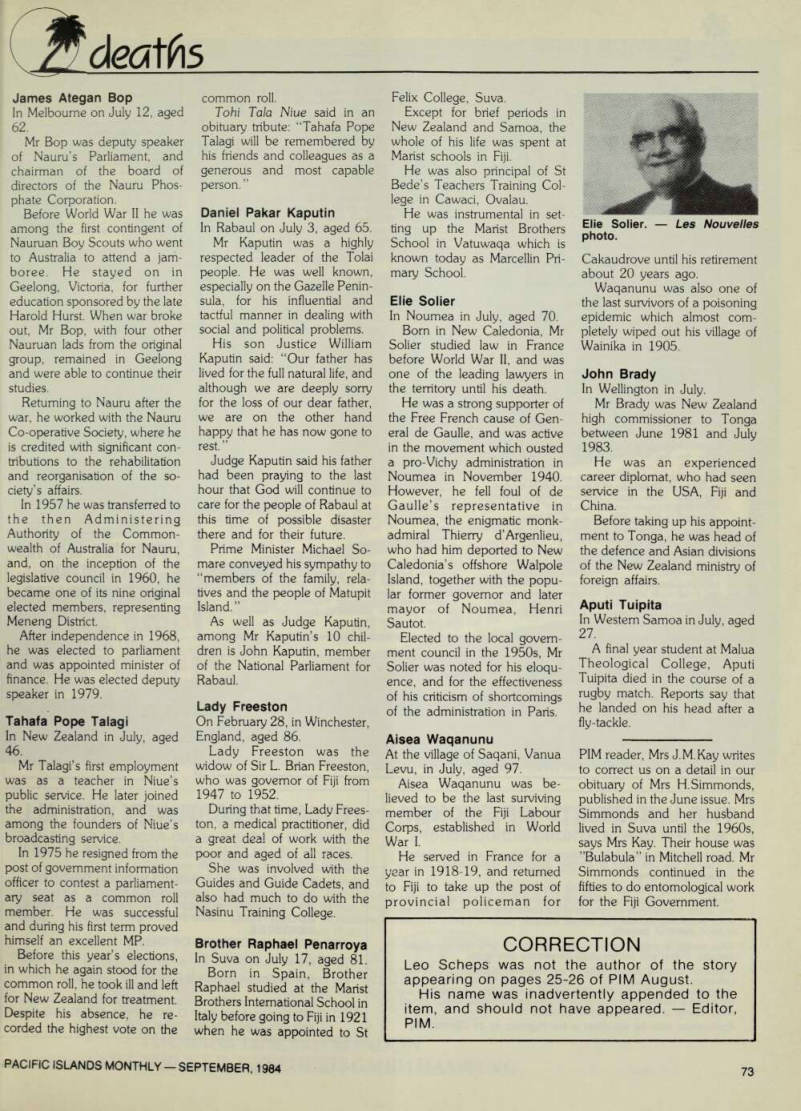
Elie Solier In Noumea in July, aged 70.
Born in New Caledonia, Mr Solier studied law in France before World War 11, and was one of the leading lawyers in the territory until his death.
He was a strong supporter of the Free French cause of Gen eral de Gaulle, and was active in the movement which ousted a pro-Vichy administration in Noumea in November 1940.
However, he fell foul of de Gaulle’s representative in Noumea, the enigmatic monk admiral Thierry d’Argenlieu, who had him deported to New Caledonia’s offshore Walpole Island, together with the popu lar former governor and later mayor of Noumea, Henri Sautot.
Elected to the local govern ment council in the 19505, Mr Solier was noted for his eloqu ence, and for the effectiveness of his criticism of shortcomings of the administration in Paris.
Aisea Waqanunu At the village of Saqani, Vanua Levu, in July, aged 97.
Aisea Waqanunu was be lieved to be the last surviving member of the Fiji Labour Corps, established in World War I.
He served in France for a year in 1918-19, and returned to Fiji to take up the post of provincial policeman for
Cakaudrove until his retirement about 20 years ago.
Waqanunu was also one of the last survivors of a poisoning epidemic which almost com pletely wiped out his village of Wainika in 1905.
John Brady In Wellington in July.
Mr Brady was New Zealand high commissioner to Tonga between June 1981 and July 1983.
He was an experienced career diplomat, who had seen service in the USA, Fiji and China.
Before taking up his appoint ment to Tonga, he was head of the defence and Asian divisions of the New Zealand ministry of foreign affairs.
Aputi Tuipita In Western Samoa in July, aged 27.
A final year student at Malua Theological College, Aputi Tuipita died in the course of a rugby match. Reports say that he landed on his head after a fly-tackle.
PIM reader, Mrs J.M.Kay writes to correct us on a detail in our obituary of Mrs H.Simmonds, published in the June issue. Mrs Simmonds and her husband lived in Suva until the 19605, says Mrs Kay. Their house was ’’Bulabula” in Mitchell road. Mr Simmonds continued in the fifties to do entomological work for the Fiji Government.
Elie Solier. - Les Nouvelles photo.