political currents
pp. 65-66 · Read in the full issue
Cheysson on France’s view of its role in the South Pacific
France’s role and position in the Pacific was a major topic of discussion among the nations of the South Pacific Forum at their annual conference in Tuvalu.
The island nations, together with Australia and New Zealand, are opposed to their nuclear testing at Moruroa, and there is also feeling, particularly among Melanesian members of the Forum, that decolonisation of New Caledonia is happening too slowly.
The French, however, maintain their considerable interest in the region and make the valid, and intriguing, distinction that there is a South Pacific, and a North Pacific, and seldom do the twain really meet.
Just before the Forum, France’s Minister for External Affairs, Claude Cheysson, came visiting the area, saying French ministers had not done enough to expand contacts between Paris and the Pacific, including Australia and New Zealand.
France might be somewhat remote in terms of distance, but she had a definite place in the Pacific, ’The French presence is a plus.”
The French-language monthly,”3o Jours,” inter viewed M.Cheysson in Noumea while he was on his second visit to the South Pacific in six months, for a preparatory meeting devoted to the third Lome Convention between the EEC and the ACP coun tries. A translation of extracts from the interview follows;
Do your two visits to the South Pacific mean that France intends to step up its relations with the region?
Certainly. My visit to Austra lia was the first ever made by a French minister of external affairs. In the case of New Zealand, things were even worse: It was the first visit ever by any French Government minister. It’s almost impossible to believe. When one considers what France’s relations have been with New Zealand and Australia over the years, and the size of the French commun ity in Australia over 15,000 people I’d say the situation was quite shocking.
But the Pacific area is impor tant from many points of view.
It has a clear strategic interest, since the maintenance of our nuclear independence requires us to carry out the testing we’re doing in Polynesia. We can’t find any place nearer to France which has the geological struc tures suitable for underground testing. It also has economic importance: Australia and New Zealand are competitors, but they’re also customers of ours.
Finally, there are political and cultural aspects: The South Pacific is a region where we have every intention of maintaining our presence, our
identity. So we’ve got to have the appropriate relationships with Australia and New Zealand particularly with Australia, which is the largest country in the South Pacific.
Why do I think it’s taken so long for such visits to take place? However trite it sounds, I’d say the distance. The South Pacific is a long way away, and more particularly it’s not a transit area. You don’t stop off in Australia or New Zealand when you’re going somewhere else. But this is not an excuse, it’s a reason.
Do you consider the fact that France is established in New Caledonia and French Polynesia as a plus or a minus
for the future development of relations with Australia, New Zealand, and the other Pacific countries?
I say without hesitation it’s a plus. Let me put the question another way. Suppose we we ren’t there: Why in heaven’s name would the New Zealan ders and Australians go on having ties with us? They’d soon get out of the way of meeting us except maybe at OECD headquarters in Paris You know, the British with drawal from a large part of the world at the time of the Macmil lan government is a classic illustration of the consequences of that type of behavior. That
was How long ago? Twenty years? In 20 or 25 years Eng land’s influence has largely dis appeared from the regions from which it physically withdrew look at Southeast Asia, or the Far East. Being present phy sically, with one’s own interests, one’s own constraints one’s own rivalries indeed is a matter of considerable interest for the inhabitants of the region.
Two years ago, in May 1982, a conference of French ambassadors from through out the Pacific was held in Paris in recognition of the importance of this region in the years ahead. What came out of it, and what can be expected of it in future?
I often wonder about the unity of the Pacific. I believe that there’s a community of approach to the problems of the South Pacific. But I’m not sure that the same reasoning, the same analytical terms, apply to what’s called the North Paci fic, where the only thing in common between the countries making up the region is that their coasts are washed by the same ocean. However, there are other sorts of ties which establish other types of com munity. Countries like France, Great Britain, or the Federal German Republic have rela tions with Japan which have
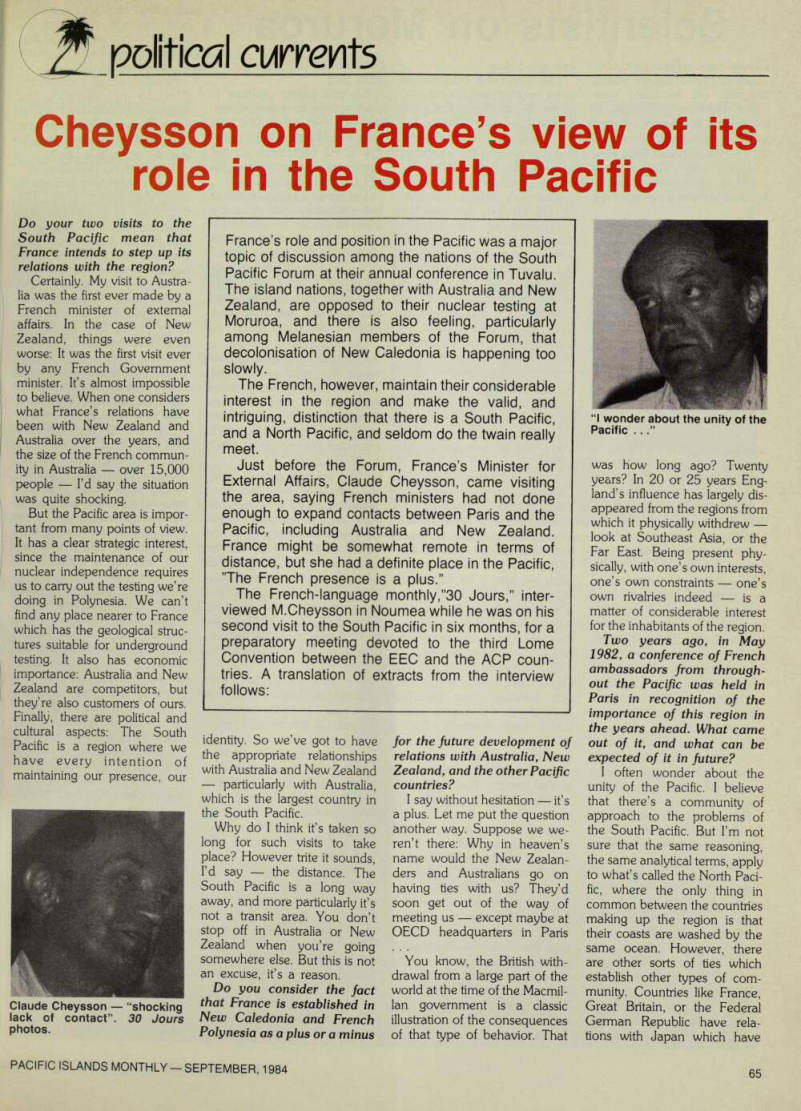
Claude Cheysson - “shocking lack of contact”. 30 Jours photos.
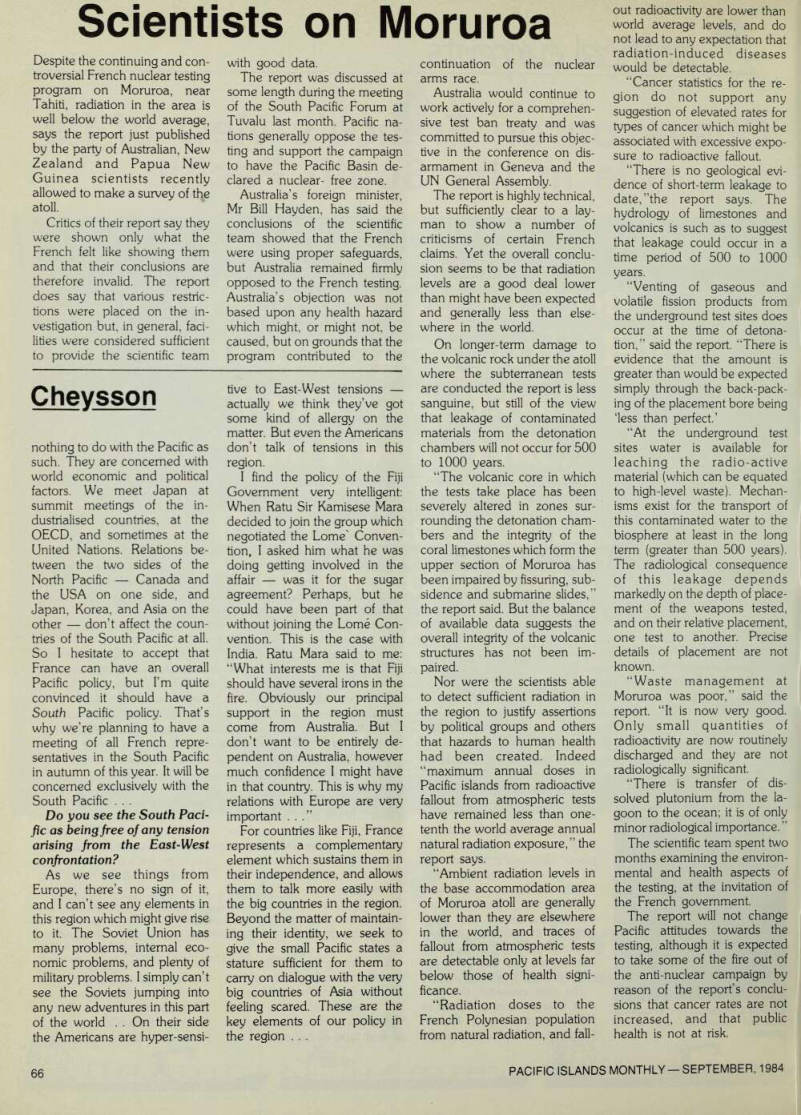
“I wonder about the unity of the Pacific . . ."
nothing to do with the Pacific as such. They are concerned with world economic and political factors. We meet Japan at summit meetings of the in dustrialised countries, at the OECD, and sometimes at the United Nations. Relations be tween the two sides of the North Pacific Canada and the USA on one side, and Japan, Korea, and Asia on the other don’t affect the coun tries of the South Pacific at all.
So 1 hesitate to accept that France can have an overall Pacific policy, but I’m quite convinced it should have a South Pacific policy. That’s why we’re planning to have a meeting of all French repre sentatives in the South Pacific in autumn of this year. It will be concerned exclusively with the South Pacific . . .
Do you see the South Paci fic as being free of any tension arising from the East-West confrontation?
As we see things from Europe, there’s no sign of it, and I can’t see any elements in this region which might give rise to it. The Soviet Union has many problems, internal eco nomic problems, and plenty of military problems. I simply can’t see the Soviets jumping into any new adventures in this part of the world . . On their side the Americans are hyper-sensi
five to East-West tensions actually we think they’ve got some kind of allergy on the matter. But even the Americans don’t talk of tensions in this region.
I find the policy of the Fiji Government very intelligent; When Ratu Sir Kamisese Mara decided to join the group which negotiated the Lome' Conven tion, I asked him what he was doing getting involved in the affair was it for the sugar agreement? Perhaps, but he could have been part of that without joining the Lome Con vention. This is the case with India. Ratu Mara said to me; “What interests me is that Fiji should have several irons in the fire. Obviously our principal support in the region must come from Australia. But I don’t want to be entirely de pendent on Australia, however much confidence I might have in that country. This is why my relations with Europe are very important ...”
For countries like Fiji, France represents a complementary element which sustains them in their independence, and allows them to talk more easily with the big countries in the region.
Beyond the matter of maintain ing their identity, we seek to give the small Pacific states a stature sufficient for them to carry on dialogue with the very big countries of Asia without feeling scared. These are the key elements of our policy in the region . . .