“Plan your family,
p. 57 · Read in the full issue
Women’S Message
“Plan your family, care for your health”
Contraception, and the health of women in the Pacific islands, have become the con cern of two of Australia’s lead ing family planning advisers, Coral Lloyd and Margaret Winn. Using a grant from the Australian government, through the Australian Deve lopment Assistance Bureau (ADAB), they are making a series of visits to island coun tries, seeking information on what Pacific women want, and need, from their health services, and what they have to say about family health and child rearing.
They are visiting the Solo mon Islands, Fiji and Tonga between August and November of this year.
Mrs Lloyd is an experienced midwife and teacher, and Mar garet Winn an organiser of aid and development personnel and an experienced teacher.
Both are leaders in the Austra lian Federation of Family Plan ning Associations and also members of the Women and Development Network. This latter organisation ran a mission into the Pacific in July and August, 1984, studying the place of women in the Pacific.
They will talk to people at all economic levels and will spend time in rural villages offering advice and information on women’s health, child-bearing,
contraception, family planning
and (very important in their minds) showing women how they may space their children, and avoid damage to their health, and shortening of their life-span.
“But we will not push any thing down anyone’s throat,” said Margaret. “We will be available if they wish to talk to us, or ask us for information. If they don’t wish to talk about certain things, then that is fine with us.
“We will get down to the absolute grass roots, with the village women, in the villages,” said Coral. “I am used to teaching at the grass roots level.
I have made two previous trips into the Pacific, to Tonga and Fiji. The villages are where we will be working a lot of the time.
“But we now have good contacts throughout the Pacific, from several sources ... island people and Australian volun teers, people in local govern ment and family planning or ganisers, too,” said Coral.
Both Coral and Margaret are very sensitive to the traditional status of women in the Pacific.
“We want them to talk about what they want, and what they think, not what other people think they should have,” said Margaret.
“I know some are particularly keen to know how to teach feminine health and awareness to their daughters,” said Coral.
“I have already been asked to run some workshops on that in Tonga.
“Women in the islands never tell their daughters about menstruation, about when they are fertile and about the func tions of their bodies. But if they are given the words ... are shown how to tackle the subject ... then it is much easier for them,” Coral said.
Reception of family planning promoters is generally good in the Pacific, with the Solomon Islands offering least official support and probably also according the lowest regard for women of all the region’s coun tries.
Quite a deal of aid has gone to the Solomons for family planning purposes, but the Solomons association does not appear to be particularly active and aid officials seem unclear about how far down into the grassroots they go; the general assumption is, not very far.
“One of the basic problems is that family planning is seen in the third world as limitation of the family,” said Margaret.
“But, to us, it is providing women with the choice to have as many children as they wish and when they wish to have them.
“Any reasonable person would accept that the health of women is important, and one of the factors adversely affecting it, particularly in the Solomon Is lands, is constant child-bearing.
They are not given time for their bodies to recover before they are pregnant again,” said Coral.
“Women need to know more about what happens to their bodies during pregnancy .. about nutrition, breast-feeding and the fact that their bodies cannot go on forever providing for children. And you get to the stage after ten babies in nine years, which can actually hap pen, that the woman just doesn’t have any stores of anything to provide for the child in her womb.
“Every woman would want to give as good a start to her last child as she did to her first, and that means allowing time for the body to recuperate in every way before she starts another.
What I call the pregnancy pause. And I tell them that if they want a holiday from hav ing babies, well, they can, through contraception and planning.”
But family planning also in volves helping infertile women to become pregnant and have the children which their society regards as important for them to have.
“In Tonga last year I was approached by many young women who had been married five or six years without becom ing pregnant. They wanted to know why.
“Infertility information is part of family planning,” said Mar garet. “We want to help women to have babies if they want them.”
It was this aspect of her family planning counselling which almost, but not quite,
gave Coral Lloyd the break through she had been seeking.
“One young woman said she would bring her husband to the lecture. He was very interested, but just couldn’t bring himself to sit down among the women while pregnancy and its various aspects and problems were dis cussed.
“He was almost on the verge of coming. It was very exciting for me. If he had come it would have been a great step for ward. ”
The islands vary greatly in their acceptance, and use of, family planning information.
Fiji is quite sophisticated, for instance, but a good deal of work still needs to be done with the young people to educate them about dangers like venereal disease, and the onset of puberty, the women said. In Samoa girls had access to fam ily planning services “right along the line,” but some even quite advanced island countries did not offer the same facilities.
There might not be any social stigma about a girl coming home with a baby, they said, but what about the life of the girl herself? She might want to do all sorts of things before she settled down to have a family.
Single girls ought to be told about contraception but, in Fiji, they are not.
“It’s all about choice, and the health of the community,” said Coral.
The Australian Federation of Family Planning Associations is a non-government body affili ated with the International Planned Parenthood Federa tion (IPPF) and coordinates Australian family planning at the national level.
It has also been the field office for the Pacific region for the IPPF since that organisa tion’s office in Singapore was closed and business taken back to London for cost reasons.
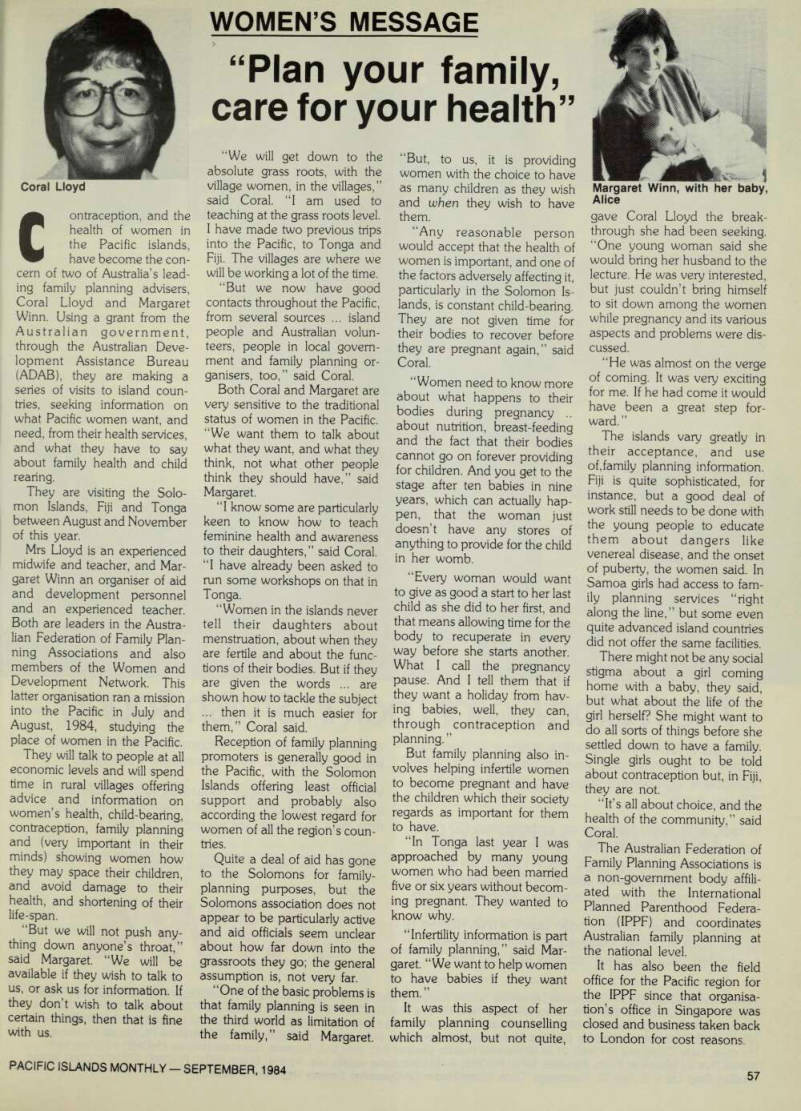
Coral Lloyd
Margaret Winn, with her baby, Alice