Vancouver, here
pp. 54-55 · Read in the full issue

Fiji
Vancouver, here we come
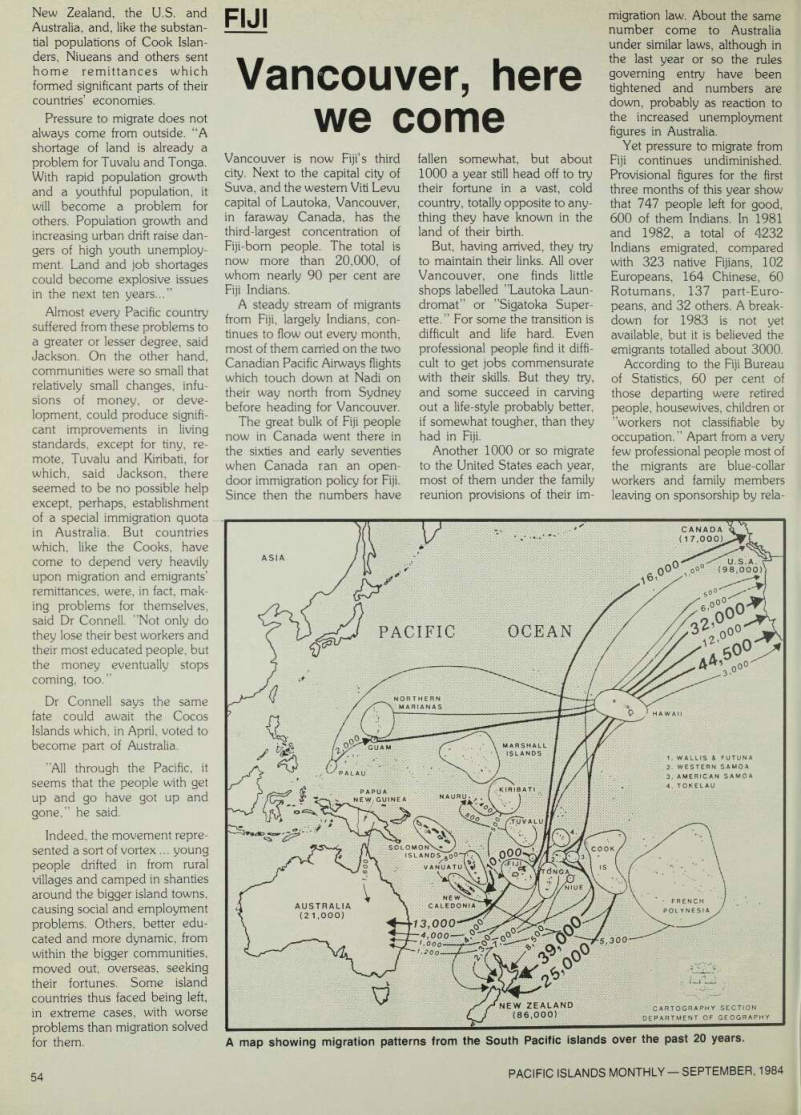
Vancouver is now Fiji’s third city. Next to the capital city of Suva, and the western Viti Levu capital of Lautoka, Vancouver, in faraway Canada, has the third-largest concentration of Fiji-born people. The total is now more than 20,000, of whom nearly 90 per cent are Fiji Indians.
A steady stream of migrants from Fiji, largely Indians, con tinues to flow out every month, most of them carried on the two Canadian Pacific Airways flights which touch down at Nadi on their way north from Sydney before heading for Vancouver.
The great bulk of Fiji people now in Canada went there in the sixties and early seventies when Canada ran an open door immigration policy for Fiji.
Since then the numbers have
fallen somewhat, but about 1000 a year still head off to try their fortune in a vast, cold country, totally opposite to any thing they have known in the land of their birth.
But, having arrived, they try to maintain their links. All over Vancouver, one finds little shops labelled ’’Lautoka Laun dromat” or ’’Sigatoka Super ette.” For some the transition is difficult and life hard. Even professional people find it diffi cult to get jobs commensurate with their skills. But they try, and some succeed in carving out a life-style probably better, if somewhat tougher, than they had in Fiji.
Another 1000 or so migrate to the United States each year, most of them under the family reunion provisions of their im
migration law. About the same number come to Australia under similar laws, although in the last year or so the rules governing entry have been tightened and numbers are down, probably as reaction to the increased unemployment figures in Australia.
Yet pressure to migrate from Fiji continues undiminished.
Provisional figures for the first three months of this year show that 747 people left for good, 600 of them Indians. In 1981 and 1982, a total of 4232 Indians emigrated, compared with 323 native Fijians, 102 Europeans, 164 Chinese, 60 Rotumans, 137 part-Euro peans, and 32 others. A break down for 1983 is not yet available, but it is believed the emigrants totalled about 3000.
According to the Fiji Bureau of Statistics, 60 per cent of those departing were retired people, housewives, children or ’’workers not classifiable by occupation.” Apart from a very few professional people most of the migrants are blue-collar workers and family members leaving on sponsorship by rela-
A map showing migration patterns from the South Pacific islands over the past 20 years.
fives already settled in their adoptive countries. From this it would appear that there is not a significant brain drain. Yet any loss of talent from a pool as small as Fiji’s gives cause for concern.
The departure of some high ly-qualified doctors has caused some anxiety. Most of them have gone off to follow further studies and research and it is thought likely some of them may return. Fiji has also lost a small but significant number of skilled workers, like motor
mechanics, electricians, prin ters, plumbers and carpenters, but the government’s training programs seem to be replacing these at more than generous rate.
Indians by far form the bulk of departures. It is not that they are by nature an adventurous community but rather that they see little prospect for their chil dren in a country where un employment, and under employment is a major prob lem.
Most of them are from rural
Indian stock and they tend to feel a deep, basic insecurity, they say, because they own very little land. Most Indian farmers are tenants, leasing their properties on 30-year, or shorter, tenures. Politically they have tended to support the opposition National Federation Party, which is probably doomed to remain in opposi tion because of the electoral system, and political alignments among the different races.
But the pastures outside Fiji are not always greener for the hopeful migrants. Many have to struggle to survive in an alien society where, often, there are deep-seated prejudices against foreign ’’interlopers.” In Can ada, for example, they were initially welcomed and they did well because the Canadian eco nomy was booming and jobs were plentiful. The migrants bought cars, houses, and other property, and sent for their relatives believing they had found nirvana.
But when the economic slump hit they were the first to be laid off. But for the Cana dian welfare system, many
would have been simply crushed.
However, fortune seems to have shone somewhat brighter on those who went to the United States. For one thing the recession was less bitter than it was in Canada and for another the American society is much larger.
Those who have gone to Australia have been mostly either professional people or highly-skilled workers, this being the basis upon which Australia accepts her migrants.
Some, a few, have been admit ted to join family members able to support them.
But, despite the tough rules and the hardships faced by many migrants, the number of people applying for resident visas in Canada, the US and Australia every year runs into thousands ... many more than can hope to get a place. The numbers are not expected to diminish, particularly among In dians who continue to look overseas for what they feel could be greater security and a brighter future for their chil
dren.
Vijendra Kumar.
The bright lights and the beautiful shops of Honolulu tempt many islanders to a culture vastly different, and harder, than their own.