Nukumanu: Home of mosquitoes,
pp. 49-51 · Read in the full issue

taro, and the dead
We hear on the radio that the Atoll Enterprise, the ship that comes here to the Tasman Islands once a month, has its engine “bakarap” and won’t be able to move for at least an other five weeks. We’re quite happy about that, as we’re enjoying the story we’re living here more and more every day.
We actually celebrate the news by drinking an even bigger glass of kareve, the alcoholic drink made from coconut which is so popular in this island.
In the past, Amotu village didn’t exist, and the Tasman Islanders all lived on the nearby island of Nokumanu, larger but infested by mosquitoes. These days, people go to Nokumanu only to bury the dead and everyone together, every Tues day to collect taro.
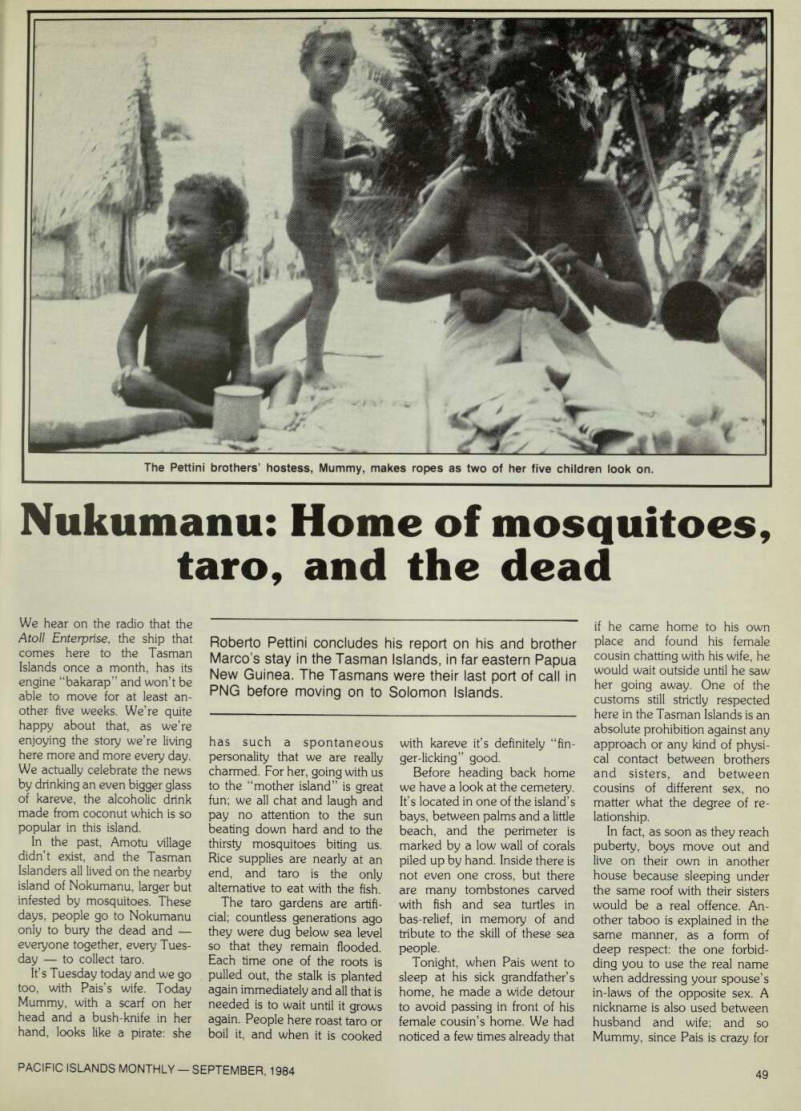
It’s Tuesday today and we go too, with Pais’s wife. Today Mummy, with a scarf on her head and a bush-knife in her hand, looks like a pirate: she
Roberto Pettini concludes his report on his and brother Marco’s stay in the Tasman Islands, in far eastern Papua New Guinea. The Tasmans were their last port of call in PNG before moving on to Solomon Islands.
has such a spontaneous personality that we are really charmed. For her, going with us to the “mother island” is great fun; we all chat and laugh and pay no attention to the sun beating down hard and to the thirsty mosquitoes biting us.
Rice supplies are nearly at an end, and taro is the only alternative to eat with the fish.
The taro gardens are artifi cial; countless generations ago they were dug below sea level so that they remain flooded.
Each time one of the roots is pulled out, the stalk is planted again immediately and all that is needed is to wait until it grows again. People here roast taro or boil it, and when it is cooked
with kareve it’s definitely “fin ger-licking” good.
Before heading back home we have a look at the cemetery.
It’s located in one of the island’s bays, between palms and a little beach, and the perimeter is marked by a low wall of corals piled up by hand. Inside there is not even one cross, but there are many tombstones carved with fish and sea turtles in bas-relief, in memory of and tribute to the skill of these sea people.
Tonight, when Pais went to sleep at his sick grandfather’s home, he made a wide detour to avoid passing in front of his female cousin’s home. We had noticed a few times already that
if he came home to his own place and found his female cousin chatting with his wife, he would wait outside until he saw her going away. One of the customs still strictly respected here in the Tasman Islands is an absolute prohibition against any approach or any kind of physi cal contact between brothers and sisters, and between cousins of different sex, no matter what the degree of re lationship.
In fact, as soon as they reach puberty, boys move out and live on their own in another house because sleeping under the same roof with their sisters would be a real offence. An other taboo is explained in the same manner, as a form of deep respect: the one forbid ding you to use the real name when addressing your spouse’s in-laws of the opposite sex. A nickname is also used between husband and wife; and so Mummy, since Pais is crazy for
The Pettinl brothers’ hostess, Mummy, makes ropes as two of her five children look on.
fish heads, has re-named him “Shark.”
Pais’s family are really funny when they try to eat spaghetti!
Some try to catch the strands with a fork, others with a spoon, others with their hands, holding them tight in their fists. But the squishy spaghetti always escapes. The strands are long and fragile, and move about in their hands or on their plates like long white worms. That is what they were eventually called, because the term “strings” wasn’t realistic enough. Pais and his wife to some extent learn to eat them, but their five small monsters, after mucking around and trying it, give up and opt for the plate of fish and taro cooked the night before.
I’ve just been with Teaku to the island of Nokumanu. Teaku likes to sail in his canoe, espedally when it’s windy, as it is today, and to make the outrigger lift up over the water, a local custom that reminds me of “chucking a wheelie” on a motorbike in our part of the
world. We went as far as the northern point of the island, where we anchored the canoe to a very secure bit of underwater coral and then en tered the bush. This time we weren’t there to gather coco nuts but to catch birds. Among the palms and the pandanus trees there are some tall bushy trees where a species of black birds with long tails build a condominium of nests. For Teaku catching them was not hard at all. I would watch him climb quickly up a trunk and then, using one hand to hold on, with the other he would snare the birds one by one by the tail, using a long stick with a loop at the end. Each bird he caught was promptly silenced with a bite on the neck and thrown to the ground. When the rest of this particular colony flew away in alarm, Teaku would tie to the end of the stick a scoop made of leaves and use it to steal the eggs and the little birds still unable to fly.
Today, from four different
A youth of Amotu Island cuts the flowers from the tip of a coconut to prepare “kareve,” the islanders’ favorite grog.
trees, we took 14 grown-up birds, four babies and at least 60 eggs. They will be cooked tonight and eaten tomorrow for breakfast. I feel upset about the fate of the birds, but after all what difference is there really between fish and birds?
We haven’t seen a cloud for a week, and in front of every house in the village there are pieces of coconut drying. We have often seen canoes arrive back loaded with coconuts col lected in Nokumanu, but only in these last few days have the village women been working at separating the flesh from the shells, breaking it and putting it out to dry to turn it into copra.
This is a long and tiresome job, but a very important one, be cause apart from the trochus shells, copra is the only source of income for the local people.
In Kieta the current price is 10 kina per bag, and here every member of each family gets busy to produce his or her bag, thus paying with their work for their share of the sugar, kerosene, soap, etc., that is consumed between one arrival of the ship and the next.
Pais explains to us that, following an agreement reached by the whole commun ity, each individual now has the right to produce one bag per month and no more. This is due to the fact that in the past “free production” created much im balance and quarrelling. Famil ies with many male members used to be advantaged partly as a result of certain customs.
Girls, apart from finding certain stages of the work such as carrying and peeling the coco nuts particularly heavy, didn’t have the freedom to move around, working and staying overnight in Nokuma nu, where there is a large coconut plantation.
We hear on the radio news, broadcast from Kieta, that in Italy police have arrested five Red Brigadists who were hol ding hostage the U.S. General Dozier from NATO . . . hearing these facts, happening so far away, has quite an effect on us.
Everybody else here is worried because the sugar is about to run out . . .
A fishing contest has been organised. The aim is not to reward a winner, but this time the person who comes home with the least fish will have to
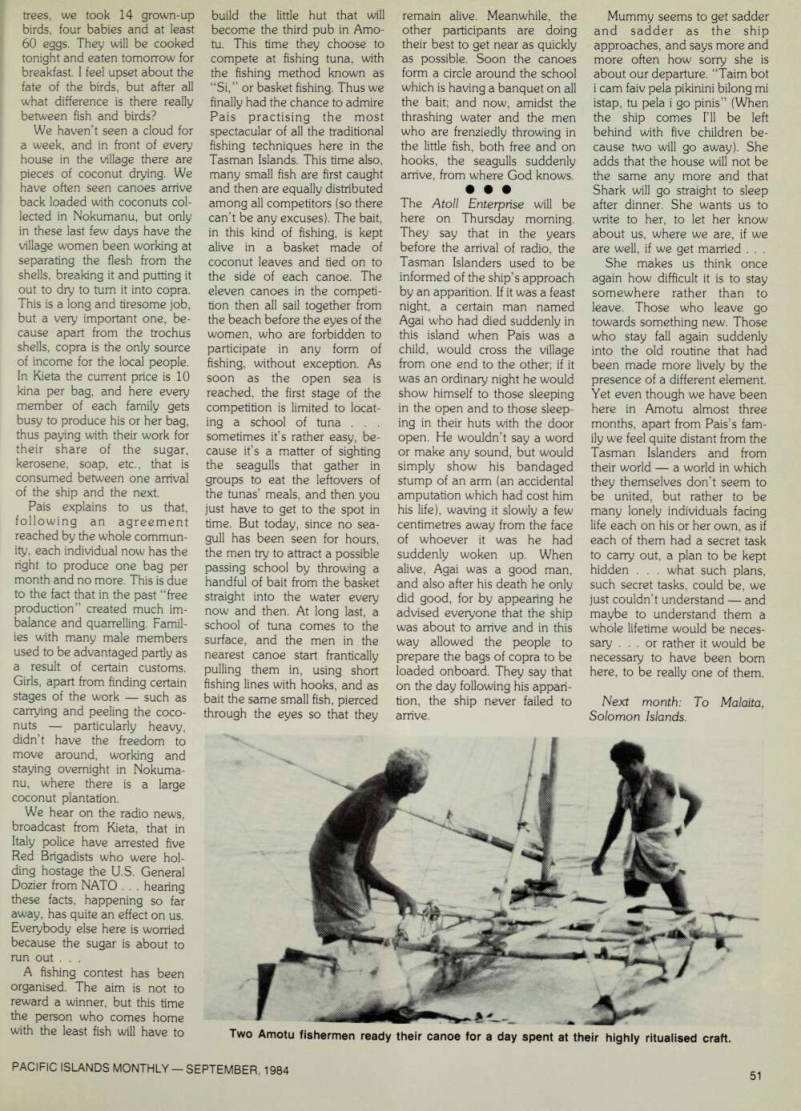
build the little hut that will become the third pub in Amo tu. This time they choose to compete at fishing tuna, with the fishing method known as “Si,” or basket fishing. Thus we finally had the chance to admire Pais practising the most spectacular of all the traditional fishing techniques here in the Tasman Islands. This time also, many small fish are first caught and then are equally distributed among all competitors (so there can’t be any excuses). The bait, in this kind of fishing, is kept alive in a basket made of coconut leaves and tied on to the side of each canoe. The eleven canoes in the competi tion then all sail together from the beach before the eyes of the women, who are forbidden to participate in any form of fishing, without exception. As soon as the open sea is reached, the first stage of the competition is limited to locat ing a school of tuna . . . sometimes it’s rather easy, be cause it’s a matter of sighting the seagulls that gather in groups to eat the leftovers of the tunas’ meals, and then you just have to get to the spot in time. But today, since no sea gull has been seen for hours, the men try to attract a possible passing school by throwing a handful of bait from the basket straight into the water every now and then. At long last, a school of tuna comes to the surface, and the men in the nearest canoe start frantically pulling them in, using short fishing lines with hooks, and as bait the same small fish, pierced through the eyes so that they
remain alive. Meanwhile, the other participants are doing their best to get near as quickly as possible. Soon the canoes form a circle around the school which is having a banquet on all the bait; and now, amidst the thrashing water and the men who are frenziedly throwing in the little fish, both free and on hooks, the seagulls suddenly arrive, from where God knows. • • • The Atoll Enterprise will be here on Thursday morning.
They say that in the years before the arrival of radio, the Tasman Islanders used to be informed of the ship’s approach by an apparition. If it was a feast night, a certain man named Agai who had died suddenly in this island when Pais was a child, would cross the village from one end to the other; if it was an ordinary night he would show himself to those sleeping in the open and to those sleep ing in their huts with the door open. He wouldn’t say a word or make any sound, but would simply show his bandaged stump of an arm (an accidental amputation which had cost him his life), waving it slowly a few centimetres away from the face of whoever it was he had suddenly woken up. When alive, Agai was a good man, and also after his death he only did good, for by appearing he advised everyone that the ship was about to arrive and in this way allowed the people to prepare the bags of copra to be loaded onboard. They say that on the day following his appari tion, the ship never failed to arrive.
Mummy seems to get sadder and sadder as the ship approaches, and says more and more often how sorry she is about our departure. “Taim hot i cam faiv pela pikinini bilong mi istap, tu pela i go pinis” (When the ship comes I’ll be left behind with five children be cause two will go away). She adds that the house will not be the same any more and that Shark will go straight to sleep after dinner. She wants us to write to her, to let her know about us, where we are, if we are well, if we get married . . .
She makes us think once again how difficult it is to stay somewhere rather than to leave. Those who leave go towards something new. Those who stay fall again suddenly into the old routine that had been made more lively by the presence of a different element.
Yet even though we have been here in Amotu almost three months, apart from Rais’s fam ily we feel quite distant from the Tasman Islanders and from their world a world in which they themselves don’t seem to be united, but rather to be many lonely individuals facing life each on his or her own, as if each of them had a secret task to carry out, a plan to be kept hidden . . . what such plans, such secret tasks, could be, we just couldn’t understand and maybe to understand them a whole lifetime would be neces sary ... or rather it would be necessary to have been bom here, to be really one of them.
Next month: To Malaita, Solomon Islands.
Two Amotu fishermen ready their canoe for a day spent at their highly ritualised craft.