help Reagan
pp. 61-62 · Read in the full issue
November Presidential Poll
U.S. Pacific territories won’t help Reagan
If Ronald Reagan is re-elected President of the United States in November it will not be because of support in the US Pacific Islands. This prediction is based on both expected Republican and Democratic participation in the summer conventions, and on the array of elected officials in the islands.
While only Hawaii actually casts electoral votes in Novem ber (it has four of the nation wide total of 538) traditionally Guam (as well as Puerto Rico and the US Virgin Islands) have also been represented in the party conventions which choose the candidate for Presi dent and Vice-President.
The political situation in the US Pacific as 1984 dawned was as follows: • Hawaii was in 1980 one of a handful of states to support Jimmy Carter and Walter Mon dale against Ronald Reagan
and George Bush and, in fact, was the only state west of Mondale’s homestate of Minnesota to do so. • Hawaii’s two senators, two congressmen, its governor and large majorities of both houses of the legislature were Democrats. • Both Guam and American Samoa were represented in the US House of Representatives here by non-voting delegates sitting with the Democrats, Guam also had a Democratic governor while Samoa (which does not have partisan elections) had chosen a Republican one, Peter Tali Coleman. The Northern Marianas also had a Republican governor.
As the jockeying for the Democratic nomination got underway the Pacific Democrats swung into action. With a total of 3933 delegates due to meet in San Francisco on July 16-19 the Democrats allocated
27 seats to Hawaii, seven to Guam and six to American Samoa, or a little over 1.0 per cent of the total. The Republi cans gave 14 seats to Hawaii and four to Guam, or about 0.8 per cent of their total.
Congressman Fofo I.F.
Sunia, the delegate from Amer iacn Samoa, helped organise a National Democratic Party in the territory, secured an alloca tion (for the first time) of the delegates’ seats, and partipated in the party caucus which gave all six votes to the Mondale forces.
Similarly in Hawaii the Democrats voted all of their 27 delegates to Mondale while the Guam Democrats split their votes IV2 to Hart and SVz to Mondale. (Some delegates cast fractional votes; Guam got one more vote than Samoa because it has a Democratic Governor and Samoa does not.) The Republicans have been
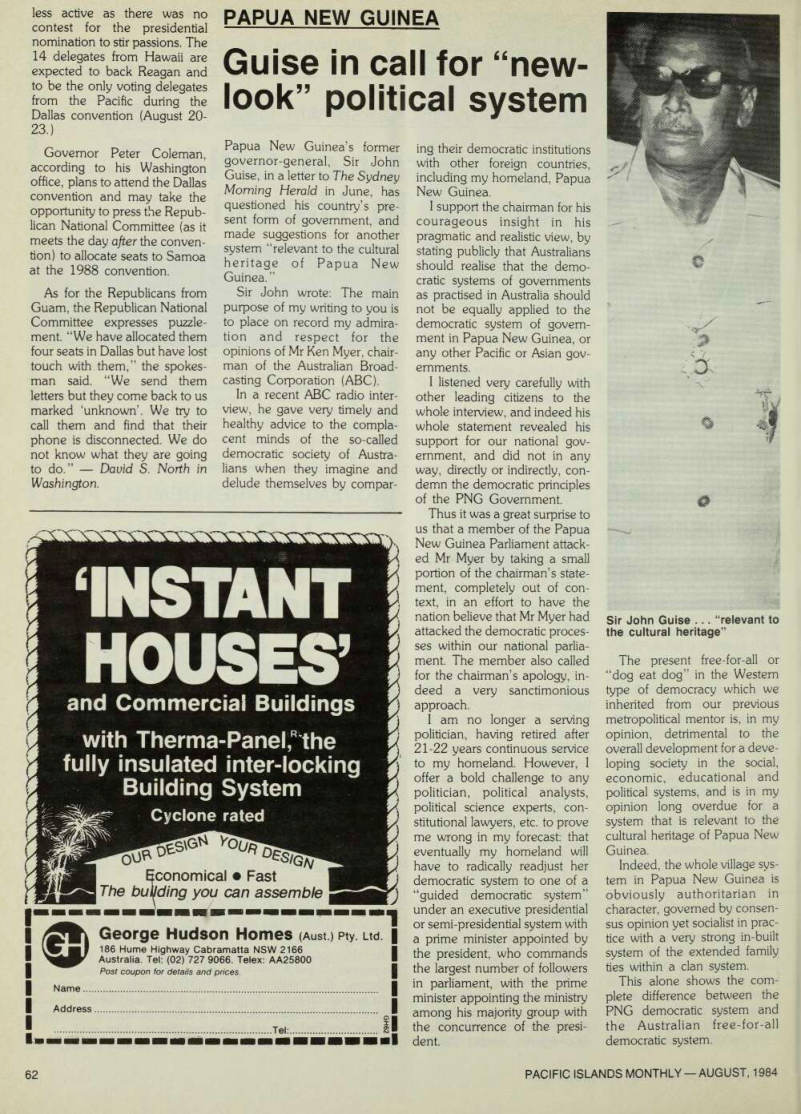
American Samoa’s Governor Peter Tali Coleman ... a Reagan ally?
less active as there was no contest for the presidential nomination to stir passions. The 14 delegates from Hawaii are expected to back Reagan and to be the only voting delegates from the Pacific during the Dallas convention (August 20- 23.) Governor Peter Coleman, according to his Washington office, plans to attend the Dallas convention and may take the opportunity to press the Repub lican National Committee (as it meets the day after the conven tion) to allocate seats to Samoa at the 1988 convention.
As for the Republicans from Guam, the Republican National Committee expresses puzzle ment. “We have allocated them four seats in Dallas but have lost touch with them,” the spokes man said. “We send them letters but they come back to us marked ‘unknown’. We try to call them and find that their phone is disconnected. We do not know what they are going
to do.”
David S. North in
Washington.