railway?
pp. 46-48 · Read in the full issue

When does a tramway become a railway?
Fiji’s Sugar Tramways, 1882- 1982. Compiled by Bob McKil lop and Peter Dyer. Published by the Light Railway Reserch Society of Australia, P.O. Box 21, Surrey Hills, Vic., Australia, 3127, ISBN 0 909340 18 8. No price provided.
In the so-called “metropolitan” countries there is often a certain bitterness associated with their railway systems caused often enough by rail-workers’ strikes or by rip-off fare increases. So it is of some comfort to know that in the Pacific there is at least one rail system which gives off a sweet odor or at least its freight does.
This impression is given by the small publication, Fiji’s Sugar Tramways 1882-1982.
Into only 36 pages printed on semigloss stiff paper there is packed a wealth of information on the history of the Fiji sugar industry and the application of modern (even from the start) transport for carriage of the sugarcane from fields to mills.
First production of sugar was in 1870 by Mr David Whippy.
Experimental mills were erected a couple of years later, and in 1880 the Australian giant, Col onial Sugar Refining Company, entered the field dominating it until 1973 when disagreeing with rates to be paid to cane farmers, CSR’s interests were sold to the Fiji government.
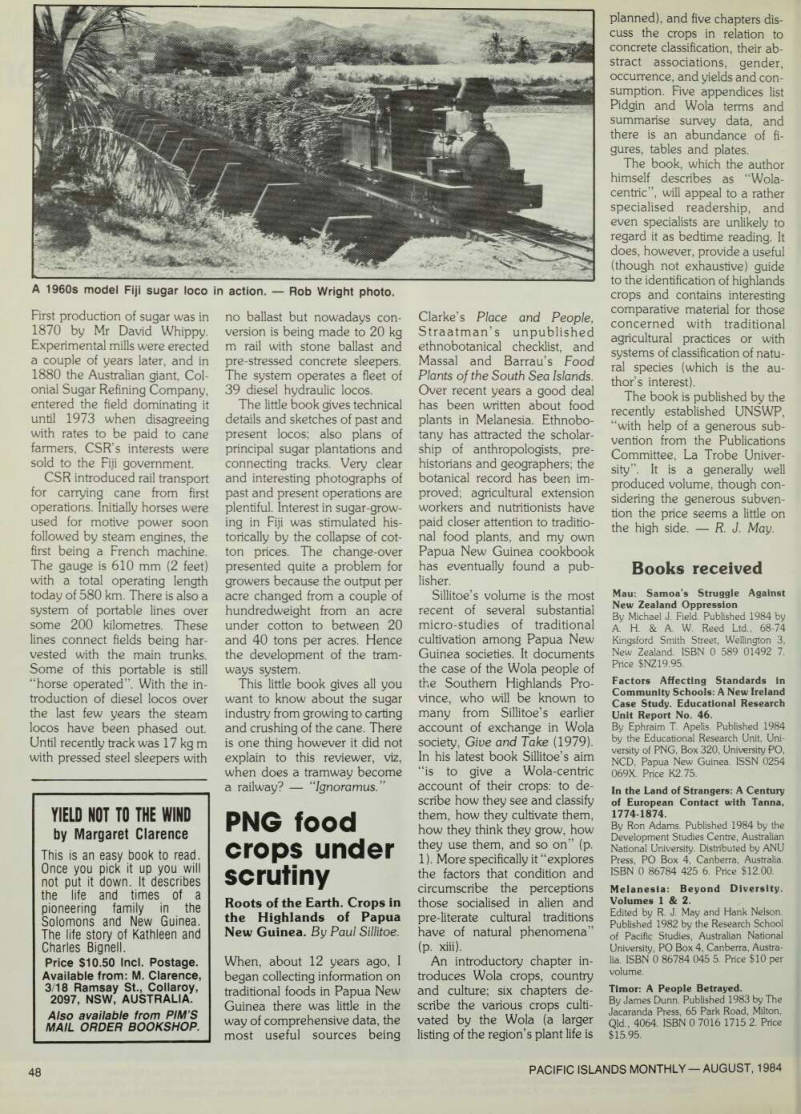
CSR introduced rail transport for carrying cane from first operations. Initially horses were used for motive power soon followed by steam engines, the first being a French machine.
The gauge is 610 mm (2 feet) with a total operating length today of 580 km. There is also a system of portable lines over some 200 kilometres. These lines connect fields being har vested with the main trunks.
Some of this portable is still “horse operated”. With the in troduction of diesel locos over the last few years the steam locos have been phased out.
Until recently track was 17 kg m with pressed steel sleepers with
no ballast but nowadays con version is being made to 20 kg m rail with stone ballast and pre-stressed concrete sleepers.
The system operates a fleet of 39 diesel hydraulic locos.
The little book gives technical details and sketches of past and present locos; also plans of principal sugar plantations and connecting tracks. Very clear and interesting photographs of past and present operations are plentiful. Interest in sugar-grow ing in Fiji was stimulated his torically by the collapse of cot ton prices. The change-over presented quite a problem for growers because the output per acre changed from a couple of hundredweight from an acre under cotton to between 20 and 40 tons per acres. Hence the development of the tram ways system.
This little book gives all you want to know about the sugar industry from growing to carting and crushing of the cane. There is one thing however it did not explain to this reviewer, viz, when does a tramway become a railway? “ Ignoramus
A 1960s model Fiji sugar loco in action. Rob Wright photo.