books
pp. 43-44 · Read in the full issue
Treasure trove in journal of scientist who sailed with Cook
The Resolution Journal of Johann Reinhold Forster 1772-1775, Volumes I-IV.
Edited hy Michael E. Hoare.
Published 1982 by the Hakluyt Society, do the Map Room, British Library Reference Divi sion, London WCIB 3DG.
ISBN 0 904180 10 7. Price 40 pounds sterling for the set of four volumes.
As Australia’s Bicentennial looms closer, there is a growing interest in both popular and academic circles in anything remotely connected with the earliest decades of British in volvement in this part of the world. Nowhere is this more apparent than in recent pub lishing, with particular reference to Captain James Cook and currently to Captain Arthur Phillip.
There has been a lively academic debate over whether or not Cook had knowledge and perhaps possession of a copy of a Portuguese map of the east coast of Australia when in 1770 he sailed the En deavour on to the coral reef off the coast of Queensland. This interest has extended to Cook’s second and third voyages and to a detailed study of the minutiae of evidence which might shed some light on the character and the motivations of the famous master mariner and scientist.
Are we in the 20th century still gullible victims of an 18th century British need to find a national hero? Are Cook’s accomplishments still worthy of the hyperbole they were accorded by many contempor aries and by subsequent gen erations of worshipful historians and biographers? Has the his torical reality become so over laid with myth and legend that we are in some danger of losing the real Captain Cook altogether? The recent irreve-
rent attempt to puncture the Cook legend by Jillian Robert son was unsatisfactory as an adequate reappraisal, though the chorus of indignant dis approval it aroused must have been eminently satisfying to its author.
If Cook is to be successfully reappraised, then it will be in the light of evidence provided by his own contemporaries, by men like Dr Johann Reinhold Forster whose journals are the subject of this review.
Johann Forster is an interes ting historical figure in his own right, and the Hakluyt Society would have performed a useful and valuable service just by reproducing the diaries of such an acute observer and natural scientist. The fact that Forster travelled as the Royal Naturalist aboard the Resolution, and en joyed the opportunity to
observe Cook at close quarters for a period of three years, makes the diaries a rich source of material for those whose main interest is in Cook, as well as scholars interested in the historical ornithology or ethnography of the Pacific.
Forster was born of German parents though of British des cent in 1729, and moved with his wife and family to Britain in 1766 where he sought to make a living by teaching and to establish a reputation as a natu ral scientist and scholar. When Joseph Banks’ intransigence over the conditions he required, if he was to participate in Cook’s second voyage, grew unsupportable, Forster and his eldest son George found them selves appointed officially as scientists to the voyage. This caused considerable ill-feeling to develop between Banks and
Forster, and Banks made his displeasure felt by refusing to assist Forster in his preparations or to advise him concerning necessary kit for a Pacific voyage. In return, the German scientist became preoccupied with the alleged machinations of Banks and his friends to diminish his scientific reputation and to minimise his accomplish ments on the voyage of the Resolution.
This introduces one of the minor leitmotifs of the journals, where Forster emerges as a very difficult and touchy man indeed. The weaknesses of his own nature were destined to play a large part in the many disputes and vendettas which bedevilled his career. Michael E. Hoare, the editor of the Forster journals is also the au thor of Forster’s biography, re vealingly entitled The Tactless Philosopher, wherein it is dis closed that an inability to get along with his fellow man was one of Forster’s most enduring characteristics.
Such a personality was bound to strike trouble when forced into close confinement with fellow-travellers aboard the restricted world of H.M.S.
Resolution, and it comes as no real surprise to find that before the voyage was over Forster had quarrelled with most of the officers including Cook, and with the official astronomer to the expedition.
When he returned to Eng land he quarrelled with the Admiralty over whether or not he had been promised the profitable rights of preparing the official account of the voyage for publication. The Admiralty denied any such understanding had existed, and in high dudgeon Forster with drew the bulk of his material and attempted unsuccessfully to arrange for its publication
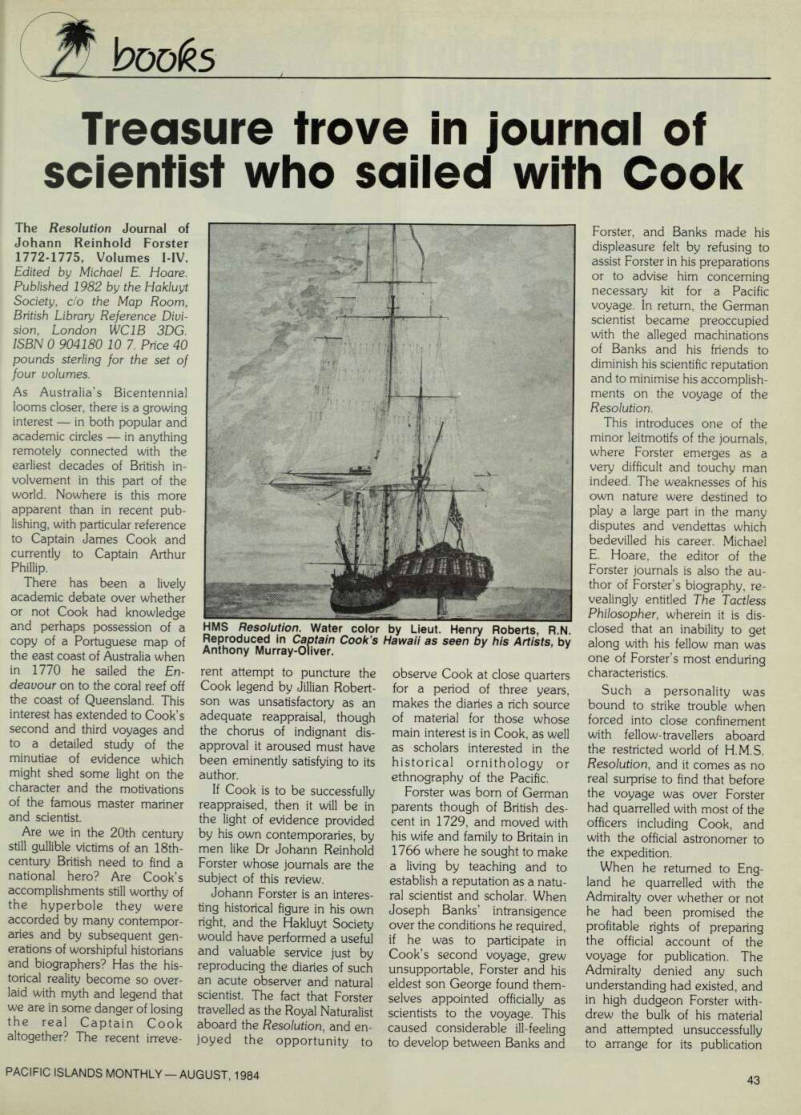
HMS Resolution. Water color by Lieut. Henry Roberts, R.N.
Reproduced In Captain Cook’s Hawaii as seen by his Artists, by Anthony Murray-Oliver.
himself. As a result, his reputa tion has always been over shadowed by that of his son George, who in 1777 at least produced a published account of the voyage.
This situation remained un changed until very recent times, because after Forster’s death in 1798 the great bulk of his books and manuscripts, includ ing the four volumes repro duced here, were sold to the Royal Library of the King of Prussia, later to become the Prussian State Library. There they remained undisturbed due to a combination of events involving Forster’s mediocre reputation amongst British scholars and a shoddy and inaccurate system of catalo guing.
Michael E. Hoare uncovered this treasure trove in resear ching for the biography of Johann Forster, and the Hak luyt Society has continued its services to scholarship by re producing the journals in a beautifully legible text and with an abundance of editorial com mentary in an introduction and footnotes provided by Michael Hoare.
The journals are absolutely fascinating coming as they do from a highly intelligent and cultivated scientist who had no experience of life at sea, and who responded to the chal lenge of this new environment by writing a detailed journal wherein he recorded not only his scientific discoveries and musings, but also many of his immediate reactions to events and the day-to-day happenings aboard ship which impressed themselves upon him. Conse quently, the four volumes of journals are an odd mixture of shrewd observation and start ling naivety, of scientific work
punctuated by amusing or irritating interludes inseparable from life in the Royal Navy at this time. Through it all, the figure of Cook dominates the human landscape, and even when Forster quarrels with Cook as he did with nearly everybody else on the voyage, his immense respect for the leader of the expedition quickly re-emerges.
Michael Hoare’s footnotes are succinct and very useful, especially his comments on the historiography of this area, as are his notations when the contemporary record is diffe rent in fact or interpretation from the secondary sources, particularly Beaglehole’s biography of Cook. The some what laborious task of tracing the origins of Forster’s frequent Latin quotations indicates the thoroughness with which the editor has approached his task; and the absolute mastery he displays of historical and scien tific materials necessary to put these journals into context fill this reviewer with respectful admiration.
As a piece of history in its own right, as a most illuminat ing commentary upon Cook by one of his contemporaries, and as a necessary adjunct to an understanding of the way in which 18th-century men of sci ence approached the races as well as the flora and fauna of the Pacific region, the publication by the Hakluyt So ciety of the four volumes com prising The Resolution Journal of Johann Reinhold Forster, 1112-1115 is an event worthy of the gratitude and thanks of all of us interested in the Pacific region and the impact eight eenth and nineteenth century Europeans had upon it.
F. G. Clarke.
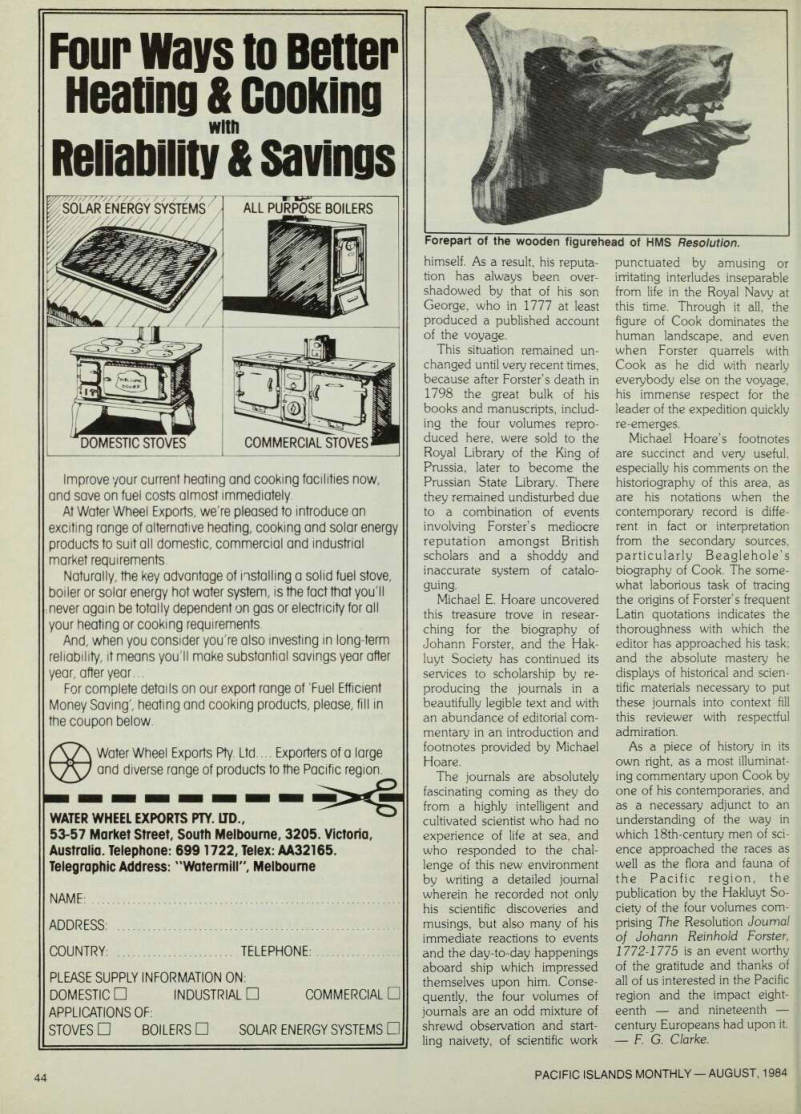
Forepart of the wooden figurehead of HMS Resolution.