Australia losing out badly in
pp. 21-22 · Read in the full issue
return-on-aid stakes
Part of the problem faced by Pacific Islands businessmen in getting commercial activity going between themselves and Australians involves the attitude of the Aussies. Some say they cannot see the opportunities for the imagined difficulties. Fiji’s Neville Smith, helped by Bill McCabe, the very active Syd ney-based Trade Commission er for the South Pacific, held a seminar last month to which were invited a parcel of NSW manufacturers and traders. All absorbed the proffered know ledge, and obviously were intri gued by the prospect of Fiji as a trading partner. But then one agent proposed it was not as easy as it might sound. “Every time I go up there I find myself in a queue behind half a dozen Kiwis,” he complained.
New Zealand’s export incen tive system has given that coun try’s manufacturers some advantages in the highly price competitive Pacific market. The presence in the Islands, and, indeed, throughout the Asia- Pacific region, of hard-grafting
New Zealand salesmen is as much a sign of their hunger for business as it is an effect of their tax-relief and price-subsidisa tion system.
This is very much the view of John Jackson, one of the peo ple involved in the rebuilding of Darwin after Cyclone Tracy, and the author of the Jackson Construction Report. He de scribes Australian construction companies as “basically order takers rather than marketers and salesmen.”
He points particularly to the fact, somewhat galling to Aus tralians whose tax money is paying for the job, that a New Zealand company, Fletchers, won the contract to build Papua New Guinea’s splendid new parliament house.
“Australians say they cannot compete, with New Zealand’s lower wage rates,” said Jack son. “That’s nonsense, because most of the labor is local and very cheap. We have a trans port differential in our favor for Papua New Guinea. The dis counted value of the New Zea
land dollar is negligible. ” In the end it came down to willingness and salesmanship, he said. business is available out there in the Pacific Basin,’ says Jackson. “There are hundreds of millions of dollars worth of it annually. Who gets it Australia, New Zealand, the U.S.A., Canada, Japan or the U.K. depends upon organisation, imagination, ability, service and not just luck. ”
Jackson is a leading exponent of the view that at least a healthy portion of Australia’s SBSO million in annual aid grants should go to Australian companies. Australia is doling out aid money, and getting very little of the work it pays for, but, in very many cases, he says, Australian companies are not even trying to get it.
Figures from the Asian Development Bank show how small is Australia’s share of civil engineering work in the Pacific Basin; Australia contributes $702.3 million to the A.D.8., or 6.2 per cent of the total annual
budget. But, of the contracts awarded through the bank, Australia won only $98.1 mil lion worth in 1982. Canada, contributor of $748 million, was worse-off with only $78.5 mil lion back in contracts. New Zea land, land of the hungry sales men, gave $155.6 million in aid, but won contracts worth $35.2 million, a return of 22.6 per cent of its aid. The United States was slightly better-off than Australia ’ with a return of 19 cents in the dollar on ADB contributions of $2071.2 mil on‘ But, all these were well below the Japanese returned-aid fl gure in 1982 of 58 per cent on massive contributions of S2BOO million. However, even this per centage figure paled into in significance beside the 84.3 per „ won by Britain ’ the con ‘ ™ utl " s most remote from ,he Paclflc “It is difficult,” says Jackson, “to comprehend the accept ance of a manifestly unecono mic return on funds by Austra-
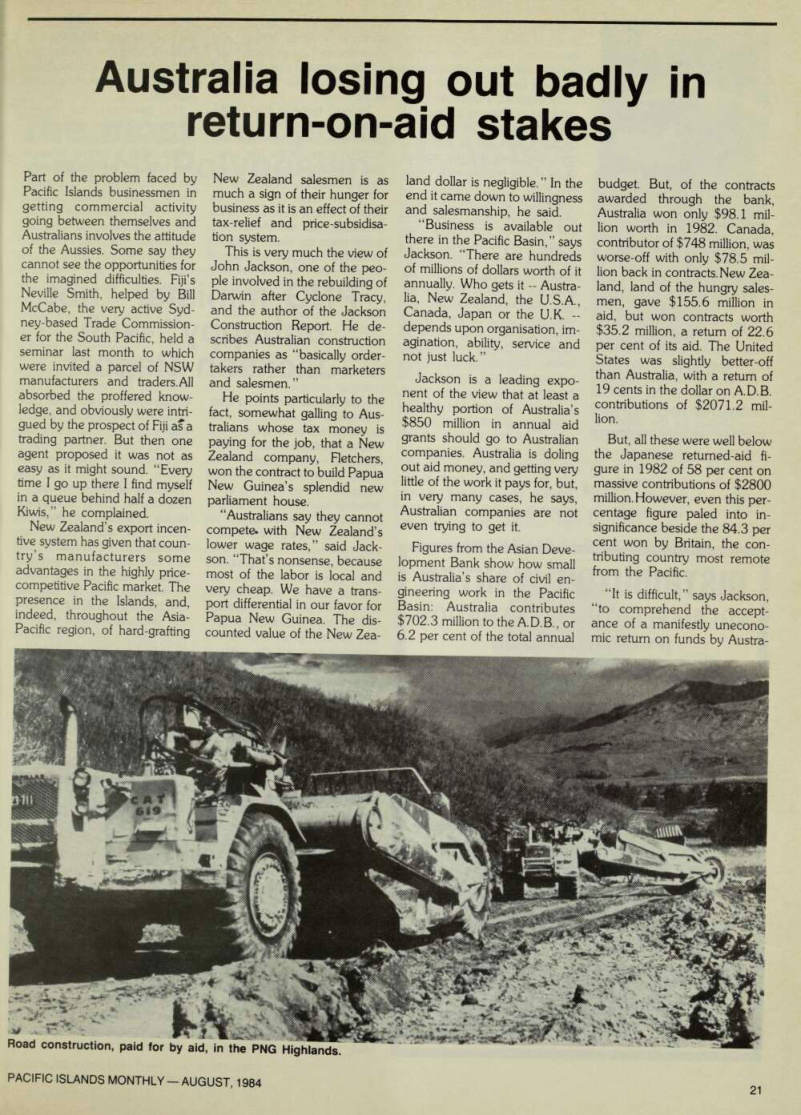
Road construction, paid for by aid, in the PNG Highlands.
lia, New Zealand, the U.S. and Canada. ’The Pacific Islands consti tute an open market for coun tries with the capacity to meet their construction requirements and the ability to export com petitively the building products and materials in the qualities needed. The Pacific region is open slather for the export of building materials because nothing of a sophisticated na ture is made in the South Pacific. It has to be imported. ”
Jackson believes the E.E.C., which is involved with Pacific aid, particularly in countries like
Vanuatu, Fiji, and the Solo mons, is placing attractive trade incentives before the Pacific Forum nations, and winning business because of them.
By contrast, Australian gov ernment policy was to give aid without strings. Winning the contracts was left to business men, and they did not appear to be doing terribly well, Jack son said.
Partly it was due to com placency, he said. “You meet with the most ridiculous com ments. Companies will tell you things like they tried in Malaysia and lost money, so they are getting out of the whole area.
Any company which thinks it can just go out and get a contract and make a lot of money is being commercially naive. You’ve got to have a presence in the market. You have to build your reputation.
“Australia has the best export incentives in the world,” he said. “The government refunds 70 per cent of the cost of tendering overseas, which cov ers the high-risk part of the venture. New Zealand’s system allows a double tax deduction on overseas profits, but the
capital has to be risked, and produce a profit before any incentive can be collected.
“Our export performance is sadly lacking... no fighting spirit at all.”
Jackson believes that in the construction industry this lack lustre attitude derives from the building boom of the 70s, when little or no effort was required to keep a business buoyant.
“Those days are over for good. We now have to look for business, and the Pacific is a good place to look.” Jackson produces a regular survey of
tenders available in the Pacific but has had trouble selling it in Australia. He has more clients in New Zealand and the West Coast of the U.S. than he has in Australia.
He estimates the Pacific Basin construction market, ex cluding New Zealand, at one billion, with a further three to four billion in New Zealand and about three billion in Hawaii.
These figures include housing and small projects which would not interest foreign contractors, but they give an idea of the size of the available market.
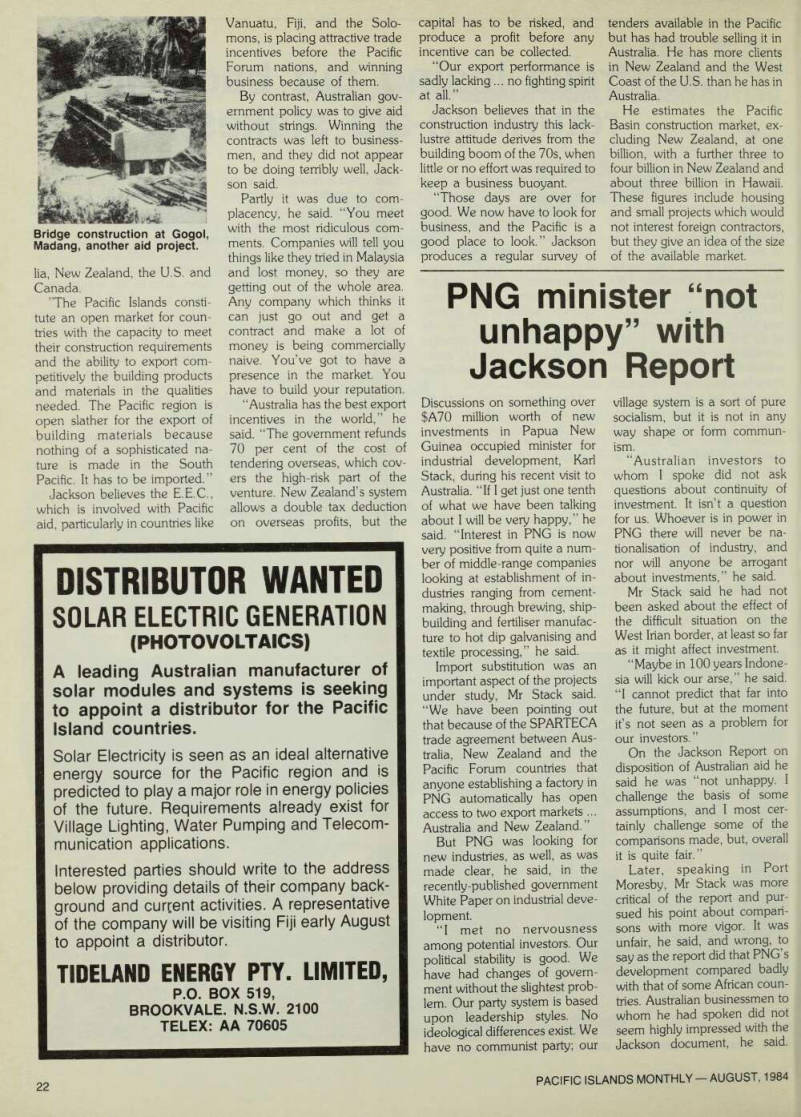
Bridge construction at Gogol, Madang, another aid project.