help” Minister
p. 17 · Read in the full issue
Regional defence
“N.Z. seeks only to help” Minister
New Zealand’s minister of de fence, David Thomson, has re jected suggestions that, by for ming a ready reaction force, his country seeks to impose its presence on partner govern ments.
In a letter to Pacific Islands Monthly, he replies to Mr Noel Levi, MR for New Ireland, Papua New Guinea, who, in a letter published in PlM’s June, 1984, issue, suggested the New Zealand force smacked of gun boat diplomacy and colonial ism.
“I am disappointed that Mr Levi should harbor such mis conceptions about New Zea land policy and I should like to set the record straight,” Mr Thomson wrote.
“The New Zealand armed forces have, over the years, worked closely with the govern ments of our South Pacific partners in providing a wide range of assistance. These acti vities have included maritime zone surveillance, search and rescue, the construction of port facilities, the provision of fresh water supplies, public health and the wide range of help needed for disaster relief. Only a few months ago an RNZAF C-130 Hercules aircraft was operating (not far from Mr Levi’s own electorate) in sup port of the Papua New Guinea government’s efforts to prepare against the prospect of a major volcanic eruption in Rabaul.
There is not, and has never been, the slightest wish on our part to impose our presence on partner governments. Quite the reverse; such tasks as these are undertaken only at the express request of the governments concerned and in close con sultation with them. “So it would be with any combat role, should the need ever arise.
“Mr Levi seems to suggest that a Ready Reaction Force is something new. In fact the concept was first proposed in our 1978 Defence Review. The force now discussed more fully in the 1983 White Paper is no more than a core element around which the Army as a whole can be structured. Estab lishment of an operationally ready component in this case a battalion group is a
matter of Army organisation, NOT a mark of any intention to launch it against our friends and partners.
“The ability to make a quick response in any emergency is essential to any armed force. It does not imply a commitment to going on the offensive. I am sorry to say that Mr Levi makes a common mistake in confusing a force organised to deter aggression with aggression it self. A careful reading of the 1983 New Zealand Defence Review will show that a princi pal purpose in the establish ment and operation of our defence forces is the wish to head-off any threat to New land or its national interests by maintaining a demonstrable capacity to hit back. The emph asis is defensive, constructive and intended to benefit the whole region of the South Pacific.
“With a clearly defined operationally ready element in the army, and likewise in the other two services, New Zea land defence policies are shar pened and made more credi ble. Equipment and training priorities can thus be establish ed and implemented. Such a basis for development of the forces is integral to modem
defence planning. It is the way we try to tailor the allocations of scarce defence resources against an uncertain future. All armed forces must make such provisions. Operationally ready forces are not designed to be interventionist. They are simply designed to be ready, suitably equipped and trained, for any service the government may designate for them at home or abroad, in the Pacific or in support of international peace keeping in any part of the world.
“Mr Levi also appears to overlook the statutory re sponsibility we have for the defence of a number of island countries in the South Pacific namely the Cook Islands, Niue and Tokelau. Of course no action would, or could, be taken without their full coopera tion and at their request whether in disaster relief or response to armed aggression.
But we need to have a real capacity to assist our South Pacific neighbors if ever asked to do so and to be appropriately equipped, organised and trained for the purpose.
“In the same way the then Papua New Guinea govern ment of which Mr Levi was foreign minister, responded in
1980 to Vanuatu’s request for assistance in dealing with a secessionist rebellion on the island of Espiritu Santo. It was an admirable operation and certainly not aggressive or in terventionist. I must say that I cannot see any difference be tween that response by PNG and New Zealand taking steps to ensure that if called upon it too could react, promptly and efficiently. I might add that only a few weeks ago the PNG prime minister, Mr Somare, in response to a question from a PNG Opposition MP, stated that he had no doubt that in the event of serious threats to his country’s national security, Australia and New Zealand would come to PNG’s aid.
“I do not know whether our neighborhood will ever move towards the concept of a regio nal peacekeeping force put for ward by PNG while Mr Levi was foreign minister. In the meantime it appears appropri ate for all partner governments to be developing to the best of their ability their own capacity to contribute if needs be. The reconstruction of the opera tionally ready core of the army that was announced in the government’s Defence Review, published late last year, is one way in which the New Zealand government can make such a contribution to regional secur ity, should such support be requested. It is not, nor will it be, the basis of any wider ranging proposals to be placed before the South Pacific Forum.
“Since the publication of the Defence Review, my defence officials have visited a number of South Pacific nations ex plaining the thinking behind the Review and New Zealand’s wish to continue to play a constructive role in our region.
These officials were well re ceived by government ministers wherever they went. I am happy to say that the response showed that these governments including Papua New Guinea do not share Mr Levi’s misunderstandings of the role of the force.”
David Thomson, Minister of Defence, Parliament House, Wellington.
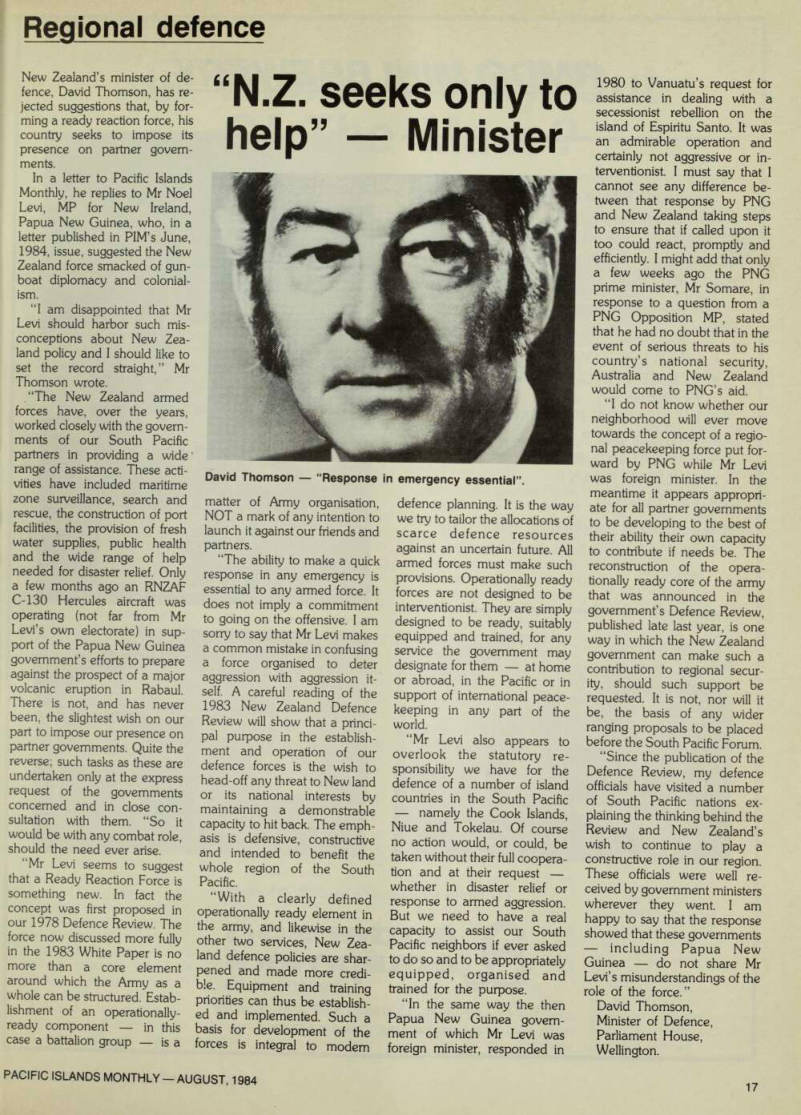
David Thomson - “Response In emergency essential”.