Main recommendations
p. 15 · Read in the full issue
for Pacific
The Jackson report has no status beyond that of a survey of the scene, and an expression of view to the Australian Gov ernment. And yet, because of the apparent need for change, and also because the people who sat on the committee were pretty much hand-picked by the Foreign Minister, Mr Hayden, their recommenda tions will carry great weight in Canberra.
Dealing with the small Pacific nations, for example, they say that Australia must adapt its assistance to the special circumstances of the island na tions, while being ’’sensitive to indigenous cultures.
“In particular Australia must identify the limits on deve lopment and learn from past mistakes. Some responses should go beyond traditional ideas of aid.”
Thus they made a series of proposals about the direction Australian aid could take in the future: • A special immigration quota should be established to help deal with the unique prob lems of Tuvalu and Kiribati.
“The numbers involved would be small as the total population of the two islands is only about
66,000 people. A special im migration scheme should be introduced gradually as part of a long-term strategy, based on training arrangements under the aid program.” • SPARTECA (the trade-aid system by which Pacific coun tries have duty-free access to Australia and New Zealand), should encourage island gov ernments and firms to foster promising export sectors, but should avoid encouraging the development of industries en tirely dependent upon duty-free access. Aid should encourage private sector development, particularly through joint ven
tures and development banks. • Existing aid levels should be maintained, but should re flect need, in terms of deve lopment potential and living standards, a decline in finance dependence, and quality of performance among recipients. • Aid levels should be suffi ciently firm to encourage long term planning. Ability of reci pients to usefully absorb a volume of aid should be realis tically monitored. • Country and regional prog ramming “are desirable to help with identification of priority sectors and to select forms of aid.” • Australia should respond readily to requests for technical assistance by way of experi enced personnel. • Training was essential, but
should not be based on large specialist bureaucracies and sophisticated services, but should be aimed at providing essential trade, technical and professional skills. • Training should be guided by the following considerations: curriculum development on a regional basis; more diversified and practice-oriented tertiary training using the facilities of the University of the South Pacific; courses in Australia and in the region to upgrade basic skills; urgent upgrading of trade train ing; courses to develop re gionally relevant technical skills, for example a tourism school; on the job training in Australia through exchanges of person nel; regional training to prepare islanders from the micro-states to work in more prosperous communities. • Head of Mission discretion ary aid should be increased, particularly as it was applied to remote villages and areas where larger scale projects had little impact. • Voluntary aid agencies should be supported and en couraged. • “Some projects in the South Pacific are large enough to justify co-financing with the Asian Development Bank. The funding of regional deve lopment banks is an example,” the report says.
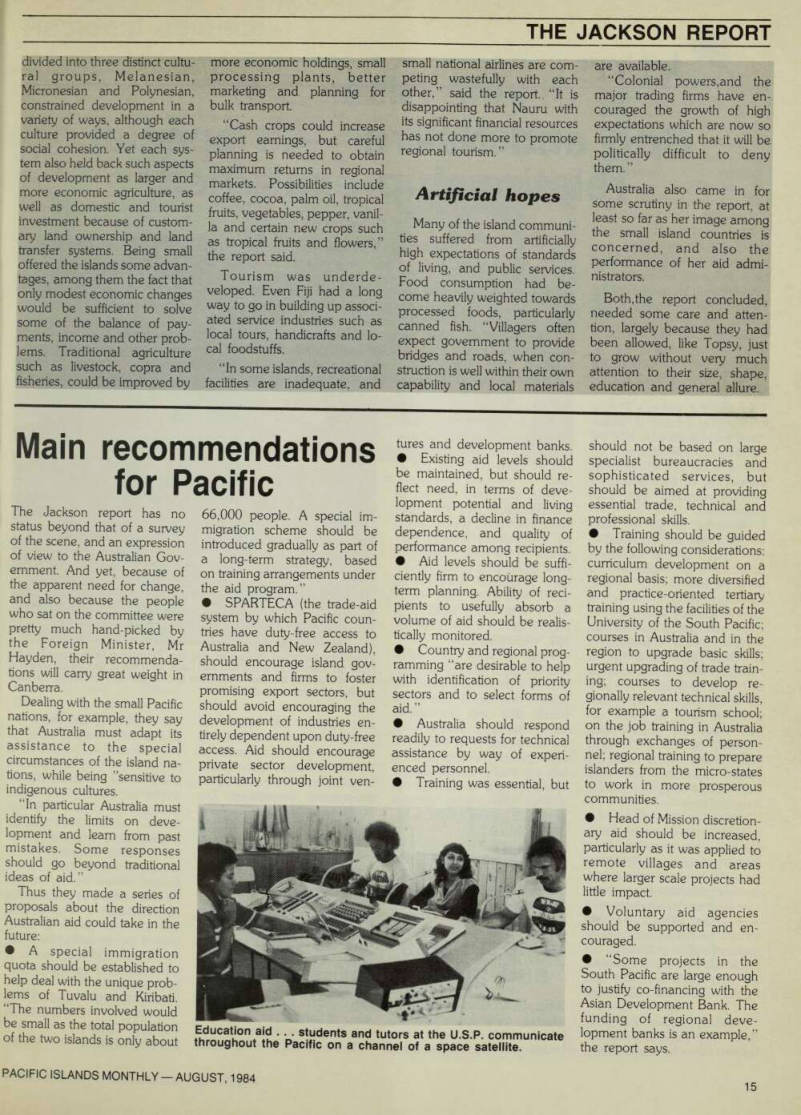
Education aid . . . students and tutors at the U.S.P. communicate throughout the Pacific on a channel of a space satellite.