Santa Cruz
pp. 28-29 · Read in the full issue
Feather money of Santa Cruz
During a recent cruise on our old favorite vessel, Lindblad Explorer, we were lucky enough to make a landfall in the remote and rarely visited Reef Islands in the Solomons’
Santa Cruz group. They have not figured much in the news since 1877, when the people of Nukapu killed Bishop John Coleridge Patteson in retalia tion for brutal kidnappings perpetrated a few years earlier by a notorious blackbirder.
Even the few Australian, American and European anthropologists, who since World War II have undertaken field work in the Santa Cruz Islands, have paid scant atten tion to the minuscule atolls scattered over the Great Reef.
In fact, it was not until the 1960 s that Professor William Davenport of the Philadelphia University Museum, and Gerd Koch, curator of the South Sea section of the Berlin Museum fur Volkerjunde, studied in depth the most famous feature of the Santa Cruz culture area: the inter-island trade based on the use of feather money, which is fully comparable in interest and ingenuity to the much better known kula ring in the Massim region.
By then, however, Australian bank notes were replacing the highly original and ornamental native currency, as we had occasion to see for ourselves during visits to Ndeni, Utupua and Vanicolo, where the only surviving specimens turned out to be tattered coils with dirty, smoke-black feathers.
It was therefore without great expectations that we set out in a zodiac from the Lindblad Ex plorer for the shallow shores of Lomlom islet, inhabited by a few hundred Papuan-speaking Melanesians. Their immediate neighbors to the north, how ever, are Polynesians, who have preserved their distinct language and culture. The Polynesians word akauloa is for instance generally used to de signate the Great Reef.
But while we were still threading our way through a maze of reef channels and coral
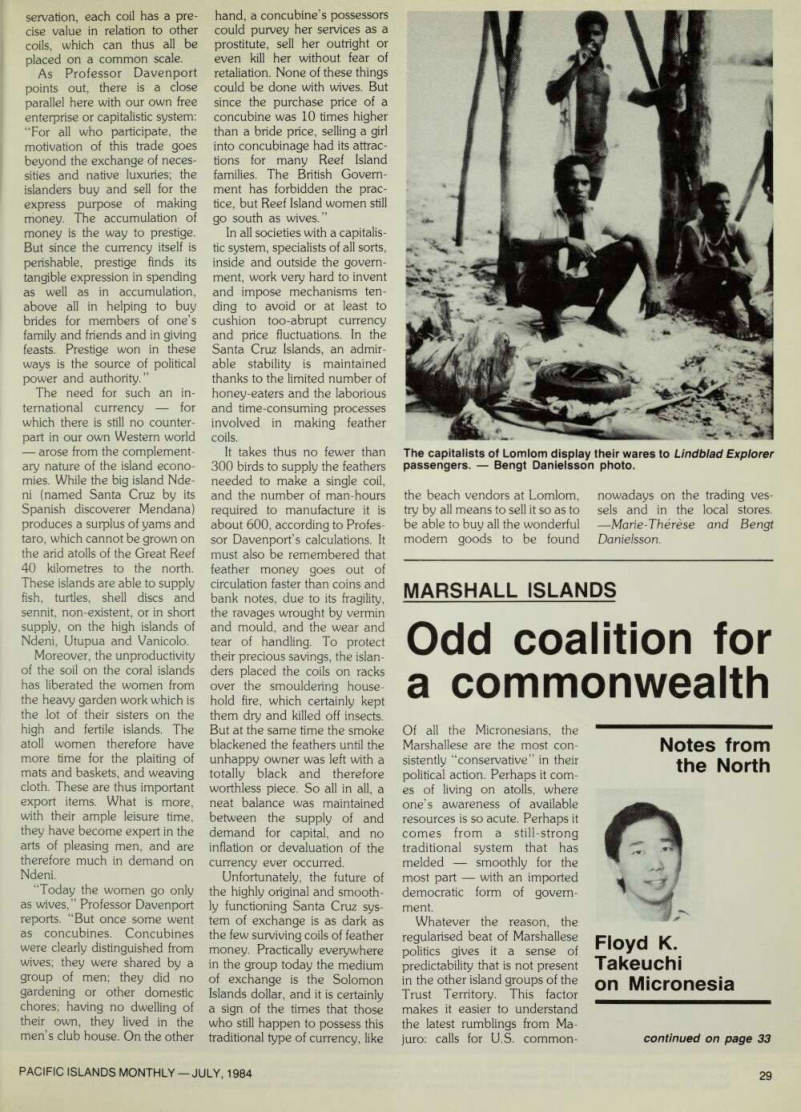
stones, about a dozen men appeared on the beach, each carrying in his arms a round bundle the size of a scooter wheel, wrapped in brown pan danus leaves. When we stum bled up the beach, after having waded the last stretch, the men had already unwrapped the contents of their bundles feather coils in excellent condi tion, which they declared them selves ready to dispose of at prices varying from 100 to 500 Solomon Islands dollars. By then more eager vendors were arriving by canoe.
The biggest craft was a sea going puke , bought a genera tion ago by the akauloa men at the even more distant Duff or Taumako islands for the traditional price of 10 coils of feather money.
Unlike the kula ring, centred on the purely ceremonial ex change of shell necklaces and armrings, the Santa Cruz trade is carried out with a medium of exchange which constitutes a true currency. The basic unit, called mangahau, is a coil or belt of plaited fibres, nine metres long and five cen timetres wide, covered with glued-on red feathers of a local species of honeyeater, Myzomela cardinalis. Depen ding on the brilliance of the feathers and its state of pre
Postmark Papeete
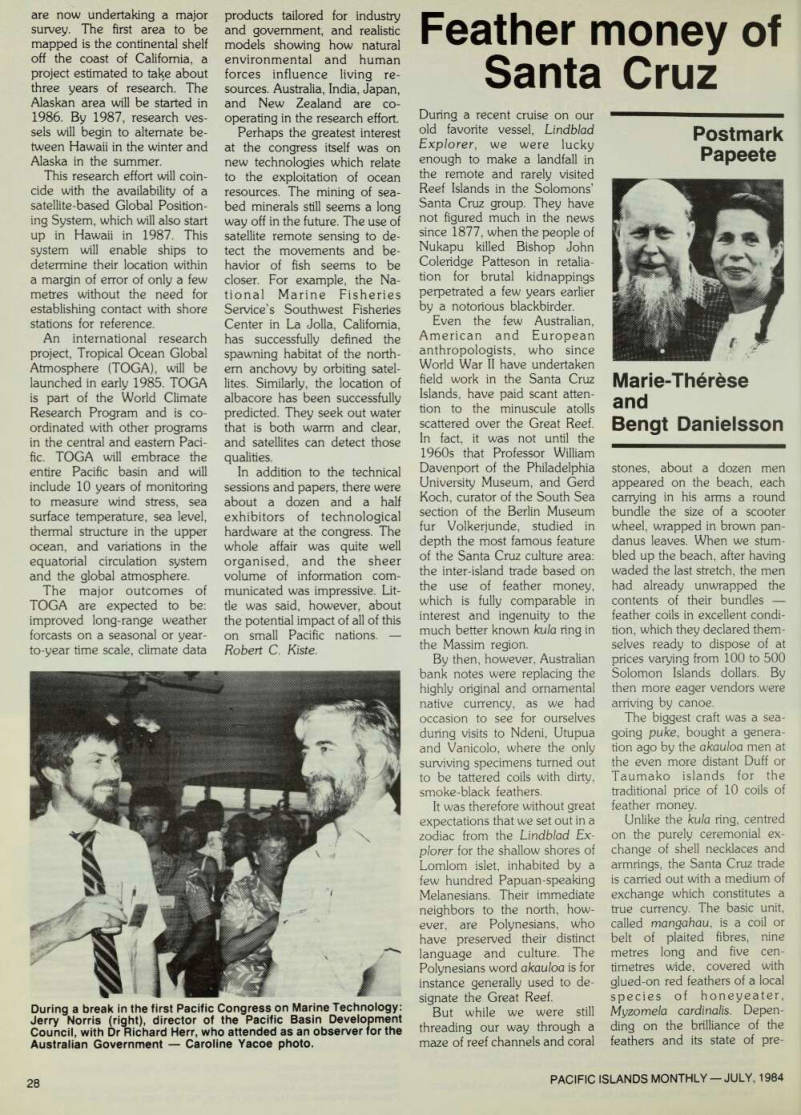
Marie-Therese and Bengt Danielsson
servation, each coil has a pre cise value in relation to other coils, which can thus all be placed on a common scale.
As Professor Davenport points out, there is a close parallel here with our own free enterprise or capitalistic system: “For all who participate, the motivation of this trade goes beyond the exchange of neces sities and native luxuries; the islanders buy and sell for the express purpose of making money. The accumulation of money is the way to prestige.
But since the currency itself is perishable, prestige finds its tangible expression in spending as well as in accumulation, above all in helping to buy brides for members of one’s family and friends and in giving feasts. Prestige won in these ways is the source of political power and authority.”
The need for such an in ternational currency for which there is still no counter part in our own Western world arose from the complement ary nature of the island econo mies. While the big island Nde ni (named Santa Cruz by its Spanish discoverer Mendana) produces a surplus of yams and taro, which cannot be grown on the arid atolls of the Great Reef 40 kilometres to the north.
These islands are able to supply fish, turtles, shell discs and sennit, non-existent, or in short supply, on the high islands of Ndeni, Utupua and Vanicolo.
Moreover, the unproductivity of the soil on the coral islands has liberated the women from the heavy garden work which is the lot of their sisters on the high and fertile islands. The atoll women therefore have more time for the plaiting of mats and baskets, and weaving cloth. These are thus important export items. What is more, with their ample leisure time, they have become expert in the arts of pleasing men, and are therefore much in demand on Ndeni.
“Today the women go only as wives,” Professor Davenport reports. “But once some went as concubines. Concubines were clearly distinguished from wives; they were shared by a group of men; they did no gardening or other domestic chores; having no dwelling of their own, they lived in the men’s club house. On the other
hand, a concubine’s possessors could purvey her services as a prostitute, sell her outright or even kill her without fear of retaliation. None of these things could be done with wives. But since the purchase price of a concubine was 10 times higher than a bride price, selling a girl into concubinage had its attrac tions for many Reef Island families. The British Govern ment has forbidden the prac tice, but Reef Island women still go south as wives.”
In all societies with a capitalis tic system, specialists of all sorts, inside and outside the govern ment, work very hard to invent and impose mechanisms ten ding to avoid or at least to cushion too-abrupt currency and price fluctuations. In the Santa Cruz Islands, an admir able stability is maintained thanks to the limited number of honey-eaters and the laborious and time-consuming processes involved in making feather coils.
It takes thus no fewer than 300 birds to supply the feathers needed to make a single coil, and the number of man-hours required to manufacture it is about 600, according to Profes sor Davenport’s calculations. It must also be remembered that feather money goes out of circulation faster than coins and bank notes, due to its fragility, the ravages wrought by vermin and mould, and the wear and tear of handling. To protect their precious savings, the islan ders placed the coils on racks over the smouldering house hold fire, which certainly kept them dry and killed off insects.
But at the same time the smoke blackened the feathers until the unhappy owner was left with a totally black and therefore worthless piece. So all in all, a neat balance was maintained between the supply of and demand for capital, and no inflation or devaluation of the currency ever occurred.
Unfortunately, the future of the highly original and smooth ly functioning Santa Cruz sys tem of exchange is as dark as the few surviving coils of feather money. Practically everywhere in the group today the medium of exchange is the Solomon Islands dollar, and it is certainly a sign of the times that those who still happen to possess this traditional type of currency, like
the beach vendors at Lomlom, try by all means to sell it so as to be able to buy all the wonderful modern goods to be found
nowadays on the trading ves sels and in the local stores, — Marie-Therese and Bengt Danielsson.
The capitalists of Lomlom display their wares to Lindblad Explorer passengers. Bengt Danielsson photo.