Studying the
pp. 26-28 · Read in the full issue
the month
Marine Technology
state of the art
The first Pacific congress on Maripe Technology was held in Honolulu over four days in late April. The event was sponsored by the local chapter of the Marine Technological Society, a national professional associa tion devoted to the marine sciences. The two co-chairmen responsible for arranging all details were Dr Narendra Sax ena, Department of Civil En gineering, University of Hawaii, and Jack Harmon, the head of SEACO, Inc., an ocean en gineering company.
The congress greatly ex ceeded the organisers’ expecta tions. A total of 19 technical sessions were held, and the number of papers delivered was 95. About 120 participants were expected, but in the end
211 scientists, government rep resentatives, and observers from Australia, Canada, India, Indonesia, Japan, the People’s Republic of China, Singapore, the Soviet Union, Taiwan, and the United States attended. The congress will be held every other year, and the 1986 event is already being planned for Honolulu. Japan and Taiwan are interested as potential hosts for 1988.
The purpose of the congress was to provide an international forum for scientists, policy-mak ers, administrators, and others concerned with marine technol ogy to discuss ocean resource development and manage ment. Sessions focused on ocean science and engineering, ocean energy, ocean mining,
offshore resource management, remote sensing, fisheries, tsuna mi detection, marine trans portation, navigation and positioning, trade, technology transfer, and marine education.
The opening keynote speaker was Dr John V. Byme, administrator of the U.S. De partment of Commerce’s Na tional Oceanic and Atmosphere Administration (NOAA). That agency was created in 1970 to improve understanding, man agement, and conservation of marine and atmospheric re sources.
NOAA is the regulatory agen cy which establishes federal policies governing the use of the U.S.’s oceanic, coastal, and atmospheric resources. Byme reported upon several deve lopments in NOAA relating to the Pacific.
Reflecting a concern to pre serve the productivity and the health of the ocean, President Reagan announced in March that the “Year of the Ocean” will be celebrated beginning on July 1, 1984. The year is designed to expand public understanding of the ocean’s
importance, to promote a sense of stewardship among ocean organisations and industries, and to foster a public-private partnership for the wise man agement of ocean resources.
In March 1983, President Reagan established the 200 nautical mile exclusive econo mic zone off U.S. shores. In order to prepare for the future exploitation of the zone, NOAA and the U.S. Geological Survey
A View from Honolulu
Robert C. Kiste looks at the Pacific
are now undertaking a major survey. The first area to be mapped is the continental shelf off the coast of California, a project estimated to take about three years of research. The Alaskan area will be started in 1986. By 1987, research ves sels will begin to alternate be tween Hawaii in the winter and Alaska in the summer.
This research effort will coin cide with the availability of a satellite-based Global Position ing System, which will also start up in Hawaii in 1987. This system will enable ships to determine their location within a margin of error of only a few metres without the need for establishing contact with shore stations for reference.
An international research project, Tropical Ocean Global Atmosphere (TOGA), will be launched in early 1985. TOGA is part of the World Climate Research Program and is co ordinated with other programs in the central and eastern Paci fic. TOGA will embrace the entire Pacific basin and will include 10 years of monitoring to measure wind stress, sea surface temperature, sea level, thermal structure in the upper ocean, and variations in the equatorial circulation system and the global atmosphere.
The major outcomes of TOGA are expected to be: improved long-range weather forcasts on a seasonal or year to-year time scale, climate data
products tailored for industry and government, and realistic models showing how natural environmental and human forces influence living re sources. Australia, India, Japan, and New Zealand are co operating in the research effort.
Perhaps the greatest interest at the congress itself was on new technologies which relate to the exploitation of ocean resources. The mining of sea bed minerals still seems a long way off in the future. The use of satellite remote sensing to de tect the movements and be havior of fish seems to be closer. For example, the Na tional Marine Fisheries Service’s Southwest Fisheries Center in La Jolla, California, has successfully defined the spawning habitat of the north ern anchovy by orbiting satel lites. Similarly, the location of albacore has been successfully predicted. They seek out water that is both warm and clear, and satellites can detect those qualities.
In addition to the technical sessions and papers, there were about a dozen and a half exhibitors of technological hardware at the congress. The whole affair was quite well organised, and the sheer volume of information com municated was impressive. Lit tle was said, however, about the potential impact of all of this on small Pacific nations. —
Robert C. Kiste.
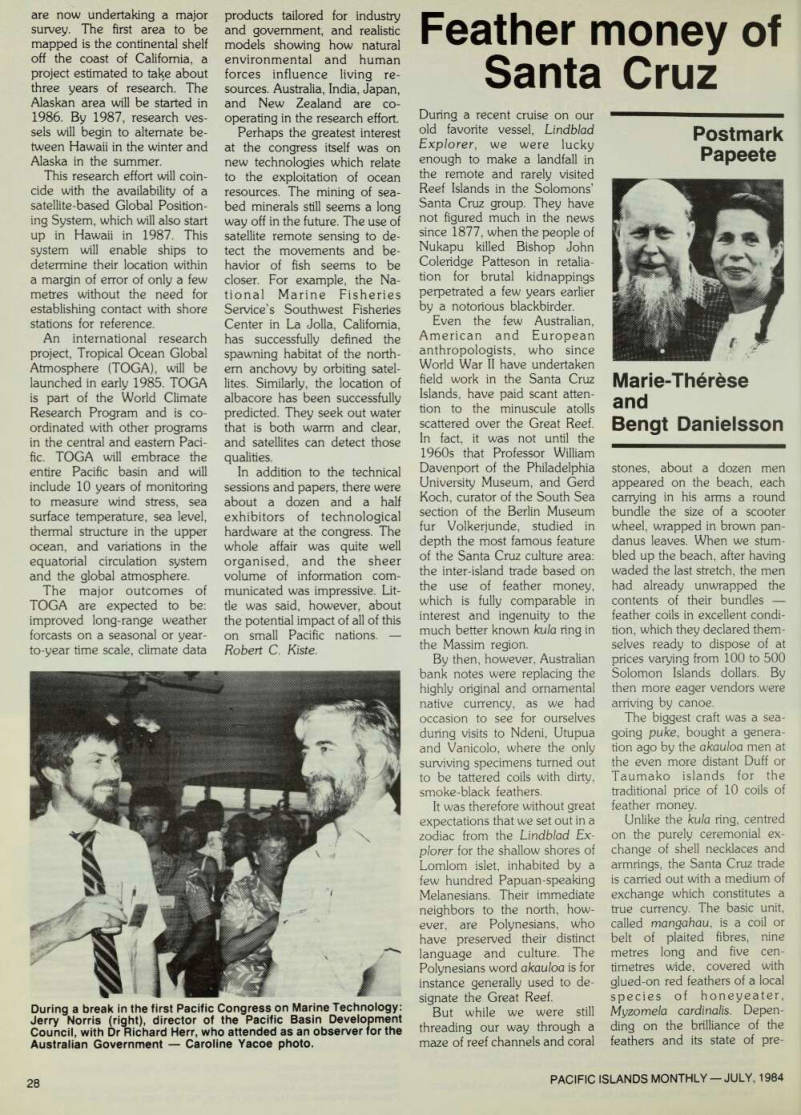
During a break in the first Pacific Congress on Marine Technology: Jerry Norris (right), director of the Pacific Basin Development Council, with Dr Richard Herr, who attended as an observer for the Australian Government Caroline Yacoe photo.