Will Sid really run?
pp. 22-23 · Read in the full issue
Kova returns in Fiji
Siddiq Koya, the ’’big bear” of Fiji Indian politics has resumed his place as leader of the National Federation Party, the major ethnic Indian group, and must now restore its unity in the wake of the resignation of former leader Jai Ram Reddy. He must also decide whether the NFP is to remain primarily an Indian party, or is to bid for grassroots Fijian support. KARAM RAMRAKHA, himself once secretary of the NFP and a”major political figure in Fiji, here examines the problems Mr Koya now faces.
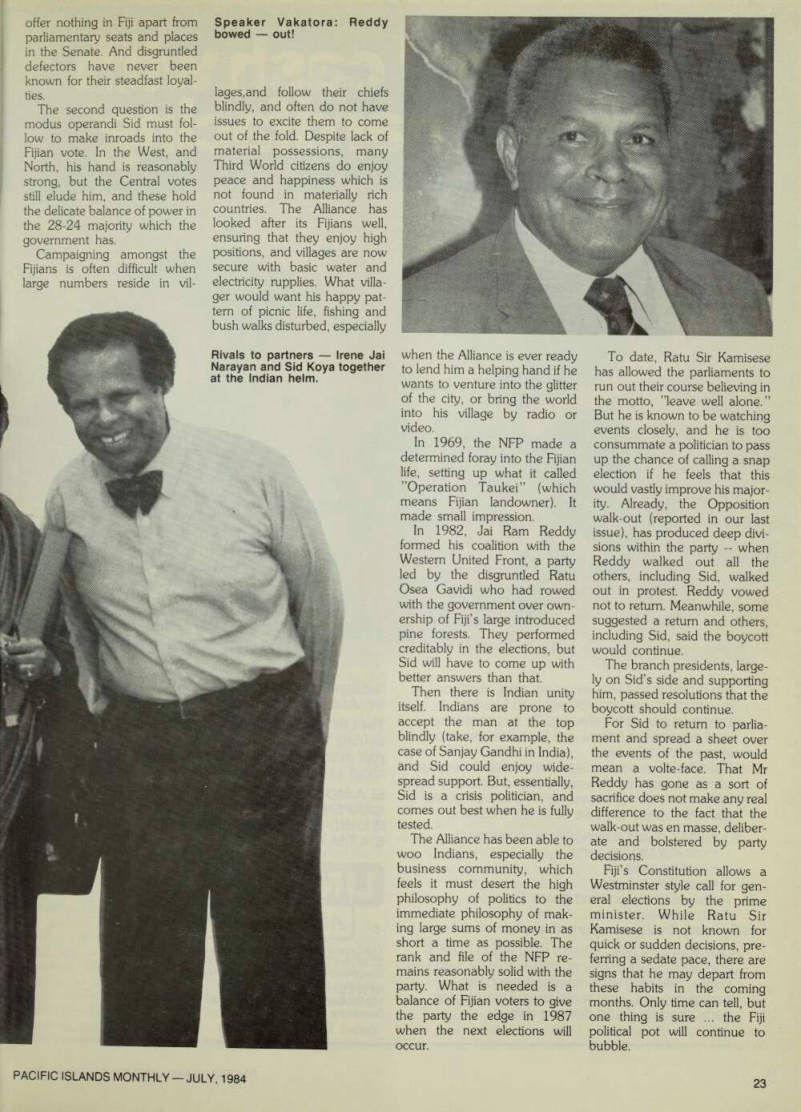
On May 20, 1984, Siddiq Koya returned on the rebound to become Leader of the Opposi tion in Fiji’s parliament, and head of the National Federation Party. Mr Jai Ram Reddy had stuck to his ’’irrevocable” deci sion not to ’’stand up, or bow to” the Speaker, Mr Tomasi Vakatora, and his resignations from both parliament and leadership of the party mean he has gone into voluntary political exile.
What does this augur for Fiji where race plays a vital part in politics and the electorates vote on racial lines? In a sense, the leader of the predominantly Indian National Federation Party is looked on by Indians on both sides of the fence as their communal leader. Sid Koya, as a sort of second choice, must live with the realisation that he may not really enjoy that position, as memories of the 1977 General Election, Phase 2, which badly split the party, do not easily fade. Besides, Sid’s followers had waged a particularly viru lent campaign, especially against Mrs Irene Jai Narayan, the NFP’s deputy leader of some years, who unsuccessfully tried to succeed Mr Reddy.
The founding fathers of Fiji’s Constitution (of which the wri ter was one), tried to create a bridge between the Indians and other races by insisting that the Leader of the Opposition should be consulted on certain vital appointments, for exam ple, that of Chief Justice. But relationships between Ratu Sir Kamisese Mara, the prime minister, who enjoys an un broken, and unchallenged, re cord of leadership in Fiji since 1964, and successive leaders of the Opposition, have waxed and waned, with periods when he was not on speaking terms with the late A. D. Patel, Sid himself, and Reddy.
Consultation, therefore,
wjich is really meant to be dialogue, and a striving for consensus, with disagreement as a remote last choice, has often deteriorated into an ex change of letters.
The position was compound ed when, just after the last elections, Ratu Sir Kamisese alleged that the Russians had funded the Opposition’s elec tion campaign. A long, drawn out, inquiry by a Royal Com mission, returned a verdict of ’’not proven.”
The first question that comes to mind is whether Sid will be able to establish dialogue with the Prime Minister. After all, in 1969-70, both men worked in tandem and produced a negoti ated freedom for Fiji and a peaceful transition into an inde pendent country. Ratu Mara, when attacking Jai Ram Reddy, made it clear that he preferred the leadership of Sid Koya.
Whether this was off-the-cuff political parrying, or a genuine expression of opinion, will now be put to the test. Sid Koya, I know, would like to see a return to the good old days. But Ratu Mara is likely to remain on guard.
For one thing, there is the current refusal of a section of canegrowers to cut their cane until various assurances are given to them by the Fiji Sugar Corporation. The Prime Minis ter has called for harvesting to begin in recognition of the
national interest in the vital crop. Sid Koya has remained president of the Federation of Canegrowers, Fiji’s powerful farmers’ union. Unless some quick rapport is reached be tween the two leaders, relation ships will remain uneasy, 'if not hostile.
Sid Koya has declared that he wants to make the NFP strong, and a viable alternative to the government. This means that he sees himself as an alternative prime minister. In Third World countries, failure of the Opposition to win elections, often as a result of entrenched loyalties, or outright vote-rig ging, has led to the collapse of democracy. Worse still, election results unfavorable to the ruling junta are quashed by military takeovers or coups. Fiji is not likely to suffer such a fate. But there are fears in the Indian community that an Indian prime minister would not be acceptable to the Fijians. In deed, it was this which led the National Federation Party to offer a coalition government to Ratu Mara after his defeat in the April, 1977, elections.
The Opposition, while it has a significant following amongst a section of Fijians, has failed to throw up a leader who would be as acceptable to the Fjians as Ratu Mara or, indeed, the re cently-appointed deputy prime minister, Ratu David Toganiva lu.
So Sid’s first priority will be to woo the Fijian vote while trying to keep his own Indian follow ing intact. Lately, many follow ers have become disillusioned with the divisions in the NFP, and some have openly crossed to the Alliance, especially where it has led to material gains. An opposition in the wilderness can
offer nothing in Fiji apart from parliamentary seats and places in the Senate. And disgruntled defectors have never been known for their steadfast loyal ties.
The second question is the modus operandi Sid must fol low to make inroads into the Fijian vote. In the West, and North, his hand is reasonably strong, but the Central votes still elude him, and these hold the delicate balance of power in the 28-24 majority which the government has.
Campaigning amongst the Fijians is often difficult when large numbers reside in vil
lages,and follow their chiefs blindly, and often do not have issues to excite them to come out of the fold. Despite lack of material possessions, many Third World citizens do enjoy peace and happiness which is not found in materially rich countries. The Alliance has looked after its Fijians well, ensuring that they enjoy high positions, and villages are now secure with basic water and electricity rupplies. What villa ger would want his happy pat tern of picnic life, fishing and bush walks disturbed, especially
when the Alliance is ever ready to lend him a helping hand if he wants to venture into the glitter of the city, or bring the world into his village by radio or video.
In 1969, the NFP made a determined foray into the Fijian life, setting up what it called ’’Operation Taukei” (which means Fijian landowner). It made small impression.
In 1982, Jai Ram Reddy formed his coalition with the Western United Front, a party led by the disgruntled Ratu Osea Gavidi who had rowed with the government over own ership of Fiji’s large introduced pine forests. They performed creditably in the elections, but Sid will have to come up with better answers than that.
Then there is Indian unity itself. Indians are prone to accept the man at the top blindly (take, for example, the case of Sanjay Gandhi in India), and Sid could enjoy wide spread support. But, essentially, Sid is a crisis politician, and comes out best when he is fully tested.
The Alliance has been able to woo Indians, especially the business community, which feels it must desert the high philosophy of politics to the immediate philosophy of mak ing large sums of money in as short a time as possible. The rank and file of the NFP re mains reasonably solid with the party. What is needed is a balance of Fijian voters to give the party the edge in 1987 when the next elections will occur.
To date, Ratu Sir Kamisese has allowed the parliaments to run out their course believing in the motto, ’’leave well alone.”
But he is known to be watching events closely, and he is too consummate a politician to pass up the chance of calling a snap election if he feels that this would vastly improve his major ity. Already, the Opposition walk-out (reported in our last issue), has produced deep divi sions within the party when Reddy walked out all the others, including Sid, walked out in protest. Reddy vowed not to return. Meanwhile, some suggested a return and others, including Sid, said the boycott would continue.
The branch presidents, large ly on Sid’s side and supporting him, passed resolutions that the boycott should continue.
For Sid to return to parlia ment and spread a sheet over the events of the past, would mean a volte-face. That Mr Reddy has gone as a sort of sacrifice does not make any real difference to the fact that the walk-out was en masse, deliber ate and bolstered by party decisions.
Fiji’s Constitution allows a Westminster style call for gen eral elections by the prime minister. While Ratu Sir Kamisese is not known for quick or sudden decisions, pre ferring a sedate pace, there are signs that he may depart from these habits in the coming months. Only time can tell, but one thing is sure ... the Fiji political pot will continue to bubble.
Speaker Vakatora: Reddy bowed out!
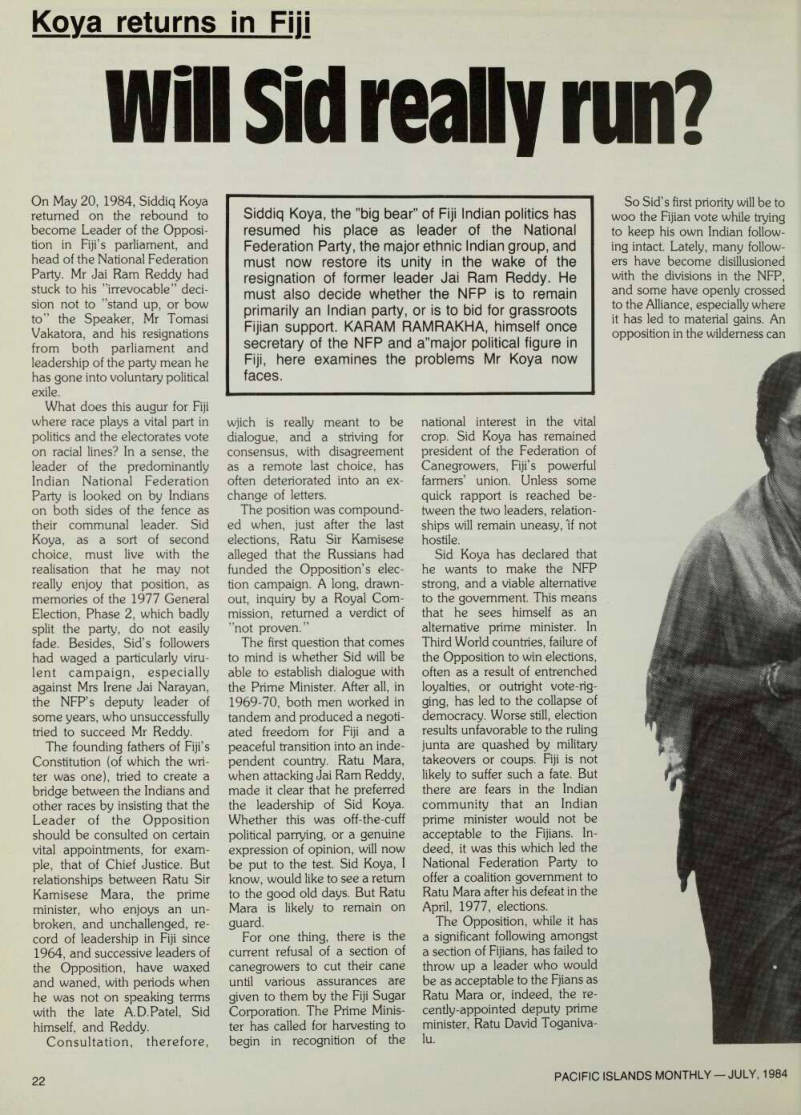
Rivals to partners Irene Jai Narayan and Sid Koya together at the Indian helm.