Behind the killing
pp. 19-21 · Read in the full issue

of Arnold Ap
Arnold Ap, an Irianese intellec tual and academic, was mur dered in prison last April by an Indonesian goon squad. As a killing it was not untypical of Indonesian dealings in Irian Jaya, and has been condemned as such. But as a political decision, which it appears to have been, it was an act of stupidity. For Ap has become a martyr, identifiable not only inside Irian Jaya, but outside, in Australia, Holland, and the Un ited States. The Indonesian hierarchy has killed off a troublesome figure, but in so doing has lost many of its former supporters and apolog ists. Jakarta’s position in the present Irianese crisis is thereby now a deal more fragile and less popular.
Nobody knows how many Irianese have died over the last 20 years in prison, or in jungle skirmishes, as a result of In donesian reaction to the activi ties of the Operasi Papua Mer deka (Free Papua Movement).
The total may run into thousands, giving credence to angry claims that the Indone sian ’’colonial masters” of Irian Jaya aim at genocide and the destruction of Melanesian cul ture. But of all the killings none has stirred quite the reaction that greeted the death of Arnold Ap, a gentle, likeable man, who was curator of a little anthro pological museum attached to Cenderawasih University in Jayapura. Ap was popular and respected. He was careful and thoughtful; a scholar much
more than a typical ’’freedom fighter.” And, at the age of 36, defenceless and alone, he was shot dead in his solitary con finement cell in Jayapura prison by his Indonesian jailers .
Those who knew him say Ap, though a sympathiser, was not an OPM activist. He was, how ever, deeply dedicated to the preservation of Irianese culture and it was this, and his position as a leading Irianese intellec tual, which undoubtedly led to his murder at the end of April.
The Indonesian goon squad ’’murdered Arnold Ap in pre meditated fashion because he was an intellectual who personi fied Irianese culture, which some powerful figures in In donesia are not prepared to tolerate,” wrote Peter Hastings, foreign editor of The Sydney Morning Herald. ’’There are no prizes for guessing who they are. The people who murdered Ap are the people who excused ill thought-out policies in Irian
Jaya with the question ’do you want us to keep the place as a zoo?’” said Hastings. ’’Arnold Ap’s murder is inex cusable on humanitarian grounds. On political grounds it is sheer lunacy...lf the Indone sian government wants to double the number of Irianese refugees, now a record 4800 crossing into PNG; if it wants to go on senselessly alienating the Irianese, especially around Jayapura and the border; if it wants to entrench mounting PNG resentment; if it wants to indulge in the counter-produc tive exercise of generating Aus tralian anti-Indonesian feelings, then murdering (Arnold Ap) is the right way to go about it.”
The murder revealed ”an appalling Indonesian misjudg ment of feeling abroad,” Has tings said. ’’While the problem of nation-building in a huge disparate country of 150 million people of diverse religious, ethnic and cultural back grounds requires measures too easily criticised by societies more fortunately-placed, the fact remains that Indonesia’s New Order government in creasingly endangers its claims to be regarded as either just or civilised. ”How can it justify the extra judicial murder of some 4000 criminals, including many inno cents, by army hit squads?
Where are the police, the courts, the judges? Where is the
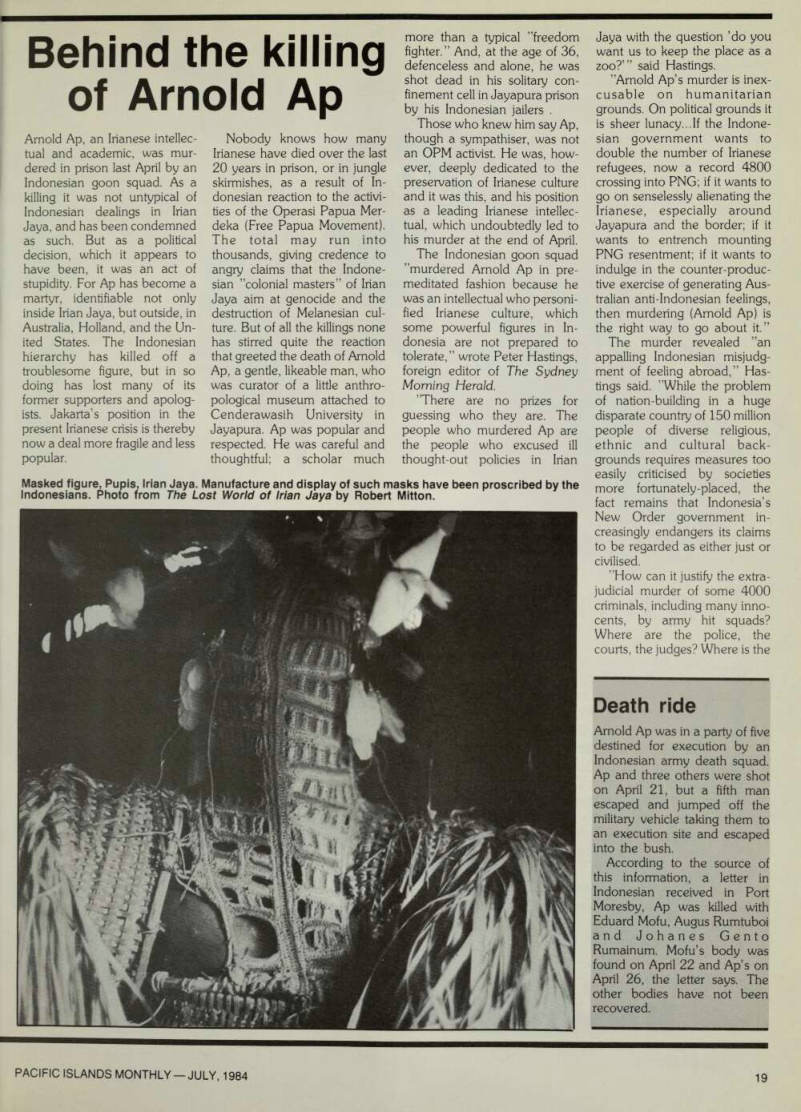
Masked figure, Pupis. Irian Jaya. Manufacture and display of such masks have been proscribed by the Indonesians. Photo from The Lost World of Irian Jaya by Robert Mitton.
rule of law?”
Arnold Ap was from Biak, a Protestant who went to school first under the Dutch and then the Indonesians. He was known among Pacific intellectuals as a man devoted to preservation of Melanesian culture, particularly its legends, songs and dance.
He sought to preserve Irianese ethnic identity in the face of Javanisation by the territory’s Muslim administrators.
He was fond of collecting songs and stories on tape, but was dismayed to discover that the Indonesian army had used some of these records to entice villagers out of the bush whence they had fled ahead of military sweeps against the
Opm.
Becoming increasingly out spoken and anti-Indonesian, Ap was finally arrested late in 1983 and held in Jayapura prison without charge or trial.
His family was not allowed to visit him.
According to some Indone sian sources reported in Sydney Ap and four others escaped from the prison on April 21.
They were recaptured but,
according to the report, Ap again attempted to escape... and was shot while making the attempt.
Few believe that. Most are convinced he was cold bloodedly murdered.
Murder or not, the shooting has rendered Indonesia’s posi tion in Irian Jaya vastly more difficult. And, that being so, the situation is now measurably more fragile. • • • Angry letters, condemning In donesia for the murder of Arnold Ap, hit the Australian press almost immediately.
Among them were some from leading academics previously noted for their support of In donesia’s viewpoint.
Four leading figures from the Research School of Pacific Stu dies; joined with Antony Forge, of the Australian National Uni versity, to write to the Sydney Morning Herald, which pub lished their letter under the heading, “Indonesian Repre ssion at its Worst.” J.A.Mackie, Peter McCawley, James Fox
snd Anthony Reid, with Forge, wrote: “Having noted with moun ting concern the heavy-handed methods of the Indonesian Government in dealing with dissidents in Irian Jaya and East Timor over the past year, we feel compelled to make some public protest about the shoot ing of Arnold Ap...This act of singular inhumanity is both politically senseless and morally indefensible.
“It is not least so because it occurred at the very time when Indonesian intellectuals, academics, and journalists were attempting to increase aware ness of Irianese culture through the medium of an Irian Jaya Festival.
“Those of us who count ourselves Indonesia’s staunch friends in Australia, and who have long been endeavoring to present the Indonesian side of the story to the Australian public on controversial issues, find it impossible to defend or condone this kind of be havior...”.
Four Sydney University academics also condemned the
killing which, they said, “tra gically illustrates a return to the cruder forms of officially sanc tioned repression that characte rised the treatment of dissidents in Indonesia in the late 1960 s and 19705. In the past few years there seemed to be signs that the Indonesian Govern ment was willing to adopt re latively more humane priorities in the treatment of its political opponents; now, however, in the wake of the murder of thousands of ‘criminals’ by Government-sponsored death squads, the increasingly repres sive action being taken by the Indonesian military against dissidents in East Timor and West Irian has once again con signed humanitarianism to the political wilderness in Indone sia.”
The four, Helen Jarvis, Carolyn van Langenberg, Michael van Langenberg, and Thea van Lennep, said they considered Indonesia’s recent policies in West Irian and East Timor had served to reinforce “a common public view in Australia,” that Indonesia was “an expansionist military state.”