What made Reddy run
pp. 22-24 · Read in the full issue

Fiji Opposition in disarray What made Reddy run
Editor of The Fiji Times, VIJENDRA KUMAR, traces the recent turbulent history of Fiji’s opposition National Federation Party, whose leadership is once again in a state of crisis and up for grabs.
Fiji’s Leader of the Opposition, Jai Ram Reddy, 48, has created a major crisis in his National Federation Party by a shock announcement in April of his decision to quit.
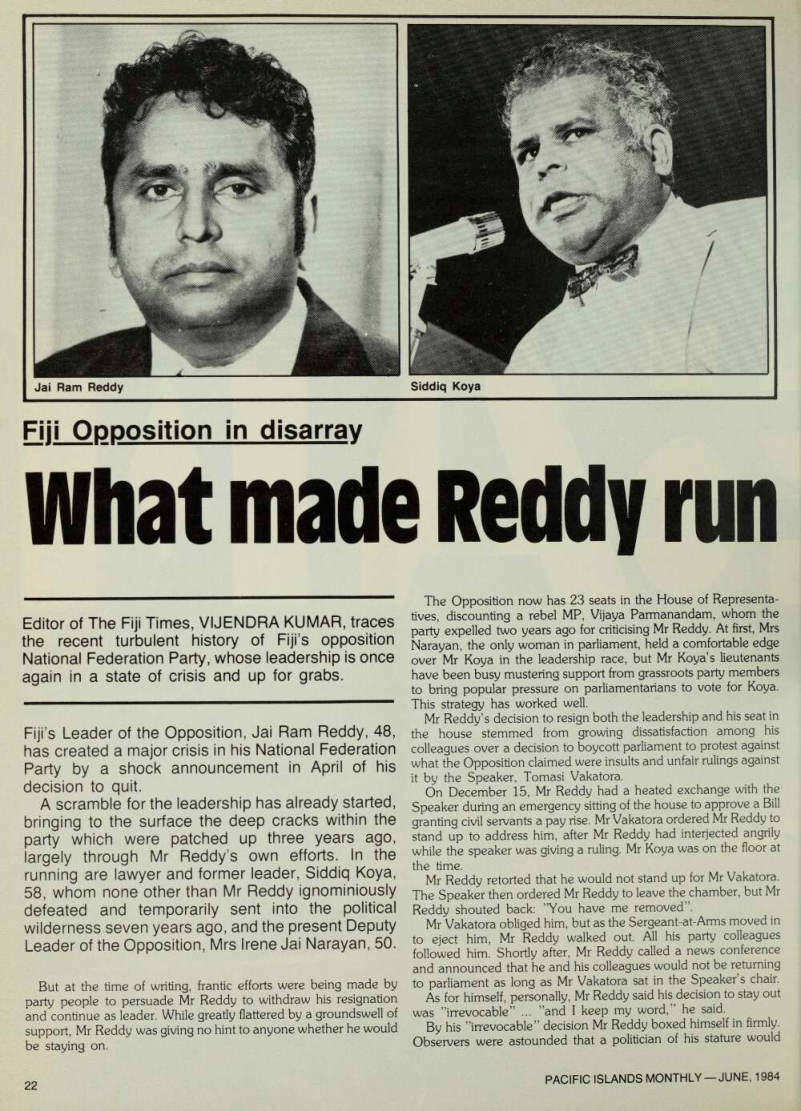
A scramble for the leadership has already started, bringing to the surface the deep cracks within the party which were patched up three years ago, largely through Mr Reddy’s own efforts. In the running are lawyer and former leader, Siddiq Koya, 58, whom none other than Mr Reddy ignominiously defeated and temporarily sent into the political wilderness seven years ago, and the present Deputy Leader of the Opposition, Mrs Irene Jai Narayan, 50.
But at the time of writing, frantic efforts were being made by party people to persuade Mr Reddy to withdraw his resignation and continue as leader. While greatly flattered by a groundswell of support, Mr Reddy was giving no hint to anyone whether he would be staying on.
The Opposition now has 23 seats in the House of Representa tives, discounting a rebel MP, Vijaya Parmanandam, whom the party expelled two years ago for criticising Mr Reddy. At first, Mrs Narayan, the only woman in parliament, held a comfortable edge over Mr Koya in the leadership race, but Mr Koya’s lieutenants have been busy mustering support from grassroots party members to bring popular pressure on parliamentarians to vote for Koya.
This strategy has worked well.
Mr Reddy’s decision to resign both the leadership and his seat in the house stemmed from growing dissatisfaction among his colleagues over a decision to boycott parliament to protest against what the Opposition claimed were insults and unfair rulings against it by the Speaker, Tomasi Vakatora.
On December 15, Mr Reddy had a heated exchange with the Speaker during an emergency sitting of the house to approve a Bill granting civil servants a pay rise. Mr Vakatora ordered Mr Reddy to stand up to address him, after Mr Reddy had interjected angrily while the speaker was giving a ruling. Mr Koya was on the floor at the time.
Mr Reddy retorted that he would not stand up for Mr Vakatora.
The Speaker then ordered Mr Reddy to leave the chamber, but Mr Reddy shouted back: ”You have me removed’.
Mr Vakatora obliged him, but as the Sergeant-at-Arms moved in to eject him, Mr Reddy walked out. All his party colleagues followed him. Shortly after, Mr Reddy called a news conference and announced that he and his colleagues would not be returning to parliament as long as Mr Vakatora sat in the Speaker s chair.
As for himself, personally, Mr Reddy said his decision to stay out was ’’irrevocable” ... ’’and I keep my word, he said.
By his ’’irrevocable” decision Mr Reddy boxed himself in firmly.
Observers were astounded that a politician of his stature would
Siddiq Koya
Jai Ram Reddy
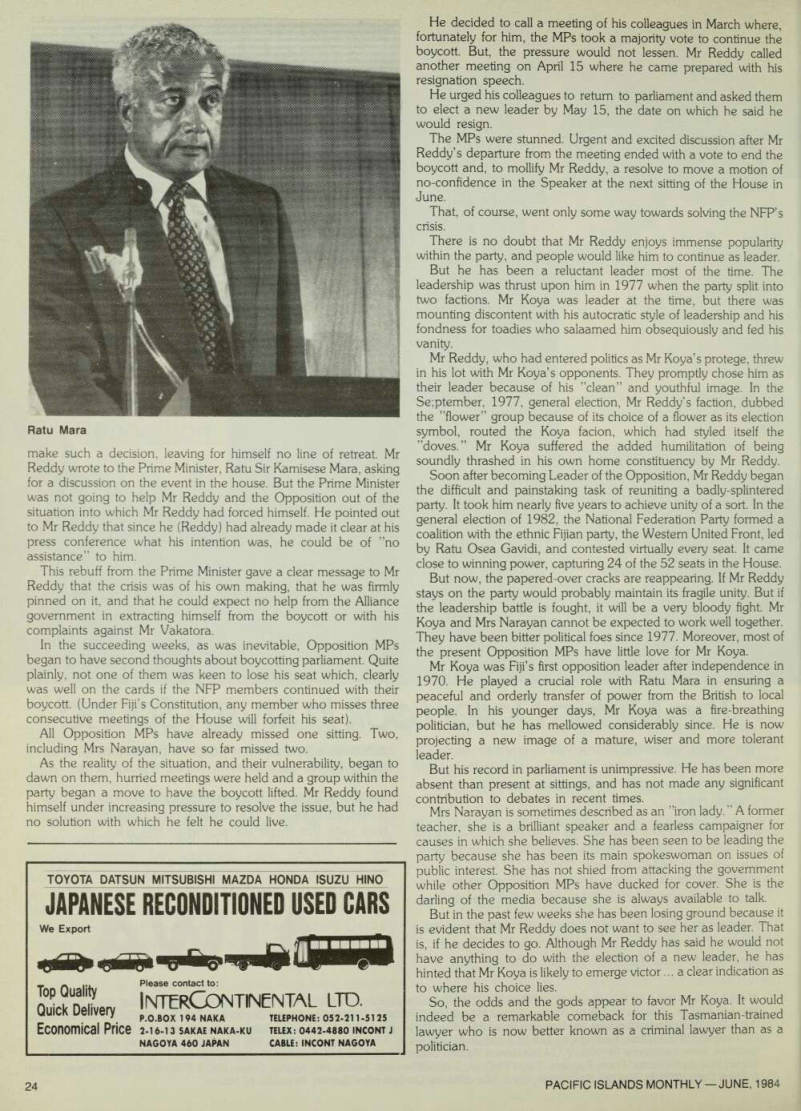
make such a decision, leaving for himself no line of retreat. Mr Reddy wrote to the Prime Minister, Ratu Sir Kamisese Mara, asking for a discussion on the event in the house. But the Prime Minister was not going to help Mr Reddy and the Opposition out of the situation into which Mr Reddy had forced himself. He pointed out to Mr Reddy that since he (Reddy) had already made it clear at his press conference what his intention was, he could be of ”no assistance” to him.
This rebuff from the Prime Minister gave a clear message to Mr Reddy that the crisis was of his own making, that he was firmly pinned on it, and that he could expect no help from the Alliance government in extracting himself from the boycott or with his complaints against Mr Vakatora.
In the succeeding weeks, as was inevitable, Opposition MPs began to have second thoughts about boycotting parliament. Quite plainly, not one of them was keen to lose his seat which, clearly was well on the cards if the NFP members continued with their boycott. (Under Fiji’s Constitution, any member who misses three consecutive meetings of the House will forfeit his seat).
All Opposition MPs have already missed one sitting. Two, including Mrs Narayan, have so far missed two.
As the reality of the situation, and their vulnerability, began to dawn on them, hurried meetings were held and a group within the party began a move to have the boycott lifted. Mr Reddy found himself under increasing pressure to resolve the issue, but he had no solution with which he felt he could live.
He decided to call a meeting of his colleagues in March where, fortunately for him, the MPs took a majority vote to continue the boycott. But, the pressure would not lessen. Mr Reddy called another meeting on April 15 where he came prepared with his resignation speech.
He urged his colleagues to return to parliament and asked them to elect a new leader by May 15, the date on which he said he would resign.
The MPs were stunned. Urgent and excited discussion after Mr Reddy’s departure from the meeting ended with a vote to end the boycott and, to mollify Mr Reddy, a resolve to move a motion of no-confidence in the Speaker at the next sitting of the House in June.
That, of course, went only some way towards solving the NFP’s crisis.
There is no doubt that Mr Reddy enjoys immense popularity within the party, and people would like him to continue as leader.
But he has been a reluctant leader most of the time. The leadership was thrust upon him in 1977 when the party split into two factions. Mr Koya was leader at the time, but there was mounting discontent with his autocratic style of leadership and his fondness for toadies who salaamed him obsequiously and fed his vanity.
Mr Reddy, who had entered politics as Mr Koya’s protege, threw in his lot with Mr Koya’s opponents. They promptly chose him as their leader because of his ’’clean” and youthful image. In the September, 1977, general election, Mr Reddy’s faction, dubbed the ’’flower” group because of its choice of a flower as its election symbol, routed the Koya facion, which had styled itself the ’’doves.” Mr Koya suffered the added humilitation of being soundly thrashed in his own home constituency by Mr Reddy.
Soon after becoming Leader of the Opposition, Mr Reddy began the difficult and painstaking task of reuniting a badly-splintered party. It took him nearly five years to achieve unity of a sort. In the general election of 1982, the National Federation Party formed a coalition with the ethnic Fijian party, the Western United Front, led by Ratu Osea Gavidi, and contested virtually every seat. It came close to winning power, capturing 24 of the 52 seats in the House.
But now, the papered-over cracks are reappearing. If Mr Reddy stays on the party would probably maintain its fragile unity. But if the leadership battle is fought, it will be a very bloody fight. Mr Koya and Mrs Narayan cannot be expected to work well together.
They have been bitter political foes since 1977. Moreover, most of the present Opposition MPs have little love for Mr Koya.
Mr Koya was Fiji’s first opposition leader after independence in 1970. He played a crucial role with Ratu Mara in ensuring a peaceful and orderly transfer of power from the British to local people. In his younger days, Mr Koya was a fire-breathing politician, but he has mellowed considerably since. He is now projecting a new image of a mature, wiser and more tolerant leader.
But his record in parliament is unimpressive. He has been more absent than present at sittings, and has not made any significant contribution to debates in recent times.
Mrs Narayan is sometimes described as an ’’iron lady. ” A former teacher, she is a brilliant speaker and a fearless campaigner for causes in which she believes. She has been seen to be leading the party because she has been its main spokeswoman on issues of public interest. She has not shied from attacking the government while other Opposition MPs have ducked for cover. She is the darling of the media because she is always available to talk.
But in the past few weeks she has been losing ground because it is evident that Mr Reddy does not want to see her as leader. That is, if he decides to go. Although Mr Reddy has said he would not have anything to do with the election of a new leader, he has hinted that Mr Koya is likely to emerge victor... a clear indication as to where his choice lies.
So, the odds and the gods appear to favor Mr Koya. It would indeed be a remarkable comeback for this Tasmanian-trained lawyer who is now better known as a criminal lawyer than as a politician.
Ratu Mara