Rebels, rhetoric and jets
pp. 17-19 · Read in the full issue

mar area relations
PIM correspondent PAMA ANIO reports from Port Moresby on recent events which have Strained relations between Papua New Guinea and Indonesia, its big neighbor to the west.
Papua New Guinea’s relation ship with its big and powerful neighbor Indonesia has come under great strain in the past few months. Source of the latest conflict has once again been the border region.
Since early February, hun dreds of Irian Jayans have been crossing into PNG, reportedly fleeing major clashes between the Free Papua Movement (OPM) and Indonesian troops.
As the influx continued, pressure mounted on the So mare government to make a decision on the fate of the border-crossers, most of whom were camped in PNG’s border province of West Sepik.
PNG’s Foreign Minister Rab bie Namaliu sought an urgent explanation from Indonesia on the Irian Jaya situation, and a week later received a “sufficient enough” reply from his coun terpart Dr Mochtar Kusumaat madja.
It confirmed an incident in the Irian Jaya capital of Jayapura on February 13 when OPM supporters raised a “West Papua” flag at the provincial parliament building.
According to one border crosser, an Indonesian army defector who was an OPM supporter was shot dead by Indonesian troops in the inci dent. It is believed it was this incident that sparked off clashes, leading to the exodus.
The reply however did not satisfy critics in PNG, and one of them, East New Britain Pre mier Ronald Tovue, accused the government of taking an “evasive and fearful” approach to the border problems.
Mr Namaliu hit back, saying that administering any in ternational border was a “sensi tive, complex, and time-con suming matter”.
Mr Namaliu’s departmental head, Paulias Matane, tried to soothe feelings when he said,
on his return from special border liaison meetings in Jayapura in mid-March, that the government might repatriate some of the border-crossers if their safety were guaranteed by Indonesia. He added that a third country may have to be found for those who were identified as defectors, and active members of OPM.
The day after Mr Matane made this statement, 73 Irian Jaya men were jailed for six weeks by Vanimo district court in West Sepik for illegally entering PNG. Another 38 were found guilty, but were not convicted and were discharged.
The decisions to charge and jail the border-crossers caused an uproar throughout the coun-
try, and many felt the govern ment had ignored humanitarian factors.
Even the magistrate who jailed the men seemed reluctant to do so. “I sympathise with your reasons for crossing the border into PNG, but I am by law required to administer the laws of this country,” he told them. The 73 were later re leased pending an appeal.
Amid criticisms of the legal proceedings, Mr Namaliu said: “We are not doing anything different from the past. Under normal circumstances, if they are illegal crossers, the police will deal with them.”
His comments only reaf firmed the government’s stand on the crossings that the Irian Jayans were not refugees, but illegal border-crossers.
PNG, like most South Pacific Island nations, is not a signatory to the United Nations conven-
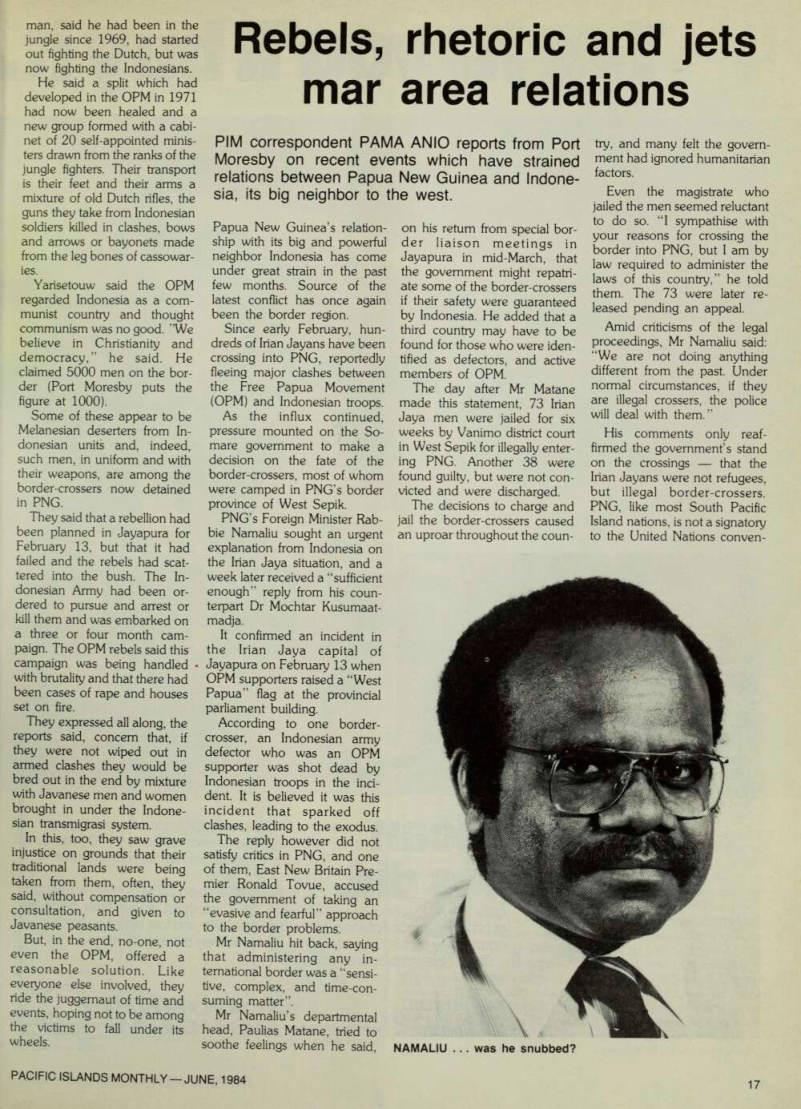
NAMALIU . . . was he snubbed?
tion on refugees.
On March 27, almost a week after the jailings, two unidenti fied jet fighter planes flew into PNG and, according to witnes ses, circled the Green River government station three times.
The station is about 20 km from the Irian Jaya border. The witnesses said the planes flew very low “two to three hundred feet above the ground” and left in the direction of Irian Jaya.
The government was con vinced from initial reports that the jets were Indonesian, but Indonesia, through its Port Moresby embassy, immediately denied owning the jets.
Prime Minister Michael So mare was not impressed by this denial and instructed Mr Nama liu to seek an immediate meet ing with Dr Mochtar.
The government then threatened to expel an Indone sian military attache in Port Moresby over what it called Indonesian “lack of response” over the border matters, includ ing the jet violations.
Jakarta withdrew the attache, but later accused PNG of ex pelling him.
PNG was also accused of allowing the OPM to operate inside its territory.
This charge followed the kid napping of the Swiss pilot of a mission aircraft by the rebels at an Irian Jaya outpost on March 26. The pilot was released unharmed, but the rebels shot dead two of his Indonesian passengers a doctor and an army officer.
PNG at the time denied knowledge of the whereabouts of the secret negotiations be tween the OPM and Swiss government representatives for the pilot’s release. It has now been confirmed that the talks took place in West Sepik.
The two countries finally came to the conference table in Jakarta on April 15 to attempt to resolve their differences and discuss the fate of the border crossers (who totalled almost 1800 by the end of March).
The PNG delegation, led by Mr Namaliu, presented a formal protest against the alleged air intrusions. In turn the Indone sians, led by Dr Mochtar, formally protested against the expulsion of their attache.
Both sides firmly maintained
their stances, and after an un scheduled third day of delibera tions finally “agreed to dis agree”, as Mr Namaliu nicely put it.
On other matters concerning the border crossings, the two sides came to terms. A joint communique said they had agreed to co-operate in retur ning the border-crossers to their homes in an orderly manner.
Dr Mochtar assured Mr Namaliu that the safety of the returnees would be guaranteed, provided they had not broken any laws. Mr Namaliu in turn assured his counterpart that PNG would not allow its terri tory to be used as a sanctuary by anti-Indonesian elements.
Both ministers agreed that misunderstanding may have occurred because of inadequ ate communication, and said measures should be taken im mediately to rectify the problem.
They also agreed to meet in Port Moresby for further talks.
The Jakarta talks are seen by many as a turning point in PNG-Indonesian relations. At the very least, many hope rela tions will improve from now on.
The outcome of the talks was in fact a success for PNG. For the first time PNG has got the Indonesians to listen and not
take her for granted, as it has done for the past decade.
For a country of its size and status, it has been a difficult task for PNG to maintain good relations with a neighbor which not only has a military govern ment but which has failed to recognise that the land border it shares with PNG cuts through ethnic ties. Lack of communica tion and dialogue is certainly a stumbling block to better rela tions, as both sides admitted at the talks. “We don’t know enough about each other,” Mr Namaliu said on his return from Jakarta.
The comment signified the fact that, to all intents and purposes, both countries have made little or no effort to improve relations beyond dip lomatic exchanges ever since Mr Somare made his first offi cial visit to Indonesia in 1973 (he was chief minister at the time), and President Suharto’s return visit to PNG in 1979.
Such basic requirements as trade and educational links, and cultural and sporting ex changes, are non-existent.
Maybe Mr Namaliu’s propo sal to Dr Mochtar for an In donesian soccer team to visit PNG will do something for the present tattered relations.
Pama Anio in Port Moresby.
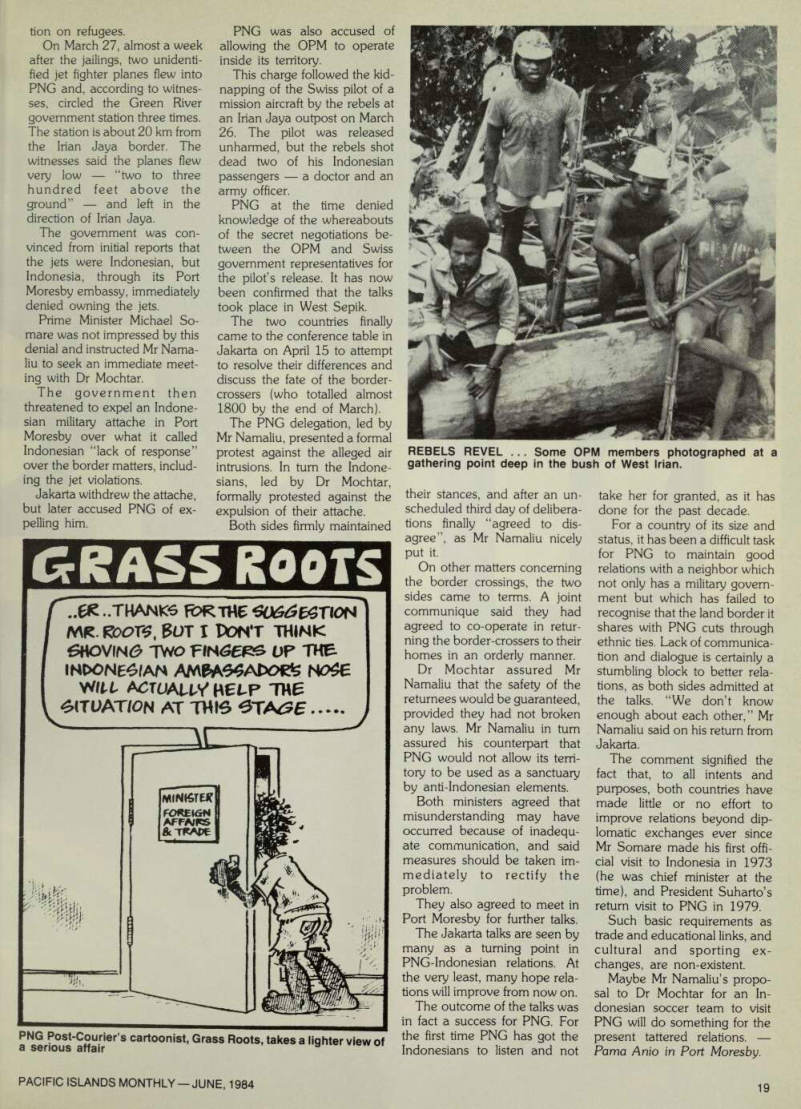
PNG Post-Courier’s cartoonist, Grass Roots, takes a lighter view of a serious affair
REBELS REVEL ... Some OPM members photographed at a gathering point deep in the bush of West Irian.