running out
pp. 13-17 · Read in the full issue


Time, and the race, running out
Two independence movements are now running in Melanesia - the painful affair in New Caledonia, and the much more violent and potentially dangerous upset in Irian Jaya. Both occupy the attention of regional governments but none so much as the tangled and fragile situation along the 141st meridian of longitude which divides Papua New Guinea from Irian Jaya.
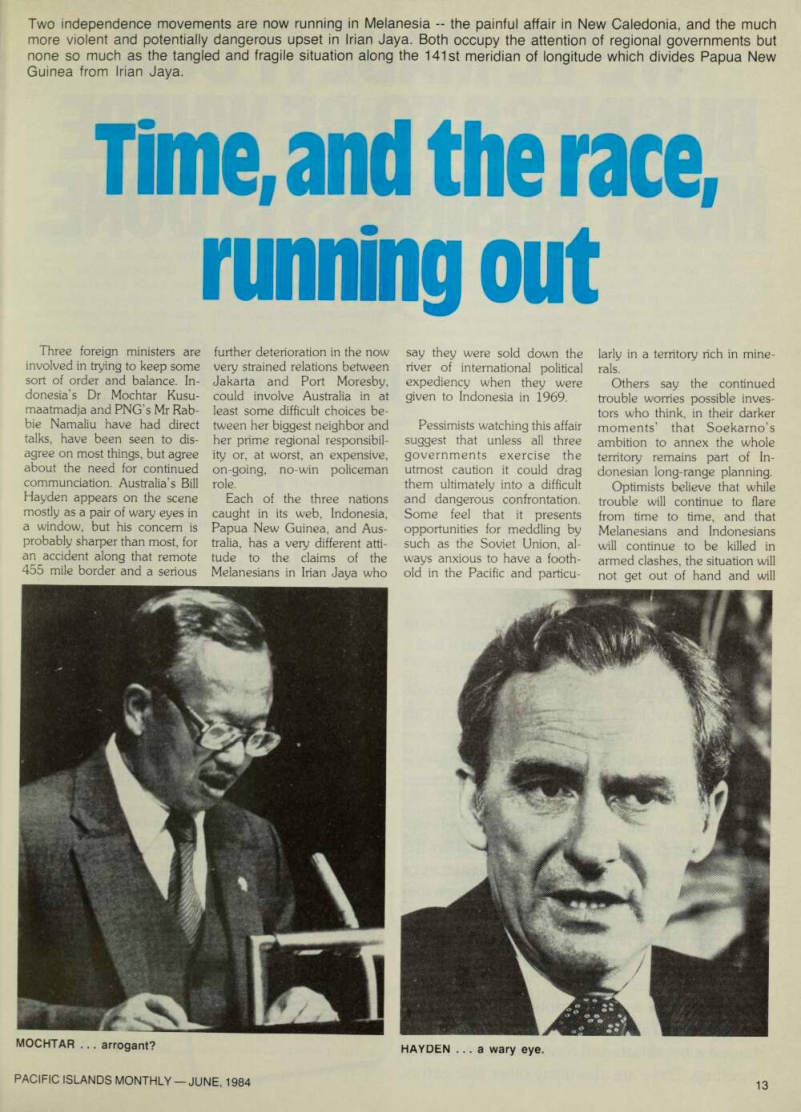
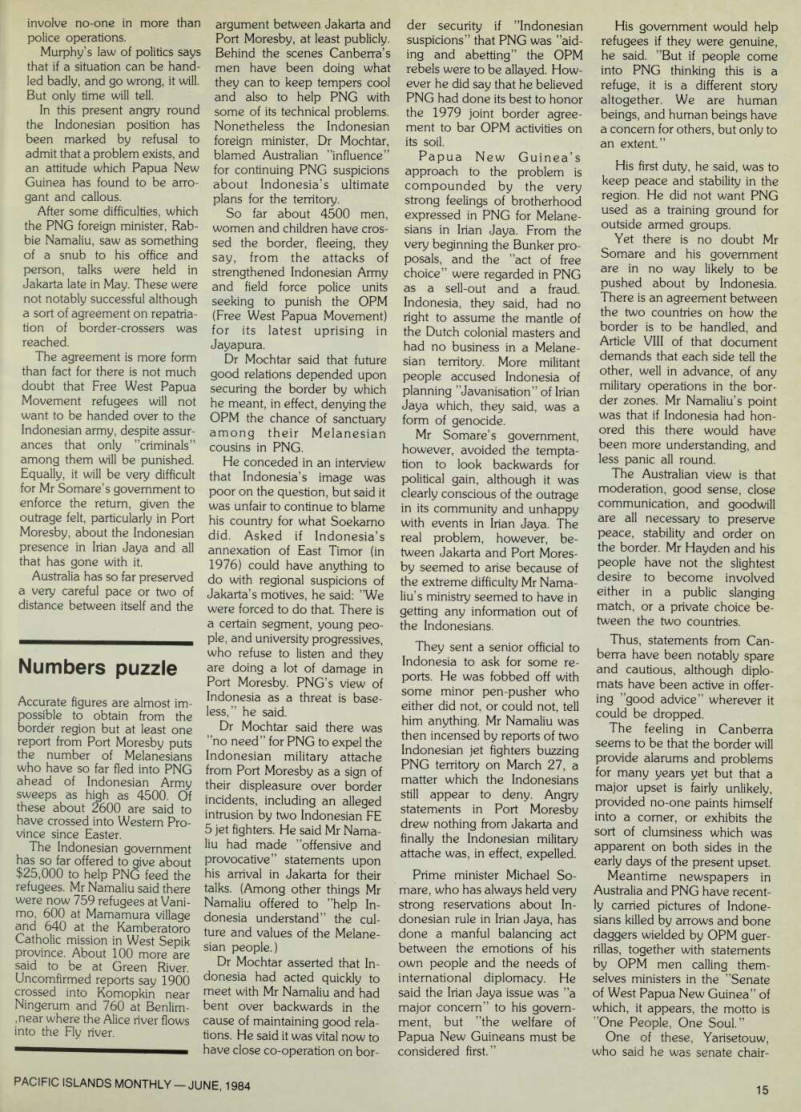
Three foreign ministers are involved in trying to keep some sort of order and balance. In donesia’s Dr Mochtar Kusu maatmadja and PNG’s Mr Rab bie Namaliu have had direct talks, have been seen to dis agree on most things, but agree about the need for continued communciation. Australia’s Bill Hayden appears on the scene mostly as a pair of wary eyes in a window, but his concern is probably sharper than most, for an accident along that remote 455 mile border and a serious
further deterioration in the now very strained relations between Jakarta and Port Moresby, could involve Australia in at least some difficult choices be tween her biggest neighbor and her prime regional responsibil ity or, at worst, an expensive, on-going, no-win policeman role.
Each of the three nations caught in its web, Indonesia, Papua New Guinea, and Aus tralia, has a very different atti tude to the claims of the Melanesians in Irian Jaya who
say they were sold down the river of international political expediency when they were given to Indonesia in 1969.
Pessimists watching this affair suggest that unless all three governments exercise the utmost caution it could drag them ultimately into a difficult and dangerous confrontation.
Some feel that it presents opportunities for meddling by such as the Soviet Union, al ways anxious to have a footh old in the Pacific and particu
larly in a territory rich in mine rals.
Others say the continued trouble worries possible inves tors who think, in their darker moments’ that Soekarno’s ambition to annex the whole territory remains part of In donesian long-range planning.
Optimists believe that while trouble will continue to flare from time to time, and that Melanesians and Indonesians will continue to be killed in armed clashes, the situation will not get out of hand and will
MOCHTAR . . . arrogant?
HAYDEN ... a wary eye.
involve no-one in more than police operations.
Murphy’s law of politics says that if a situation can be hand led badly, and go wrong, it will.
But only time will tell.
In this present angry round the Indonesian position has been marked by refusal to admit that a problem exists, and an attitude which Papua New Guinea has found to be arro gant and callous.
After some difficulties, which the PNG foreign minister, Rab bie Namaliu, saw as something of a snub to his office and person, talks were held in Jakarta late in May. These were not notably successful although a sort of agreement on repatria tion of border-crossers was reached.
The agreement is more form than fact for there is not much doubt that Free West Papua Movement refugees will not want to be handed over to the Indonesian army, despite assur ances that only ’’criminals” among them will be punished.
Equally, it will be very difficult for Mr Somare’s government to enforce the return, given the outrage felt, particularly in Port Moresby, about the Indonesian presence in Irian Jaya and all that has gone with it.
Australia has so far preserved a very careful pace or two of distance between itself and the
argument between Jakarta and Port Moresby, at least publicly.
Behind the scenes Canberra’s men have been doing what they can to keep tempers cool and also to help PNG with some of its technical problems.
Nonetheless the Indonesian foreign minister, Dr Mochtar, blamed Australian ’’influence” for continuing PNG suspicions about Indonesia’s ultimate plans for the territory.
So far about 4500 men, women and children have cros sed the border, fleeing, they say, from the attacks of strengthened Indonesian Army and field force police units seeking to punish the OPM (Free West Papua Movement) for its latest uprising in Jayapura.
Dr Mochtar said that future good relations depended upon securing the border by which he meant, in effect, denying the OPM the chance of sanctuary among their Melanesian cousins in PNG.
He conceded in an interview that Indonesia’s image was poor on the question, but said it was unfair to continue to blame his country for what Soekarno did. Asked if Indonesia’s annexation of East Timor (in 1976) could have anything to do with regional suspicions of Jakarta’s motives, he said: ”We were forced to do that. There is a certain segment, young peo ple, and university progressives, who refuse to listen and they are doing a lot of damage in Port Moresby. PNG’s view of Indonesia as a threat is base less,” he said.
Dr Mochtar said there was ”no need” for PNG to expel the Indonesian military attache from Port Moresby as a sign of their displeasure over border incidents, including an alleged intrusion by two Indonesian FE 5 jet fighters. He said Mr Nama liu had made ’’offensive and provocative” statements upon his arrival in Jakarta for their talks. (Among other things Mr Namaliu offered to ’’help In donesia understand” the cul ture and values of the Melane sian people.) Dr Mochtar asserted that In donesia had acted quickly to meet with Mr Namaliu and had bent over backwards in the cause of maintaining good rela tions. He said it was vital now to have close co-operation on bor
der security if ’’lndonesian suspicions” that PNG was ’’aid ing and abetting” the OPM rebels were to be allayed. How ever he did say that he believed PNG had done its best to honor the 1979 joint border agree ment to bar OPM activities on its soil.
Papua New Guinea’s approach to the problem is compounded by the very strong feelings of brotherhood expressed in PNG for Melane sians in Irian Jaya. From the very beginning the Bunker pro posals, and the ’’act of free choice” were regarded in PNG as a sell-out and a fraud.
Indonesia, they said, had no right to assume the mantle of the Dutch colonial masters and had no business in a Melane sian territory. More militant people accused Indonesia of planning ’’Javanisation” of Irian Jaya which, they said, was a form of genocide.
Mr Somare’s government, however, avoided the tempta tion to look backwards for political gain, although it was clearly conscious of the outrage in its community and unhappy with events in Irian Jaya. The real problem, however, be tween Jakarta and Port Mores by seemed to arise because of the extreme difficulty Mr Nama liu’s ministry seemed to have in getting any information out of the Indonesians.
They sent a senior official to Indonesia to ask for some re ports. He was fobbed off with some minor pen-pusher who either did not, or could not, tell him anything. Mr Namaliu was then incensed by reports of two Indonesian jet fighters buzzing PNG territory on March 27, a matter which the Indonesians still appear to deny. Angry statements in Port Moresby drew nothing from Jakarta and finally the Indonesian military attache was, in effect, expelled.
Prime minister Michael So mare, who has always held very strong reservations about In donesian rule in Irian Jaya, has done a manful balancing act between the emotions of his own people and the needs of international diplomacy. He said the Irian Jaya issue was ”a major concern” to his govern ment, but ’’the welfare of Papua New Guineans must be considered first.”
His government would help refugees if they were genuine, he said. ’’But if people come into PNG thinking this is a refuge, it is a different story altogether. We are human beings, and human beings have a concern for others, but only to an extent.”
His first duty, he said, was to keep peace and stability in the region. He did not want PNG used as a training ground for outside armed groups.
Yet there is no doubt Mr Somare and his government are in no way likely to be pushed about by Indonesia.
There is an agreement between the two countries on how the border is to be handled, and Article VIII of that document demands that each side tell the other, well in advance, of any military operations in the bor der zones. Mr Namaliu’s point was that if Indonesia had hon ored this there would have been more understanding, and less panic all round.
The Australian view is that moderation, good sense, close communication, and goodwill are all necessary to preserve peace, stability and order on the border. Mr Hayden and his people have not the slightest desire to become involved either in a public slanging match, or a private choice be tween the two countries.
Thus, statements from Can berra have been notably spare and cautious, although diplo mats have been active in offer ing ’’good advice” wherever it could be dropped.
The feeling in Canberra seems to be that the border will provide alarums and problems for many years yet but that a major upset is fairly unlikely, provided no-one paints himself into a comer, or exhibits the sort of clumsiness which was apparent on both sides in the early days of the present upset.
Meantime newspapers in Australia and PNG have recent ly carried pictures of Indone sians killed by arrows and bone daggers wielded by OPM guer rillas, together with statements by OPM men calling them selves ministers in the ’’Senate of West Papua New Guinea” of which, it appears, the motto is ’’One People, One Soul.”
One of these, Yarisetouw, who said he was senate chair
man, said he had been in the jungle since 1969, had started out fighting the Dutch, but was now fighting the Indonesians.
He said a split which had developed in the OPM in 1971 had now been healed and a new group formed with a cabi net of 20 self-appointed minis ters drawn from the ranks of the jungle fighters. Their transport is their feet and their arms a mixture of old Dutch rifles, the guns they take from Indonesian soldiers killed in clashes, bows and arrows or bayonets made from the leg bones of cassowar ies.
Yarisetouw said the OPM regarded Indonesia as a com munist country and thought communism was no good. ”We believe in Christianity and democracy,” he said. He claimed 5000 men on the bor der (Port Moresby puts the figure at 1000).
Some of these appear to be Melanesian deserters from In donesian units and, indeed, such men, in uniform and with their weapons, are among the border-crossers now detained in PNG.
They said that a rebellion had been planned in Jayapura for February 13, but that it had failed and the rebels had scat tered into the bush. The In donesian Army had been or dered to pursue and arrest or kill them and was embarked on a three or four month cam paign. The OPM rebels said this campaign was being handled • with brutality and that there had been cases of rape and houses set on fire.
They expressed all along, the reports said, concern that, if they were not wiped out in armed clashes they would be bred out in the end by mixture with Javanese men and women brought in under the Indone sian transmigrasi system.
In this, too, they saw grave injustice on grounds that their traditional lands were being taken from them, often, they said, without compensation or consultation, and given to Javanese peasants.
But, in the end, no-one, not even the OPM, offered a reasonable solution. Like everyone else involved, they ride the juggernaut of time and events, hoping not to be among the victims to fall under its wheels.