letters
pp. 10-11 · Read in the full issue
New Zealand’s RDF: A second opinion
The rapid deployment force that New Zealand is currently organising should serve as a reminder to the Pacific Islands that gunboat diplomacy and colonialism are well and truly alive in the Pacific region.
Contrary to Ratu Sir Kamisese Mara’s confidence that the proposed force would serve as a security deterrent for the Pacific region, I believe that such a force under the sponsor ship of a single nation is very dangerous. My view is that there is no guarantee that a force of this kind would not be used to suppress smaller island nations who fail to see matters eye to eye with “Big Brother”.
Should the Cook Islands, for argument’s sake, invite a power unfriendly with New Zealand to participate in and assist in their development, there is no guarantee that New Zealand would not use its rapid deploy ment force to discourage Cook Islanders from exercising their democratic right to free associa tion with whoever they wish.
Another factor that should not be overlooked is the de stabilising effect that the New Zealand proposal is likely to create in the region. There already exists within the region a degree of suspicion by smaller Polynesian states of the Melanesian states. This has been especially apparent following the Papua New Guinea Defence Force aid to Vanuatu in its bid for independ ence.
The fact that New Zealand, which was formerly completely against PNG’s proposal for the establishment of a Pacific peace-keeping force, has seen fit to reverse its position follow ing upon Vanuatu’s recent deci sion to permit the establishment of a Cuban diplomatic mission in Villa may not be simply coincidence.
Enthusiastic support for Prime Minister Muldoon’s pro
posals by another opponent of a Pacific peace-keeping force, Ratu Sir Kamisese Mara, appears not to have been given simply to please Sir Robert but rather as an indirect manner of signalling agreement between New Zealand and Fiji as to the real nature and purpose of such a force which appears to me to be to act as a deterrent to other Pacific nations.
I suspect that Sir Robert’s next move, now that he has gained Fiji’s support, will be to bulldoze his proposals through the South Pacific Forum. I hope and trust that the Melanesian states, namely PNG, Solomon Islands and Vanuatu, will not lend blind support to them. The broader implications of such a single-nation rapid deployment force must be honestly and thoroughly examined by all na tions of this region if the pro posals are tabled at the next Forum meeting.
At a time when the less fortunate nations of the Pacific region are making attempts to help themselves through gain ing membership of co-operative organisations in the Pacific, they are on the point of being blatantly subjugated by the re gion’s so-called “elder states men”, who appear to be simply awaiting their opportunity to gather support for proposals that on the surface appear benevolent but in fact are characterised by a diabolical interest.
I detect the germination of a most unfavorable set of values in the South Pacific. Such values pose a very real threat to peace and co-operative deve lopment within the region.
These misplaced values appear to be being nurtured in New Zealand and Fiji, and perhaps to a lesser extent within Austra lia as well. I fear that if con tinued growth of such values is permitted they will soon lead to the undermining and break
down of the spirit of co-opera tion that gave rise to the Forum and the other co-operative or ganisations of this region.
I question the sincerity of New Zealand’s rapid deploy ment force proposals, and feel that Pacific support for such proposals would amount to un precedented political hypocrisy.
Sir, my letter is written in my capacity as an elected leader within this region. I am con cerned for the welfare of the small island states that make up a large part of the Pacific.
I firmly believe that Ratu Sir Kamisese Mara’s spontaneous support for Muldoon’s pro posals cannot result in any practical contribution to resolv ing the basic problems of practi cal development in the Pacific.
W. Noel Levi Cbe Mr
Member for New Ireland National Parliament Port Moresby Papua New Guinea
E. E. Luxford
Some years ago, with the aid of a metal detector, I found a stainless steel identity disc. It was unearthed on Horn Island, Torres Strait, and was owned by E. E. Luxford, NX 149971, a New Guinea volunteer.
Does any PIM reader know anything about E. E. Luxford?
David Richardson
Cairns, Qld.
Australia
‘Bombay factor’
I was saddened to find, under the heading “PIM Opinion” (February PIM, p 5), reference, in some comment on a recent political event in Fiji, to “what might be termed the ‘Bombay Factor’ adding . . . curry to an already active pot”. I hope and trust that most of your readers will, like me, regard the “Bom bay Factor” wording as a de plorable lapse from the good sense and good taste which have for quite some time now
characterised the phraseology of PIM. As for the culinary metaphor the sooner that is consigned to oblivion the better.
David Walsh
Anthropology Department University of Sydney, Sydney, NSW Australia Our thanks to Dr Walsh for writing. We regret that he took offence, but his is the on/y such reaction received from any where and that, of course, includes Fiji. Editor.
Micronesia
Not only do I find Floyd K.
Takeuchi’s bias extremely dis tasteful in its openly subversive “Uncle Sam-ism”, but I am surprised that PIM constantly allows him to air his emotional personal opinions to the detri ment of the constructive alternatives given by Pacific Islanders who are not ashamed to become independent of “Big Brother” paternalism.
How many times must the Palauans be humiliated and belittled by their U.S. “super iors” telling them to take their brilliant, world-influencing, ma ture constitution back to their parliamentary “schoolrooms” and wait until their U.S. masters correct all the “mistakes”?
Recently a U.S. presidential adviser, who is also a leading academic, was questioned by me during a seminar he gave in Perth. To my question “When will the U.S. accept that auton omy and independence mean governments in places like Palau must be left to make democratic policies and de cisions for the good of their people and their future?” he replied: “The Reagan adminis tration cannot be asked to consider seriously the opinions of countries of 15,000 people in opposition to the views of the political leaders of the U.S.”
That just about sums it all up!
Just as the political leaders in the U.S. adore our own Labor prime minister because he is
prepared to go all the way with Reagan, even on such issues as the mining of uranium (against the stand of a majority in his own Labor Party), the Palauans are expected to behave “ration ally” and let the U.S. continue to control their future by using their country as a base to accelerate the arms race.
My suggestion to RIM if it wishes to continue as a credible magazine representing views from the Pacific Islanders is to find a less openly biased repor ter than its Micronesian cor respondent. Obviously, my bias is as strong as his in the opposite direction, but I’m sure there are proficient Micronesi ans able to strike a healthy balance, just as those who report to the magazine from the other islands appear to do.
Diana Rickard
Bullcreek, WA Australia
Nauru
RIM has received five letters from correspondents commen ting unfavorably on the story headlined “Unchanged Change in Nauru” (RIM Feb p 49).
All are strongly critical of the article, which one writer de scribed “a fawning and servile load of rubbish”.
Likewise all are strongly criti cal of President Hammer De- Roburt (“one man band”, “thinks he talks to God”).
Again, all strongly support Bernard Dowiyogo (“someone you can talk to”, “didn’t let the job gp to his head when he was
president”).
In view of the fact that the letters are so similar, and espe cially that none of the writers signed his/her name, we are able only to summarise their content here. Editor.
Western Samoa
I read with interest your article entitled “Smooth Talking, Rough Times” (RIM Jan. p 23) on the Western Samoan eco nomy and would like to offer a number of comments.
I was surprised at the bleak picture painted by your cor respondent of the Western Samoa economy and of the performance of the Tofilau gov ernment in view of the remark able turn-around in Western Samoa’s economy in the past 12 months. It is common know ledge that Tofilau and his gov ernment inherited an economy that was all but bankrupt after six years of mismanagement.
The country had no foreign exchange reserves left. Instead it owed millions overseas. In ternally, government had bor rowed most of the money from the banking system to finance its over-spending, leaving nothing for the private sector.
The measures the new gov ernment implemented to avert a total collapse included a se vere cutback in government spending and in the flow of some imports. Devaluation and other measures were taken to stimulate production and ex ports. Such measures do not win popularity but they were necessary for an economy that
had been made to live beyond its means for too long.
The success of these mea sures is now apparent. The country’s external trade posi tion is healthier now than it has been in years. This is reflected in the availability of more im ports and the reported fall in the rate of inflation for 1983. The reduction in the government’s overdraft with the banking sys tem has meant that the private sector has money for invest ment. Overall, a very happy position to be in for an eco nomy that was on the blink only a year ago.
Your correspondent may find it useful to compare Western Samoa’s 1984 budget with some of the other island coun tries in the region to see how they are faring before he criti cises. I would also refer your writer to an editorial in The Samoa Times recently, which, while referring to the eco nomy’s performance under Tofilau’s leadership, said, “these achievements were all made within 12 months and no one can take the credit away from government.” As no one could ever accuse that paper of a pro-government bias, that is praise indeed! It went on also to warn the government against “eating these gains away”. And yet that seems to be the kind of policy which your writer advo cates.
Tupuola, as reported in your article, now criticises what he refers to as government corrup tion. Really, one can only won der at such hypocrisy. As your correspondent points out him self, scandals and corruption were part of the reasons for the failure of the Tupuola govern ment. But if enough muck gets thrown around, some of it is bound to stick. Never mind that he may be covered in the stuff himself.
His criticisms of the prime minister’s overseas travel are equally without any basis.
Western Samoa, like most other nations, has joined the major forums of the world. This necessitates a certain amount of overseas travel. It is also quite normal for heads of govern ments to take officials to advise if necessary. No one is an expert on every issue these days. Tupuola himself used to take an entourage on his exten sive overseas trips. And what is
more, his entourage consisted mainly of his papalagi cronies and advisers. Really he should be the last person to want to raise such an issue!
Your correspondent will no doubt be producing other re ports in future on the Western Samoan situation. If he does, one hopes that he will be a little more factual and a little less biased, with these accounts.
One could be forgiven for thinking that Tupuola himself wrote the last one. Better to leave politics to the politicians and let reporters stick to provid ing information so people can make up their own minds.
(Name And Address Sup-
Plied)
Apia Western Samoa
Grenada
In reporting on a rapid-deploy ment force for the Pacific, your writers dragged in the irrelevant analogy of Grenada and then proceeded to garble the story.
The U.S. invasion was not in respose to a Cuban “attempt”.
Grenada had long had a Marx ist government, aided by Cuba.
But when the Grenadan leaders feuded bloodily among them selves, the U.S. took its opportunity to depose them.
Please stick to PlM’s area of expertise: the Pacific.
Supportively,
G. Maxwell
Sydney NSW Australia While we would expend our last breath in defence of Mr Maxwell’s right to interpret in ternational politics as he chooses, we rather thought we were dealing with the Pacific and its defence problems. Gre nada was used simply as an example, probably fresh in most minds, of a small nation under threat of political hi jacking. In politics, we fear, much depends upon viewpoint, and the truth in any situation as complicated as the Grenadan affair may hardly be summed up in 40 words.
It is perhaps also worth not ing that in a speech welcoming the establishment of the N.Z. rapid deployment force Fiji’s prime minister, Ratu Sir Kaminese Mara, also used the Grenada analogy.—Editor.
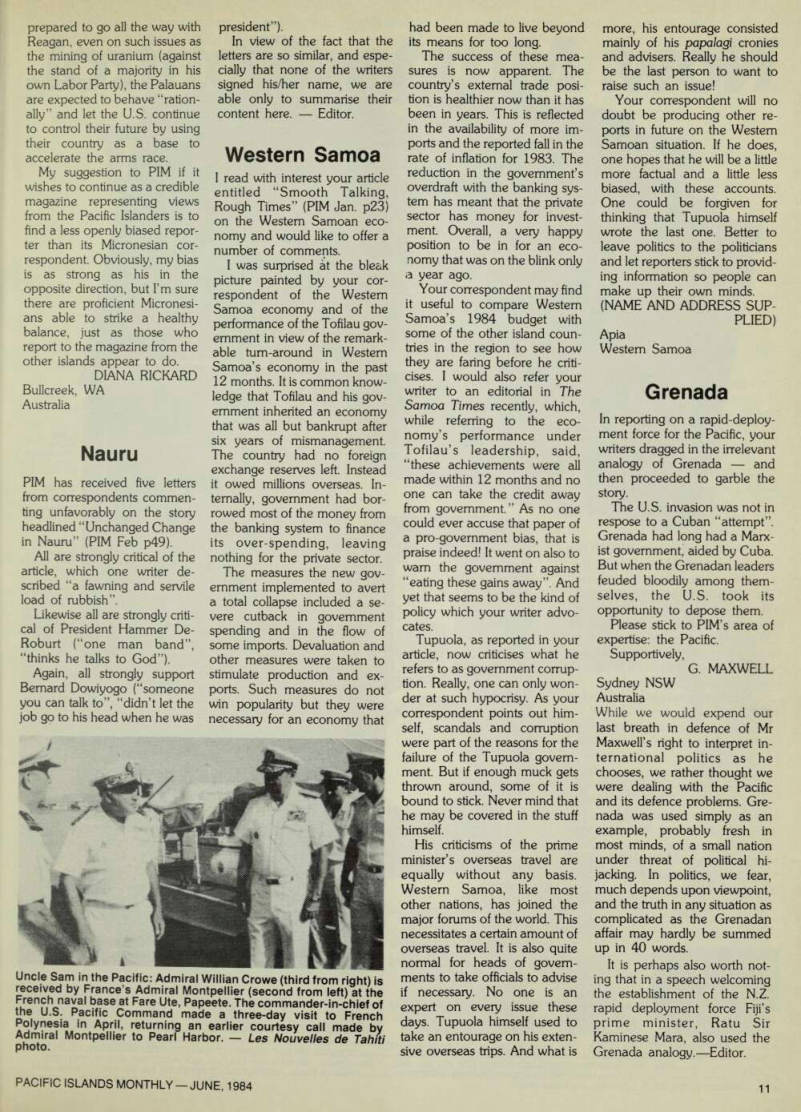
Uncle Sam in the Pacific: Admiral Willian Crowe (third from right) is received by France’s Admiral Montpellier (second from left) at the French naval base at Fare Ute, Papeete. The commander-in-chief of the U.S. Pacific Command made a three-day visit to French Polynesia in April, returning an earlier courtesy call made by Admiral Montpellier to Pearl Harbor. - Les Nouvelles de Tahiti photo.