tropicatities
p. 61 · Read in the full issue
Easter Island gets first local governor
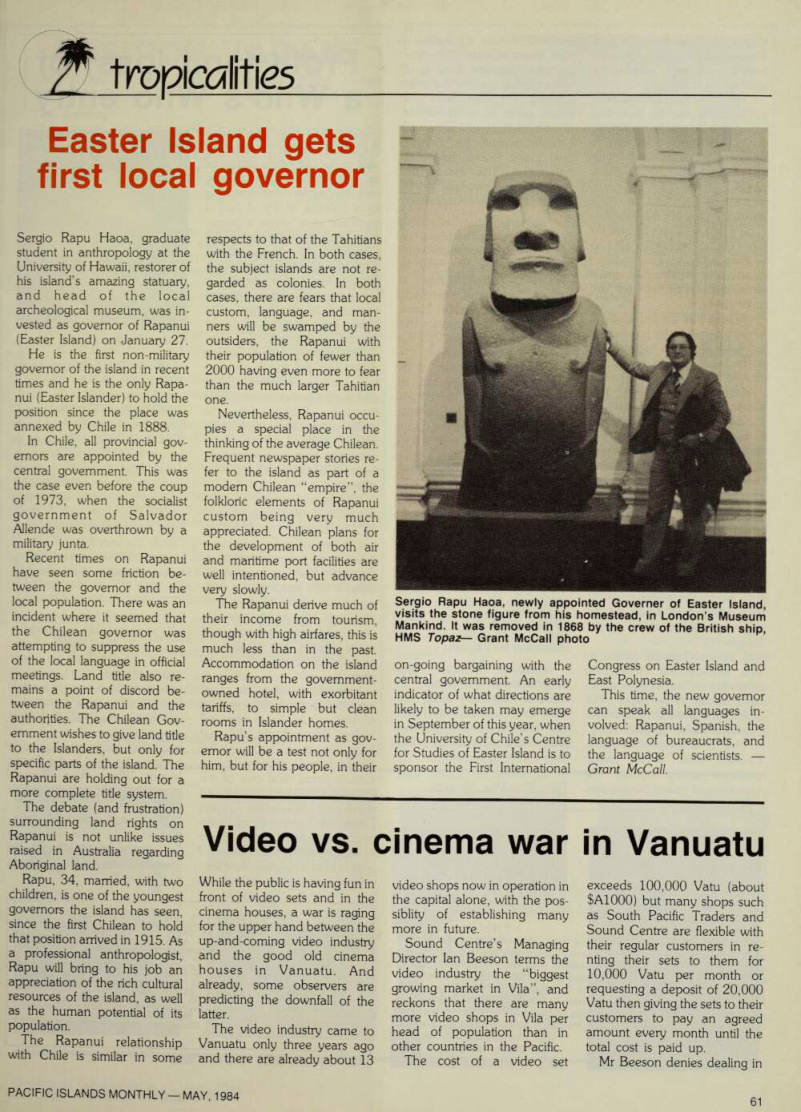
Sergio Rapu Haoa, graduate student in anthropology at the University of Hawaii, restorer of his island’s amazing statuary, and head of the local archeological museum, was in vested as governor of Rapanui (Easter Island) on January 27.
He is the first non-military governor of the island in recent times and he is the only Rapa nui (Easter Islander) to hold the position since the place was annexed by Chile in 1888.
In Chile, all provincial gov ernors are appointed by the central government. This was the case even before the coup of 1973, when the socialist government of Salvador Allende was overthrown by a military junta.
Recent times on Rapanui have seen some friction be tween the governor and the local population. There was an incident where it seemed that the Chilean governor was attempting to suppress the use of the local language in official meetings. Land title also re mains a point of discord be tween the Rapanui and the authorities. The Chilean Gov ernment wishes to give land title to the Islanders, but only for specific parts of the island. The Rapanui are holding out for a more complete title system.
The debate (and frustration) surrounding land rights on Rapanui is not unlike issues raised in Australia regarding Aboriginal land.
Rapu, 34, married, with two children, is one of the youngest governors the island has seen, since the first Chilean to hold that position arrived in 1915. As a professional anthropologist, Rapu will bring to his job an appreciation of the rich cultural resources of the island, as well as the human potential of its population.
The Rapanui relationship with Chile is similar in some
respects to that of the Tahitians with the French. In both cases, the subject islands are not re garded as colonies. In both cases, there are fears that local custom, language, and man ners will be swamped by the outsiders, the Rapanui with their population of fewer than 2000 having even more to fear than the much larger Tahitian one.
Nevertheless, Rapanui occu pies a special place in the thinking of the average Chilean, Frequent newspaper stories re fer to the island as part of a modem Chilean “empire”, the folkloric elements of Rapanui custom being very much appreciated. Chilean plans for the development of both air and maritime port facilities are well intentioned, but advance very slowly, The Rapanui derive much of their income from tourism, though with high airfares, this is much less than in the past, Accommodation on the island ranges from the government owned hotel, with exorbitant tariffs, to simple but clean rooms in Islander homes, Rapu’s appointment as gov ernor will be a test not only for him, but for his people, in their
on-going bargaining with the central government. An early indicator of what directions are likely to be taken may emerge in September of this year, when the University of Chile s Centre for Studies of Easter Island is to sponsor the First International
Congress on Easter Island and East Polynesia, This time, the new governor can speak all languages in volved: Rapanui, Spanish, the language of bureaucrats, and the language of scientists.
Grant McCall.
Sergio Rapu Haoa, newly appointed Governer of Easter Island, visits the stone figure from his homestead, in London’s Museum Mankind. It was removed in 1868 by the crew of the British ship HMS Topaz — Grant McCall photo