‘Kastom meresin’
pp. 31-33 · Read in the full issue

in Vanuatu
“She’s got fingers like steel, She came up to the house, felt all along my back, around my spine and nearly killed me in the process!
“It was fascinating. By the time Mabol had finished feeling, she could tell me what $l2O worth of X-rays and diagnosis had told me ”
The speaker is David Aitchison, Vanuatu’s Canadian auditor-general. Early this year he flew to Australia in a vain attempt to find some relief for a sudden aggravation of a longstanding back condition.
On his return, he was approached by some ni- Vanuatu friends, who suggested that he might like to consult a traditional healer Mabol, from Pentecost, who specialises in massage and manipulation techniques, “After everything I’ve done, I’ll try anything,” he replied, and thus became part of Mabol’s regular practice, which includes six other expatriates and many ni-Vanuatu.
He finds her therapy, which is still continuing, hard work, but worthwhile. “I’m screaming, ? yelling, biting the pillow; she s digging like hell. She’s got
good, strong hands and a good
understanding of anatomy . . .
She’s definitely started to get results. The pain is not as severe as it was previously this morning I was relatively upright. ” .i a , L As Da " d Aitchison s story shows, kastom meresin 1 medicine - is a I,ve y ? n info ™ a part ’ of Vanuatu s medlc f l P ra <*ce, tmd many peopte hope “ wlll contmue t 0 flourish - The Malvatumauri, or Coun cil of Chiefs, is one body committed to its continuance, not only for its value as health care, but because it is part of the living culture of Vanuatu, However the chiefs are aware, also, of some of its limitations and dangers. The body of knowledge gathered under the name of kastom meresin is amorphous, beginning, but not ending, with herbal knowledge, embracing massage and heat treatments and stretching as far as sorcery and poisoning. The Malvatumauri is adamant that malpractices must stop, and suggests that traditional healers should attend only to those in their own communities, so that
some check can be kept on their activities.
The Malvatumauri also points out that kastom meresin cannot heal all the illnesses now known in Vanuatu. Chief Willie Bongmatur, chairman of the Malvatumauri, believes that this is in part because new diseases not known before European contact are now in the islands new strains of malaria, for
instance. But he believes that another reason is the changing physical nature of the ni- Vanuatu themselves. “People’s bodies have changed. When their mothers were pregnant, they went to hospital, and took European medicine. They ate rice, milk, Milo, butter, tinned fish this affects the blood, changing it so that the herbal medicines can’t work as well. ”
Nevertheless, he believes that kastom meresin and West ern medicine can work to gether, and hopes for research to make clear their respective strengths.
The Vanuaaku Party, now in government, also recognises the value of centuries of traditional knowledge. It stated in its most recent platform that it intends to “promote traditional medicine use in modem ni- Vanuatu society” and to “en courage and promote more re search into practical medical uses of traditional medicine.”
This research has been undertaken, on behalf of the
Report from Vanuatu
Julie-Ann Ellis
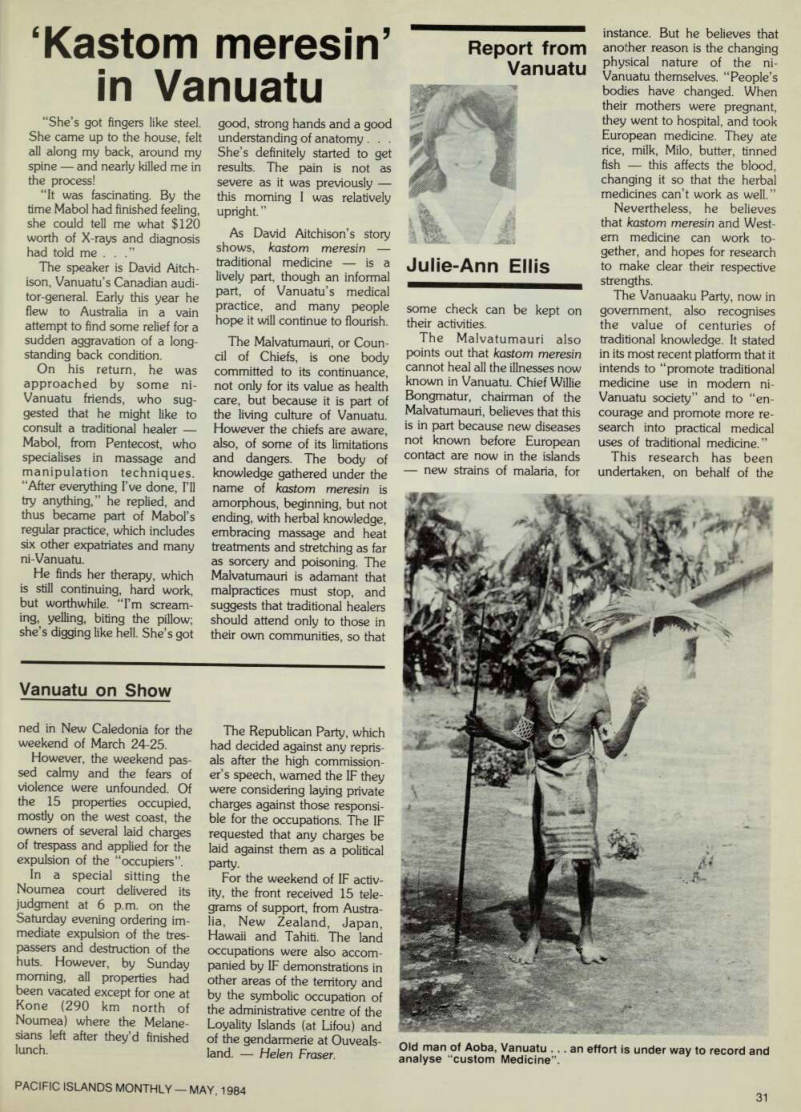
Old man of Aoba, Vanuatu ... an effort is under way to record and analyse “custom Medicine”.
Vanuatu Government, by OR STOM, the French Govern ment Office de la Recherche Scientifique et Technique d’Outre-Mer. Two ORSTOM employees have begun the huge task of classifying and ordering kastom meresin.
One is ethnobotanist Pierre Cabalion, who with two ni- Vanuatu assistants, Sam Chanel and Siwi Seoule, has been establishing a herbarium of Vanuatu’s plants, with spe cial emphasis on their medical use. This has entailed years of research in the bush, asking for each plant, its local name, the meaning of that name, its gen eral use and its medical use which can extend to extracts, infusions and poultices of roots, bark and leaves. The plants would then be classified, identi fied and recorded. Back in Port-Vila, they would be given preliminary chemical analysis, up until the Thin Layer Chro motography stage, tested for alkaloid content, and then sent to France for further testing.
This is not done in the hope of finding a wonder drug for release on the world market; Dr Cabalion points out that years of exhaustive and expensive tests would have to precede any such “discovery”. The pur pose is primarily for Vanuatu, to record its plants and their medi cal use.
He has found much of in terest, including local systems of nomenclature resembling the Linnaean system, with a “big name” (generic) and a “small name” (specific) for each plant.
One plant, for example, cal led Acalypha grandis in the Linnaean system, is called Nayang yang on Motolava, and is used to cure conjunctivitis, mouth ulcers, boils and sto mach pains; it is called Haari puusi on Santo, and used there for headaches, while on Erro mango it is known as Nognom pi nelavruli, and used to induce prophetic dreams.
Dr Cabalion has so far built up a collection of 4000 dried and classified plants, some of which were shown in a public exhibition in Port-Vila in March.
When complete, the collection will be presented to the people of Vanuatu.
The second ORSTOM em ployee, Dr Annie Walter, formerly worked as a medical doctor in several Third World
countries, and found; “I had problems with my medicine.
Patients didn’t respond as well as I had expected. There were misunderstandings very often. I realised it is important to see how to integrate Western medi cine with their traditions.”
Accordingly, she began the project she has been working on for the past two years, intensively studying traditional family planning and maternity practices, and the effect of Western practices, in central Pentecost.
The traditional understan ding of procreation and birth which she found was the “bas ket” model, where the woman is thought to be the passive nurturer of the baby implanted in her by the man. This led to many irrational taboos (for ex ample that the woman must not even look at the baby’s father during pregnancy) but also to many helpful practices (for ex ample, when an unweaned child is ill, the nursing mother is also treated).
The breaking down of these traditional patterns has led to a progressively shrinking interval between births formerly the average was 36.8 months, now it is 26.7 months which puts a greater burden on the women.
Kastom meresin practices she has found include diagnosis of impending birth by palpation (when dilation is complete, women are generally brought to the government dispensary for delivery), heat treatments after birth, and, above all, her bal treatments. There are plants to protect against abortion (be lieved to be caused by sorcery) and plants to help during pre gnancy and labor. There are three different kinds of con traceptive one to be taken monthly, one where a single dose makes a woman infertile until she takes a counteracting medicine, and one which leads to permanent infertility. These plants, like those Pierre Caba lion has found, have been sent for analysis.
Dr Walter’s work is not com plete; she intends to work a further 18 months collecting information on obstetrics and child care. However, she has begun to draw some tentative conclusions from her studies, and to describe the daily reali ties of kastom meresin, even
those parts, like sorcery, which seem imaginary to Western eyes. The value of this is recog nised by the people themselves, as she works among them. She reports that they said to her, before she last left the village, “Tankyu tumas (thank you) for Western medicine. Our children don’t die now as they did before. Your medicine is very
good but we have some sicknesses you don’t under stand. ”
It is the recording, and study, of these things, not understood by Western medicine, that is the aim of the research program, not just as anthropology, but as a positive contribution to the health system in Vanuatu.
Julie-Ann Ellis.