The Micronesian imbroglio
pp. 25-27 · Read in the full issue

- or the difficulty of calling a spade a spade
Dr STEWART FIRTH here presents a clear-cut and challenging viewpoint on the background to the present situation in Micronesia. Dr Firth recently toured the Trust Territory after complet ing a year teaching politics at the University of Hawaii. He has a career-long interest in Micronesian problems, having gained his PhD at Oxford with a study of aspects of the German colonial presence in the Pacific. He is at present senior lecturer in politics at Macquarie Univer
sity, Sydney.
What is independence and what is development? These are the two fundamental ques tions now confronting Ameri can Micronesia, and the answers being given are by no means clear.
A few weeks ago at a school at Ibobang on the west coast of Babelthuap, Palau, an Ameri can Peace Corps volunteer was asked to address a group of high school students. Keen eyed, barefooted, they wanted to hear what the expert had to say. She told them that Palau had gained its independence in 1981 and now faced post-inde pendence problems like those of the Ivory Coast, her previous posting.
In fact, Palau did not gain its independence in 1981. It gain ed self-government. And, bar ring the unexpected, it will not gain independence for 50 years.
Was it a random case of ignorance on the part of a well-meaning volunteer? At first I thought so, but then I was told by an official from the Trust Territory Administration in Saipan that the Palauans would be “independent” once agree ment was reached on the com pact, that same compact which all along has conferred control of Palau’s foreign alliances on the United States.
Misconceptions such as these are symptomatic of a wider problem in Micronesia, one which afflicts both Americans and Micronesians (though by no means all of them): the failure to call a spade a spade.
Palau, the Federated States of Micronesia, and the Marshall Islands, were and still are strategic colonies of the United States. Even when the Trust Territory is finally dissolved they will continue to be what the British in the days of the British Empire would have call ed “Protected States”, self governing countries under the
official suzerainty of a foreign power.
On the face of it, the reasons why the three Micronesian en tities are not gaining independ ence seem obvious: they are too small; they are overwhelm ingly dependent on the United States economically; and the Micronesians themselves voted for free association and do not
wish to be cast adrift from America.
But that interpretation of events leaves out the most crucial point, namely, that the United States has never been willing to lose its formal control over Micronesia and has there fore ensured that independence was never a real option for the Micronesians. American aid
offers have been tied to the status of free association, leav ing the Micronesians with a choice that was not a choice: either opt for free association and keep your standard of living, or else take your inde pendence and survive on fish from the lagoon. The third alternative independence followed by generous post independence aid has never existed in Micronesia.
As for smallness, an indepen dent Palau or Marshalls would not be the smallest nation in the Pacific; and the F.S.M., with 83,000 people, would be almost a middling power.
The origins of America’s de termination to stay in Mic ronesia go back to those des perate battles of World War II when hundreds of thousands of Japanese and Americans ended up as rotting corpses on the beaches and in the jungles of
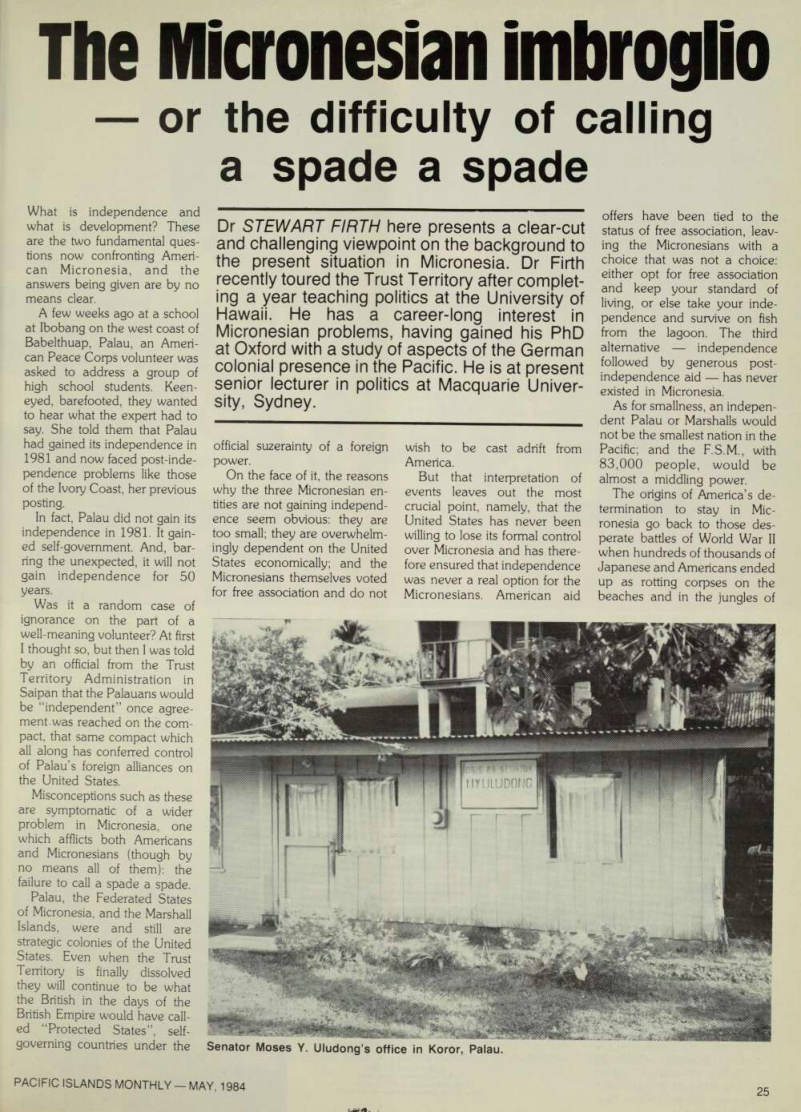
Senator Moses Y. Uludong’s office in Koror, Palau.
the islands. The reaction of the American joint chiefs of staff at the time was to demand that the U.S. simply annex the form er Japanese possessions. Presi dent Roosevelt and other inter nationalists such as Cordell Hull wanted trusteeship. The solu tion was a compromise: strategic trusteeship.
Nowhere else in the Pacific Islands since World War 11, with the possible exception of French Polynesia, has military influence been so significant as in the American Trust Territory; and now in the 1980 s decolon isation itself continues to bear the military stamp.
As Ambassador Fred Zeder, head of the (J.S. negotiating team, told a U.S. Senate hear ing in December 1982: “Mr Chairman, we work, of course, very closely with the Defense Department. As a mat ter of fact, about half my staff is from the Defense Department . . . One of the basics of this, entire exercise is our defense posture in the Pacific. Again, I believe the Defense Depart ment is very happy with the arrangements that have been spelled out in the Compact.”
To seasoned observers of the Micronesian scene, Zeder’s comment is a truism. But it is a truism worth emphasising, be cause it explains why decolon isation in Micronesia is such a special case, with no real equivalents in the South Pacific.
In the suzerain relationship which the Micronesians are en tering, the U.S. will continue to operate the Kwajalein Missile Range and will control the entry and movement of people in that area of the Marshall Is lands; the U.S. military will have free access to Micronesian waters and airspace and, at least in the Marshalls and the F.S.M., will be able to transport and store nuclear weapons; de pending on the outcome of the unresolved dispute between the U.S. and Palau, the Americans may be permitted to occupy four separate defence sites in Palua, including a great swathe of 30,000 acres in Babelthuap to be used for manoeuvres training.
As Michael Somare realises now that Australia is talking about tied aid, there is no such thing as complete independ ence in the Pacific Islands. Yet there are degrees of independ
ence, and the effect of the American military requirements in the compact is that the freely associated Micronesian coun tries will be the least indepen dent of all- the decolonisec Pacific nations. The U.S. armed forces in Micronesia will be a law unto themselves, exercising considerable powers of exclu sive jurisdiction, and even civ ilian Americans employed by the U.S. Government will enjoy special privileges and protec tions from local law.
How could it be otherwise, I hear my American friends saying, when the financial de pendence of Micronesia is so great? The F.S.M., for example, currently receive about 97 per cent of national and state gov ernment revenue directly or indirectly from U.S., and to a small degree Japanese, grants.
At least in the district centres, Micronesia has an economy which has jumped straight from subsistence to mass consump tion without the inconvenience of production. The disposable nappies, piles of Budweiser beer cans and rusting Japanese pickups attest to that.
Nor are the new Micronesian governments well known for scrupulous oversight of how all this money is spent. People on the government payroll in Koror or Kolonia, Ponape, or Majuro (and who isn’t?) seem to be able to pay for things somehow for trips in trucks, postage, airfares by drawing on some huge unseen account.
The government of President Haruo I. Remeliik in Palau has recently run out of funds for the fourth quarter of the current financial year.
It is on this question that the Micronesians, or some of them, are not calling a spade a spade.
True, there is not much to show for the $2 billion which the U.S. has spent in the Trust Territory since 1947. Water still fails to come out of taps; telephones squeak and go dead; roads are generally few and primitive for such small places. But the self governing states now have the chance of showing what could have been done with the money by spending less on private consumption and more on public facilities. Instead, they are running into debt by con tinuing to use U.S. funds to sustain a massive system of easy-going government jobs.
When the American warship USS Peleliu recently visited Peleliu Island in Palau, a small contingent of Palauans carried placards objecting to the visit.
But the Navy was smart. Not only did it organise a huge free barbecue for the islanders; it also sent helicopters ashore to take people back to the ship. As the helicopter landed near the protesters, they threw down their placards and clambered aboard with everyone else for a free flight.
The incident is a symbol of the tension between principle and expediency in the Micron esians’ attitude to the U.S. All along both sides have known that America will not leave Micronesia. There has been no deadline to concentrate Micronesian minds on really surviving on their own rather than mouthing the rhetoric of independence while waiting for the cash from Washington. And the Micronesians have negoti ated in the correct belief that the U.S. will pay a high price to remain in strategic control of their islands.
So the Micronesians have traded what they have. The Marshalls traded their value to the U.S. as a site for the testing of ICBMs; the F.S.M. theirs as territory denied militarily to other powers; and the Palauans are still negotiating, some be cause they are opposed in principle to the Americans’ attempt to make them abandon their nuclear-free constitution and to provide land to the U.S. military, others because they think they can make the Amer icans pay more.
Both sides have been cor rupted in this process. The Americans have pretended that they have the interests of the Micronesians at heart and have talked big about a new relation
ship which is not new at all. The Micronesians, not having to ponder seriously what devel opment might be, have deman ded more and more cash.
Recently, however, the Palauans have been more de termined than ever to protect their constitution and their land.
Their November counter-prop osal, which was supported by a united front of all Palauan fac tions, offered no military land options whatsoever and no au thorisation of nuclear sub stances. It was rejected by the U.S. in Washington in Decem ber. Early in February the Palauan Council of Chiefs admittedly only one factor in local politics called upon the Palauan Government to negoti ate for full independence.
Even the visit of the USS Peleliu, intended as a goodwill gesture by the Navy, has to some extent backfired now that Palauans are asking whether it was carrying nuclear weapons and was therefore in breach of the Palauan constitution. One thing that the Americans must wish the Palauans had not leamt so well is pride in their constitution.
The most recent develop ment is a new tack in the U.S. negotiating position. Ambassa dor Zeder has agreed to elimin ate designation of military land options from the compact with Palau. Yet the record of the U.S., which has never encour aged the political or economic independence of Micronesia, suggests that Zeder’s offer is cosmetic. He will seek the same land options by some backdoor agreement.
The real question is: will the Palauans settle for a price? Will they jump aboard the helicop ter? Or will they hold their placards? Stewart Firth.
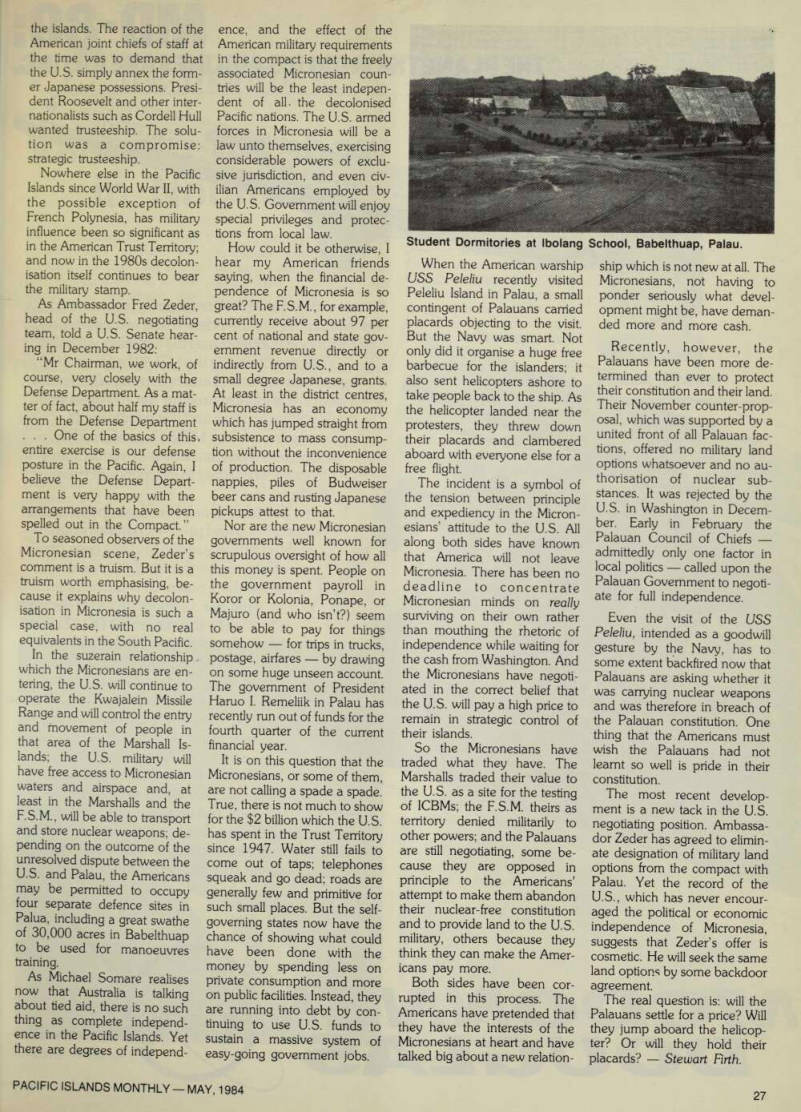
student Dormitories at lbolang School, Babelthuap, Palau.