W. Samoa” - says Eti.
pp. 19-24 · Read in the full issue

political currents
“We’re Turning the Corner in W. Samoa” - says Eti.
Western Samoa’s bulky and amiable Prime Minister, Tofelau Eti, has but one major idea in his mind ... the economic re covery of his small nation. His watchwords are self-reliance and hard work. When I inter viewed him in his spartan office on the Apia seafront, he quoted Churchill, saying he was offer ing his people only toil, tears and sweat. But then he chuck led and said it really wasn’t as hard as some people com plained and improvements were already notable.
Tofelau Eti’s administration does seem to have taken West ern Samoa a long way down the road to economic recovery in the last two years.
At that time the government had an overdraft of $13.2 mil lion at the national bank, owed large sums for oil, cement, cigarettes and airline services, and had twice fallen foul of the International Monetary Fund.
Today, after two quite rapid currency devaluations, and some measures which brought a good deal of grumbling from the public, the overdraft is gone and there was a surplus of $2.2 million at the beginning of 1984.
The foreign exchange debt of $13.8 million, locked in for oil and other essential commod ities and services, is now down to $5.3 million and the World Bank, which has just been in Apia looking at the books and taking the national pulse, has not only given Tofelau’s admin istration an A for effort, but has pronounced Western Samoa a model which other small third world countries should emu late.
All this, says the prime minis ter, is the result of careful attention to proper manage ment rules, which, he is quick to point out with notable relish, his
In the last 12 months, by a combination of guts, luck, and a shrewd appreciation of his own people and their abilities, Western Samoa’s prime minister, Tofelau Eti, has hauled his country much of the way out of a financial and political morass.
Since 1982 the country has had four prime ministers and three governments. In the past there was heavy spending, and little attention to the fine detail of fragile, small-country economics. Today, under Eti, things are less heady, but more stable.
In Apia Eti is not popular with some politically-active people, but he is a wise politician who knows that his power lies with the chiefs in the rural villages, and he pays great attention to them, cajoling, demanding, but always leading.
It was Tupuola Efi, aggressive, opinionated, who put Western Samoa on the international map. It is Tofelau Eti who has brought stabilisation and a plan for growth. His government seems likely to be re-elected next February and, on that basis stability, and international confidence, in W.Samoa will likely grow.
The budget is in pretty fair shape, dependent upon $25 million in aid funds, mostly from Australia and N.Z., but providing for expenditure of $85.6 million, much of it going into development.
The Public Service, which threw the country into chaos with a three-month strike in 1981, has a gripe, but was recently given a 5 per cent pay rise and their rumblings have diminished.
As Eti says in this conversation with P.1.M., his main problem is productivity, and he is doing something about that
predecessor, Tupuola Efi, seemed to ignore.
Of course, Tofelau Eti has been lucky as well as shrewd .. a powerful combination indeed.
Prices for agricultural commod ities upon which Western Samoa depends very heavily, have lately been very good. ”We had a surplus of $l4 million in our foreign exchange earnings last year,” he said.”l think that within a month or so’ we will be able to do away with the allocation system through which we have controlled im ports ... that system was intro duced seven years ago by the former government ... and our people will again be able to get the items they want.”
How stringent the allocation system has been is very evident in Samoa’s shops where empty shelves are everywhere and prices for even very basic items like toothpaste, imported from Fiji, are quite high.
Apia’s ’’coconut wireless” has developed a keen ear for the ’’cigarette rumor” which has the effect of creating long in stant queues outside shops alleged to have obtained sup plies. Burns Philp got their shipment of cigarettes just the other day ... eight cartons of them ... and the queue of hopeful smokers, or traders, stretched far down the street.
Tofelau Eti is confident he will be re-elected next Febru ary, but says there is yet much to do to consolidate Western Samoan prosperity.
His great strength lies in the grass roots of the country, and he is very conscious of this fact.
He has the attention of, and widespread support among, the village chiefs who, in fact, elect the government. Under the Western Samoan system, con firmed by a national referen dum, village chiefs hold the
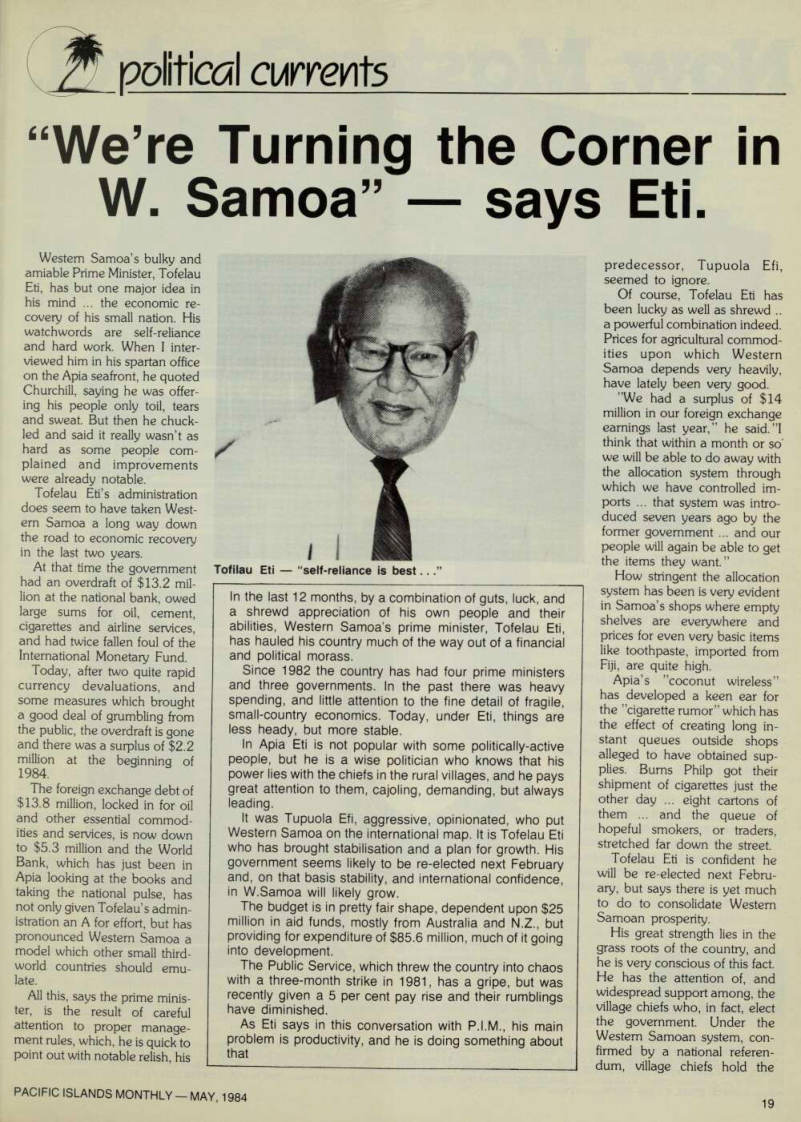
Tofilau Eti - “self-reliance is best..."
proxies of their people in na tional elections. Some say uni versal suffrage is coming, but probably slowly. Meantime the system has general public sup port and allows Tofelau Eti to manage the country’s affairs rather more easily than might otherwise be. ’’When I introduce new mea sures I always tell them they will be swallowing a pill not everyone will like,” he said. ”1 tell them that, but I also tell them WHY the hard times are necessary. The former govern ment did not want to put the house in order, but it MUST be put in order...and then things will be much, much better for everyone. ”
Samoa is currently enjoying a bonanza in prices for her goods.
Copra is now at WSs4l2 a tonne, and cocoa at WSS3SOO a tonne, both higher than they have ever been. ”Our biggest problem is pro ductivity,” the prime minister told me. ”Our farms could produce much more .. they have to produce much more. ”Our available manpower must be organised, and that is what I am doing by talking to the people and to the chiefs. ”1 want to make the country self-reliant. I don’t want everyone waiting for the teams from the agriculture department to come around to tell them what to do, and even to do it. ”So I talk to the chiefs, and I tell them there is a bill which recognises the authority of the chiefs, and they must realise that it means they have a
responsibility to their people. ’’They must not think they can just sit around and be chiefs, and do nothing,” he said with a grin.
The prime minister is a man of great enthusiasm, and he is also a very good and clever grass roots politician, for he knows his people and has not lost touch with the villages.
In the towns, especially among the young intelligentsia, he is frequently criticised for his ’’failure to overcome the coun try’s problems.” But this seems to be the impatience of youth, and the reaction of smaller groups, rather than the wide spread opinion of the country.
Among businessmen, and foreign diplomats, he is re spected and admired, and the general feeling in these areas seems to be that the country is emerging from its troubled times, and is now set on a careful, conservative, and con structive course. But there is much yet to be done.
Tofelau Eti says, with jus tification, that nobody in West ern Samoa needs a Doctor of Philosophy at their shoulder to plant a coconut. But since ’’the previous government closed the nurseries three years before we came to power, we now have to arrange supplies of planting materials from the Solomons, and perhaps even from Papua New Guinea where they have a surplus of these things,” he said. ”In another year’s time we will be back on the road to providing these things ourselves. The agriculture de
partment has started the nurseries again. ”So this year, of 1984, is for sustaining the growth we have had. Last year we stabilised things. This year, and the three years after that, if my govern ment is re-elected, will be years of growth and a return to prosperity. ’’Then, maybe, we can re value our currency. Inflation is down a little, and with hard work and organisation we can take it down further. We can get the cost of living down and return to normalcy in our eco nomy.”
The key to much, if not all, of this ... the economic turn around, and the guarded confi dence Tofelau Eti shares with his business and diplomatic community, is the expansion and development of Apia’s Faleolo Airport.
At least WS$lO million, and probably nearer WSsl4 mil lion, will be spent here up grading the strip to handle Boeing 727 and similar aircraft, and the passenger and freight loads they can carry.
Work has already started (although it has been subjected to some slight delays because of a land dispute with local villa gers), and government negotia tions are under way with Aus tralia, New Zealand and Japan about total funding.
Tofelau Eti wants the donor countries to advance their aid packages two or three years to give him the finance for the vital project.
Australia may do this. New Zealand, which bears the cost of running, maintaining and servicing the airport, may not, but will be helpful in other directions.
Bigger aircraft (though not yet, and perhaps never, any thing as big as a Boeing 747), will swell a two-way traffic of tourists in, and agricultural pro ducts out. ”1 don’t want to be too optimistic,” he said, ’’but I have my faith that if we devise things properly in our minds, if we plan and work, and get the people to cooperate, then we can be successful. ”1 don’t want my country to be an asking country all the time. I want us to be self-reliant, and we can be.”
Development of tourism is already looking up. Richard
Hadley, the millionaire Amer ican entrepreneur who, ten years ago, started the big Royal Samoan Hotel project around the point from Apia town, and then stopped it when he be came wary of Samoa’s pros pects, and could not get assur ances about development of the airport, team from the Had ley organisation was in Apia just before Christmas, 1983, and Hadley himself has now been back to talk with Tofelau Eti about resumption of work.
The project is for a 500-room hotel with, probably, a casino, which would operate entirely for tourists. Tofelau Eti is now nudging 60 years of age, but is the picture of health, is full of enthusiasm, plans, and hopes.
He believes in his people, and in the virtues of hard work and the use of traditional social systems to organise it.
But he has also learned to be cautious. ”1 have been elected since 1957,” he said. ’’But I was beaten in 1973 .. only by six votes, but beaten .. and it was because I was over-confident.
Over-confidence breeds mis takes. ”
I asked him to enumerate the problems he saw ahead of Western Samoa, and he thought carefully for a time. ”Our defence we have already discussed with Austra lia, New Zealand and the Un ited States,” he said, clearly confident of their support. ”Our people are being made aware of what they must do to be prosperous. ”Our only problem is with trade, and perhaps a little with education. ”Our debt-servicing ratio, which was at 20 per cent after the last government finished, is now back to 14 per cent of revenue, and is likely to go down still further. ”We sometimes have too much politics ... politicians who want to arouse the public and make them impatient, but it’s not really a problem. ’’There is a strong tendency of our people to migrate to New Zealand, mostly for family reasons, but some come back, too. (It is estimated that about 100,000 Samoans, including foreign-bom Samoan offspring, now live in New Zealand). ’’Samoa is a very good coun try to live in, but no-one likes it when there are economic prob
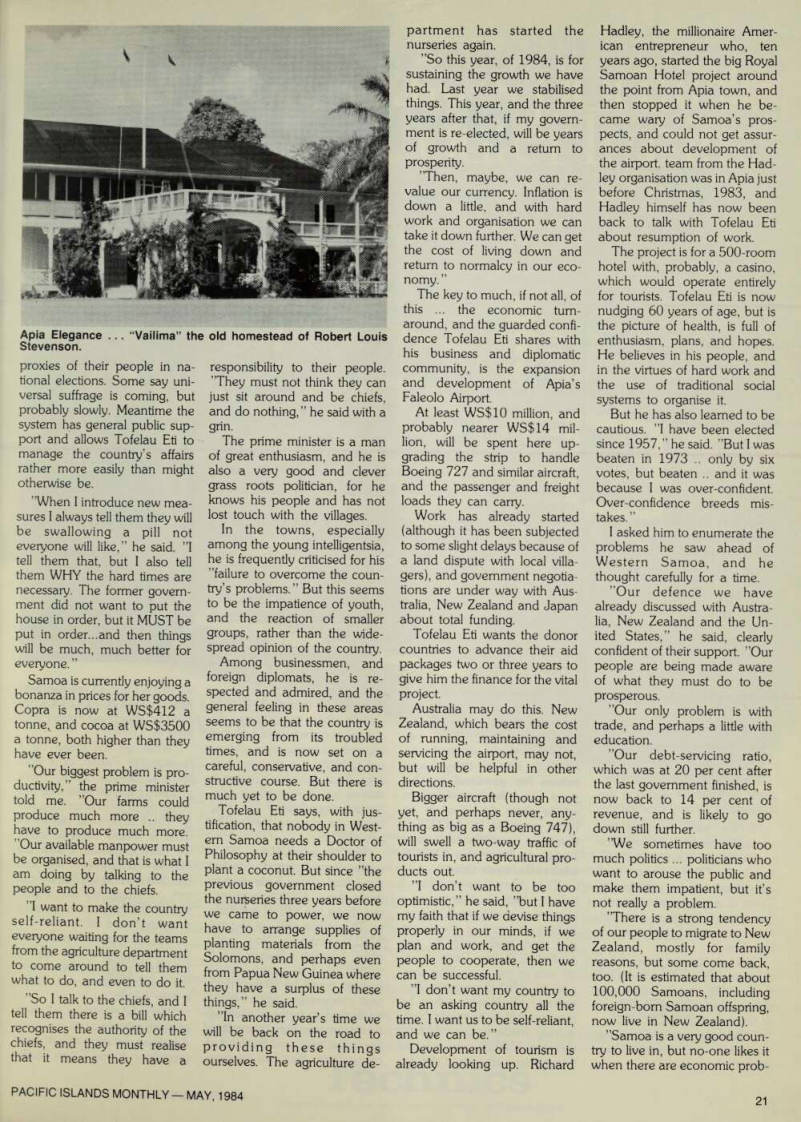
Apia Elegance ... “Vailima” the old homestead of Robert Louis Stevenson.
lems and upsets,” he said.
As for the educational prob lems he sees, much of this is connected with the hoped-for establishment of a national uni versity of Samoa.
There are probably two reasons why Tofelau Eti’s gov ernment, and some others, would like their own university.
One, clearly enough, is that they feel students of a national university would be much more ”in tune” with their home than if they went away to Fiji and returned, probably with a whole bunch of radical ideas.
The other may have to do with the fact that there is a university in the country already, run by the Congre gationalist church, the biggest church in Western Samoa, but it reportedly suffers from lack of funds. Most students go to the University of the South Pacific, based in Suva, Fiji.
USP’s agriculture faculty is, however, in Apia, and is heavily over-subscribed for 1984.
Tofelau Eti himself, associ ated as he is with the Con gregational church, would, fair ly naturally, like to see a na tional university established, but seems fairly philosophical about it.
But one move has already been made by the establish ment of a 7th form, known as the university foundation year, in Apia for 1984. This will be funded by scholarship money given by Australia and New Zealand ... money which other wise would have gone mostly to USP in Suva where, previously, most Samoan university aspir ants did their foundation year.
Tofelau Eti has received some criticism for allowing this to be done on very short notice. ”lt we keep sending our students abroad, they forget the problems we have at home,” he said. ’’They come back expecting to be spoon-fed.
Then, if a government cannot give them what they demand, there are strikes and troubles like that. ”We don’t want that sort of thing in Samoa. They have got them in Fiji .. trade unions and strikes .. but it is too early for us to have them. ’’While we are developing, we have to conserve our strength,” he said •
“I have sensed in the last months,” said Sir Robert, “that some of the island states have re thought their attitude to ANZUS which they have taken for granted in the past, and have said that while they don’t wish to be a partner in ANZUS... they are nevertheless very happy to have the ANZUS umbrella over them.
“This has come about, I believe, because there was a change of government in Aus tralia and some of the things that had been said by the Australian Labor Party when (it) was in the opposition wor ried the ANZUS partners. For tunately Mr Hawke, when he became prime minister, very quickly made it clear that he was pro-ANZUS, and a lot of things that were feared did not
eventuate.
“Inside 12 months ANZUS is back to where it was before the change in government and, be cause these issues were addres sed publicly, it is stronger than ever. Because, what it means is that as far as Australia is con cerned, regardless of who may be the government, they will be pro-ANZUS.
“But the effect of it ... this is really where I started ... is that the island states have had to think about ANZUS in a way they have not had to previous ly. They have said we like the ANZUS umbrella. Now that’s good, because it means that if there is any cooperation needed it will be forthcoming, and cooperation again would be limited to perhaps visits by American warships when they are in the area, and the kind of cooperation that has to exist
when you are an independent state and you’ve got a defence treaty that in effect covers your area. ”
“What do we mean by a nuclear-free Pacific, or a nuc lear-free South Pacific, more precisely? It is an issue that has come up in the Forum regular ly. There is no clear picture of what is meant because when we have discussed it with the Hawke government we find that there is nothing that we can put our finger on that repre sents a change from the present situation,” said Sir Robert.
“We all oppose French nuc lear testing. We all oppose nuclear testing whether it is in the South Pacific or not. That’s a firm position...
“We, and Australia, fall short of saying that we will not have American warships with nuclear propulsion in the South Pacific
because we regard that as in consistent with our membership in ANZUS. You cannot say we have got a defence treaty with the U.S. which means that the U.S. will come to our rescue if we are attacked, but they must not bring any one of 40 per cent of the American Navy ... they can only bring ships with conventional propulsion sys tems. Plainly, that would be ridiculous.
“As to nuclear weapons, the Americans will never disclose whether a ship is carrying nuc lear weapons. I accept that. The Hawke government accepts that. Why should we tell the Soviet Union precisely the capability of various ships of “The Soviet Union has ex panded its activities tremendously over recent years and established new bases ... they are very active in the Pacific ... the one thing they would dearly love to have, I believe, is a land-based pre sence in the South Pacific ... they were rebuffed, and the principal reason why they were rebuffed is the existence of the
South Pacific Forum which is very cohesive. The leaders of the island states would far soon er be members of the Forum ...than be satellites of the Soviet Union,” Sir Robert said.
“One has to be very careful here (in discussing French atti tudes on New Caledonia),” said Sir Robert. “Am I convinced they are doing the right thing? I would not use those precise words. I am satisfied with what they are doing. I believe the present French government sincerely intends to move New Caledonia to independence in the shortest possible time, and I would put a time-scale of five years on it.
“I believe that there is still a difficulty in that the independ ence movement has not yet accepted the fact that you can not have a Kanak state with everyone else as second-class citizens ... I have said ... as far as New Zealand is concerned, we could not support any indepen dent state where all of those citizens who are of French or part-French origin don’t have the same value of vote as the Melanesians.
“Now, that is in my mind the only issue of substance that is preventing a rapid movement toward independence. In other words, it is a constitution that’s required, and the way to do it is to have a mixed electorate so everyone has a vote of the same value, but you vote in such a fashion as to preserve the nationalist aspirations of the indigenous people.
“1 think independence will come. I don’t think there are any problems there. I have talked to President Mitterrand a number of times ... it is not a question of whether it will come, but when...”
Sir Robert said he thought “Vanuatu has caused some concern. There is no question about that. But I see signs of maturity in that government.
They are less strident today than they were even a year ago ... in the broader sense, although they established direct diplomatic relations with Cuba, my feeling is that it was more a gesture than anything of real substance. ”
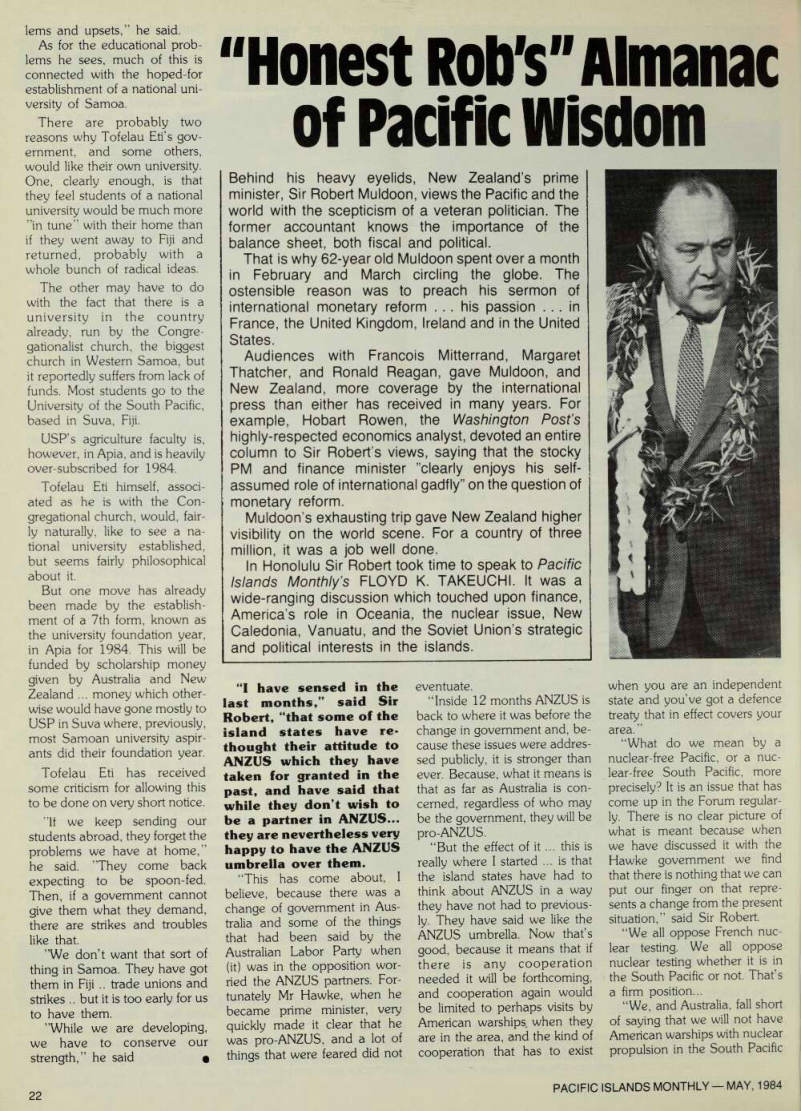
“New Zealand is the honest broker of the Pacific. To some
extent we have a foot in both camps. We are small, but we are affluent. We earn our living from the sale of primary pro ducts, as do many Third World countries.
“When someone says to us ’the price of sugar has collapsed and our economy is in trouble,’ we understand. Because if the price of butter or wool col lapses, our economy is in trou ble.
“The reason why I am so active in (urging international monetary reform) is because we do come very much be tween the developed and deve loping world. There are no votes in this for me, because at home the people do not fully understand what it is all about.
They say the prime minister is travelling when he should be at home. But we are the go between,” Sir Robert said. “At New Delhi we were seen as that by the Commonwealth heads of government .. it was the Third World countries that wanted New Zealand to lead the reform effort because they understood that we could be an honest broker...”