letters
pp. 9-59 · Read in the full issue

Kava benefits Australian Aborigines
I read with interest your recent report “Looking at Kava as an Export Crop” (February 1984) by Julie-Ann Ellis.
In recent years, the con sumption of kava in northeast Arnhem Land (Northern Terri tory of Australia) has experi enced a profound acceptance and expansion. It has proved not only a cash-earner for the Pacific exporters, but also for the outstation resource or ganisation located at Yirrkala (the major Aboriginal settle ment located near the bauxite mining town of Nhulumbuy).
I understand profit from its sales to outstation groups has enabled the purchase of a Toyota truck by the Resource Centre used to service the growing number of outstations. (Outstations are those home land centres in Arnhem Land which is land owned by Yolngu under the Aboriginal Land Rights Act (N.T.) 1976).
The use of kava was re portedly introduced by Fijian community workers associated with the United Church. It has displaced, or at least provided
an alternative to, alcohol and has the advantage of being a social activity without the side effects of intoxication which has, in the past, led to argu ments and deaths.
In my experience important community meetings are now preceded by the drinking of kava so that social cohesion is reinforced before the discussion of important issues.
Government understanding is yet to be fully achieved with respect to the consumption of kava. At least one senior gov ernment officer has stated that kava is a drug and therefore to be opposed. Thankfully, the Uniting Church has taken a more positive approach.
Perhaps the Pacific has more to offer us in the Territory?
Certainly kava has proven a useful contribution.
R. W. Ellis
Director, Aboriginal Sacred Sites Authority.
Darwin N.T.
Australia
Fate of the
Wphc
archives
I hope you will allow me, through your columns, to shed further light on the situation described in Dr Jim Boutilier’s recent article “Little short of a tragedy” (January 1984 issue of PIM).
The files of the Western Pacific High Commission (WPHC), which previously formed part of the Western Pacific Archives (WPA), are deemed to be British public records. This point, and its legal implications is well known to the archivist of the Solomon Islands National Archive, Mr Wale.
The background to the return of the WPHC and other records to the UK is that in 1978, with the lease of the WPA building in Fiji running out, a quick deci sion on how best to safeguard the records had to be taken.
Considerable deterioration of the records had already taken place, due to the ravages of climate and insects. No other building in the Western Pacific region was suitable for the storage of the archives, which included not just the records of the Western Pacific High Com mission but Island records from miscellaneous other sources which some of the individual governments were not in a position to take over. These
were crated and removed to Britain as an immediate step, to ensure their safekeeping and to guard against further deteriora tion. At the same time, some material from the WPA was sent to the individual govern ments of Solomon Islands, Kiri bati and Tuvalu; this consisted of their own more recent territo rial records.
In his article, Dr Boutilier quotes Bruce Burns as obser ving that it would be “little short of a tragedy” if the WPA holdings were broken up and dispersed. He goes on to com ment “sadly, that is exactly what happened”. This is not correct.
The principle of safeguarding the integrity of the archives was regarded as of paramount im portance and the records of the Western Pacific High Commis sion have not been dispersed.
The records are residing in the Foreign and Commonwealth Office from where, since the crates were opened in Septem ber 1980, all queries, whether from governments or from pri vate individuals, have been answered. Where practicable, photocopies have been pro vided. The records may soon be back in the Pacific, following a formal request for them from the Solomon Islands Govern ment. Initial legal obstacles to making a gift of these records to the Solomon Islands have been overcome and the British Gov ernment is.currently seeking the views of other governments in the Western Pacific region on this proposal.
M. S. Berthoud
Consul-General British Consulate-General Sydney, NSW Australia
Trader Bob
Re PIM December 1983: I should like to submit the follow ing lines concerning the story “Trader Bob: A Fisherman’s
Continued on page 59
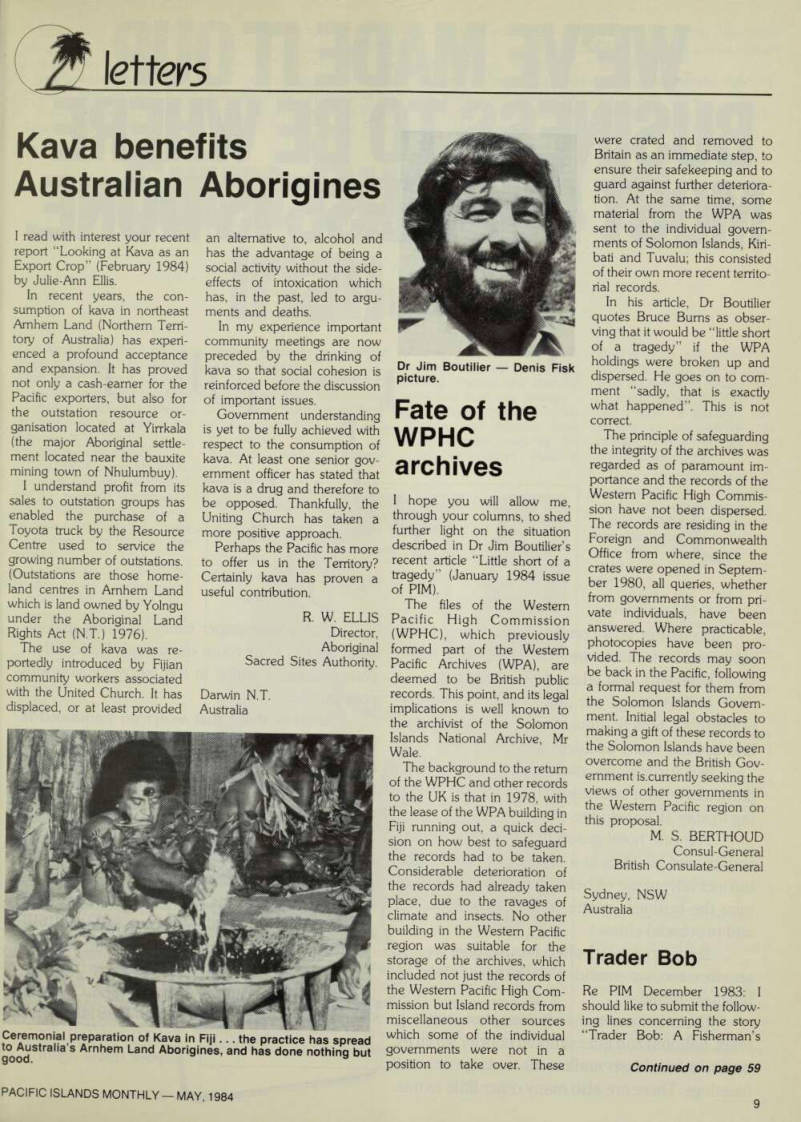
Ceremonial preparation of Kava in Fiji... the practice has spread to Australia's Arnhem land Aborigines, and has done nothing but good.
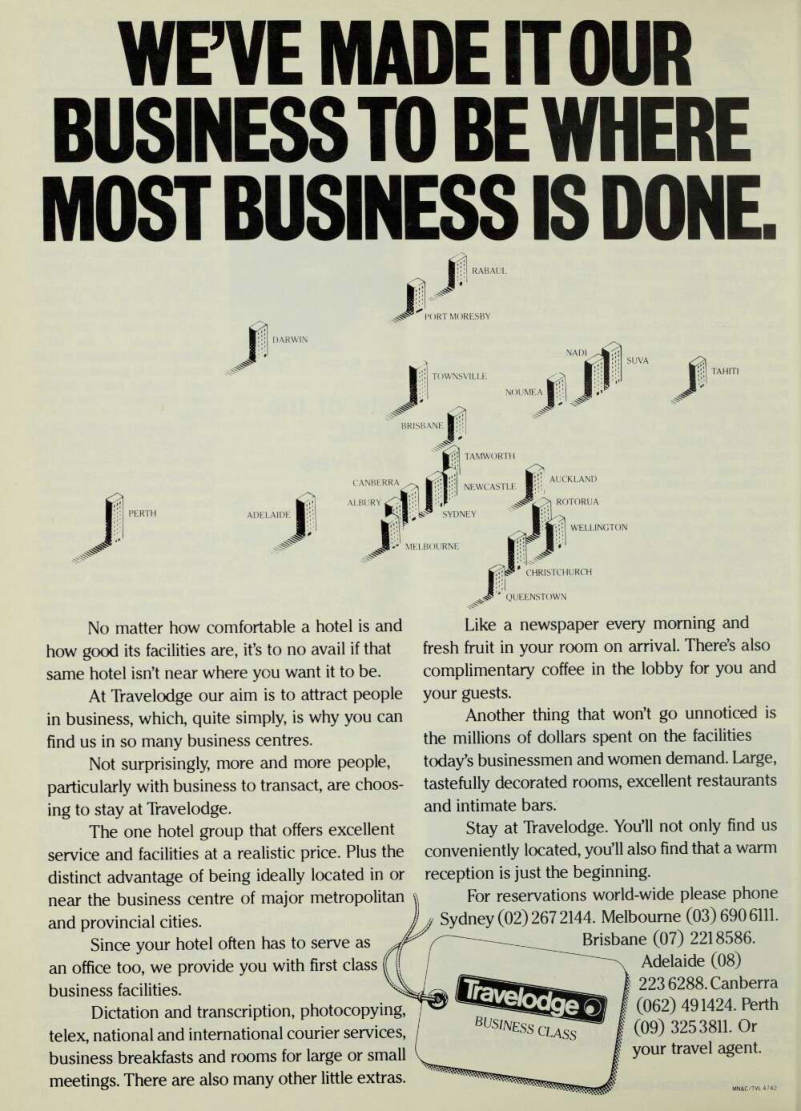
Dr Jim Boutilier - Denis Fisk picture.
Tale from the Old Condomin
ium” (p 47):
In Russell Paul’s tale Trader Bob Comes through like a fearsome slob.
Did the “uncrowned king” of Tanna Really behave in such oafish manner?
And are we long-time friends of
Pim
To be affronted by more of him?
Still, I reckon that no literary fuss Will follow from the yams of Russ.
His prose style may be !*!*!*ing quaint But Louis Becke he !*!*!*inq ain’t
Tom Dennison
Waverley, NSW Australia
Vanuatu’s
Cuban
connection
During a visit to Port-Vila last year I had the opportunity to admire the work of Nikolai Michoutouchkine although re grettably I did not have the pleasure of meeting the artist himself.
I was therefore surprised to read in PIM February issue of a personal attack on me by Mr Michoutouchkine who, like others in Vanuatu, seems to have become particularly upset over an article I wrote, which appeared in a number of Aus tralian newspapers, highlighting the fact that Vanuatu has estab lished diplomatic relations with Cuba.
In the same issue of PIM you report the December 20 state ment by Papua New Guinea Prime Minister Michael Somare who told of Indonesian Presi dent Suharto’s concern over the establishment of diplomatic relations between Vanuatu and Cuba. Mr Somare told the president that at the South Pacific Forum meeting in Can berra in August last year, Pacific Islands leaders had met in formally with Vanuatu Prime Minister Fr Walter Lini to tell him of their concern also. Prime Minister Somare comments “Anywhere Cuba went, there
were always problems.”
Unfortunately, this is all too true.
The Cuban constitution itself commits that country to the support of revolutionary move ments in countries overseas. A recent CIA report said that President Castro now had 50,000 troops and “advisers” stationed in 20 nations. Cuba is active in Africa, the Caribbean, Central and South America. It gets more than one billion dollars a year in military aid from the Soviet Union. It has a long history of being an in ternational trouble-maker and meddler in the affairs of small states.
Although Vanuatu has apparently decided not to ex tend diplomatic recognition to the Soviet Union because it does not wish to be seen allying itself to a super-power, it has recognised Cuba. And Cuba has moved smartly to send an ambassador to present his credentials at Port-Vila.
The unanswered question re mains why?
This was one of the reasons I sought an interview with Prime Minister Lini when I visited Vanuatu. My request for an interview was met by a counter request from the prime minis ter’s media adviser that I submit a list of questions for considera tion. One of my questions was the subject of Cuba.
Some time later I was told the prime minister was too busy to see me. The question remained unanswered by the prime minister or anybody else on his staff.
Mr Michoutouchkine theo rises that my article on Vanuatu and its Cuban connection was somehow written in a fit of pique because I did not meet the prime minister.
Let me assure him it was not.
It was written by an Australian
journalist concerned that Cuba now has a toehold in the Pacific and that the stability of the region may be threatened in the future.
John Hamilton
Brisbane, Qld.
Australia. • Mr Hamilton, a Specal Correspondent for The Herald and Weekly Times Ltd., has won the 1983 Canadian Award for Journalistic Merit in Repor ting International Affairs (Paci fic Region).
Micronesia
How much longer do we have to put up with Floyd K. Takeu chi’s apologist articles on the intransigent Micronesian poli ticians and the generous and well-meaning U.S. Govern ment? It would be of benefit and interest to all PIM readers if a Micronesian writer could en lighten us about the real aspi rations that motivate these “dif ficult” islanders.
Take the case of Palau. In PIM of June, 1983, Takeuchi says that “the compact was approved by a majority, but voters failed (my emphasis C.C.) to override constitutional prohibitions on nuclear materials . . . this is a con stitutional issue and must be worked out by Palauans with out American interference Vincent Ito (PIM, Aug.) says that inadequate education about the compact led to confu sion among Palauan voters, and that a vote for the compact cannot be interpreted as a true reflection of Palauan people’s perceptions.
However, Palau’s controver sial “nuclear-free” constitution has been put to the vote in one form or another three times, and each time the Palauan people have clearly indicated their support for their unique constitution.
So the problem would now seem to be a problem with the compact and not a problem with the constitution.
As the Palauans don’t want to amend their constitution, the U N Trusteeship Council should ensure that the U.S. fulfils its obligations, i.e. to safeguard the rights of the indigenous people under its “trusteeship”, and not
to safeguard the rights of the U.S. military machine.
Chris Chandler
French Island, Vic.
Australia
A word for
people-to
people aid
The article “Sulphur in the Air as Rabaul waits for the big blow” (PIM March p2l) pro vided good background to the next volcanic eruption which the oddly-sited town must en dure sooner or later.
When discussing possible foreign aid, you said that the ministers of foreign affairs and defence would determine the level of assistance from Austra lia. This is perfectly correct, insofar as it applies to govern ment-to-government aid. But there is more to inter-country aid than that.
The Australian Overseas Dis aster Response Organisation (AODRO) happens to believe that the very substantial people to-people aid which its 19 com munity organisation members can give through their Papua New Guinea counterparts is equally important and should be mentioned. The ministers will not determine that.
If aid is necessary, during or after an eruption in Rabaul, and we pray to God that it will not be, assistance from the Austra lian people, alongside that pro vided by their government, will be determined by the wishes of the PNG people, as expressed through their own community organisations and churches, and the spontaneous outpour ting of care and concern by individual Australians for their fellow humans in distress.
PIM readers may also be interested to know that, in AODRO, the Australian com munity has its own point of co-ordination and source of expertise to make the non government component of Australian overseas disaster aid, particularly in the Pacific, as effective as it can be.
Robin F. Morison
Executive Director Australian Overseas Disaster Response Organisation Surry Hills NSW Australia
Nikolai Michoutouchkine - AIS picture by Alex Ozolins.