A Hi-Jacking
pp. 13-15 · Read in the full issue


Cover Story
How To Stop
Pacific means peaceful. And so it has been, more or less, tribal rivalries and historic happenings excluded, since time immemorial. Yet, how fragile is that most devoutly-sought condition of peace. Could we see a Grenada in the Pacific?
Defence planners don’t say yes, and they don’t say no. But Britain has now joined Australia and New Zealand in establishing within her armed forces units designed to react quickly in support of any regional government appealing for help against political “hi-jacking.”
THE ATTEMPT made late last year by Cuban-supported forces to “hi-jack” the small British Commonwealth na tion of Grenada, in the Carib bean, shook a lot of comfort able international thinking to its core.
It also embarrassed Britain as the United States, ignoring accusations that it was using a broad-sword to pluck a daisy, staged a massive rescue operation.
Today, with order restored, and coup-makers pushed back, calmer heads believe the Americans were probably correct to thus demonstrate how costly any political hi jacking attempt could be, and how slender its chances of success.
But there is another, and more pregnant question which is now bothering many small countries, even in the warm and serene Pacific reg ion. Could it happen again?
And if it did, how could the hi-jackers be stopped?
Australia, which takes its “friend and brother” role in the Pacific very seriously, has for some time had within its army a battalion-strength unit called the O.D.F. (operational deployment force) capable of re
spending within hours to any call for
help.
New Zealand is about to set up a similar group of about 1200 men backed up by Scorpion light armored reconnaissance tanks, helicopters and transport aircraft.
And now, from London, come reports that the British also have contingency plans for a highly sophisticated amphibious strike force able to move by jet transport aircraft to the aid of any Commonwealth or
friendly nation under threat of a
political hi-jacking.
The Special Air Service (SAS), that most expert and secret of special commando forces, and its naval counterpart, the Special Boat Squad ron (SBS) are reported to have sur veyed both the Caribbean and the Pacific already, working to special orders written by the British Prime Minister, Mrs Thatcher.
London reports say that the idea of this Commonwealth strike force was
raised at the last Commonwealth Heads of Government Meeting (CHOGM) in New Delhi in December.
Mrs Thatcher is believed to have suggested the Commonwealth force, involving not only Britain, Australia and New Zealand, but also Canada, as a way of avoiding repetition of the
embarrassing and dangerous Grenada
affair. That Grenada happened at all was bad enough, she is believed to have said, but that a non- Commonwealth nation had to go in and clean up is worse, for it threw into doubt the Commonwealth’s abil ity to defend itself and its smaller, possibly more vulnerable members.
How far strategic and tactical plan ning has gone on an integrated Com monwealth force is unknown, but, since Commonwealth armed forces leaders are in constant contact, the files are probably more than detailed.
The British Foreign Secretary, Sir Geoffrey Howe, more or less con firmed Whitehall’s decision to go ahead on the strike force in a state ment to the House of Commons in December. At that time it seemed that the Commonwealth, judged at least by reactions at the CHOGM meeting, were not about to cooper ate. Yet, very soon afterwards, the New Zealand Defence Review tabled in parliament in Wellington, was also talking about a “ready reaction force.”
This, said the Wellington reports, would be part of a program which would involve scrapping New Zea land’s frigate fleet and replacing
those surface ships with four submarines.
The special ready reaction force would consist of between 1000 and 1200 troops and be based at Burnham Camp in Canterbury. In addition to ordinary infantry companies and light, fast. Jaguar-engined Scorpion tanks, this force would also include SAS troopers.
“It will be equipped and trained for land operations up to as high a scale of intensity as can be foreseen in the circumstances of the South Pacific,” said the review. It would also have priority within the New Zealand ar my in its selection of manpower and equipment.
And then, in one small paragraph, came what most see as the core of the thinking behind the plan: “The South Pacific has remained largely unaf fected by the military conflicts and tensions that have plagued other reg ions. The aim of our foreign and defence policies must be to keep things that way ...”
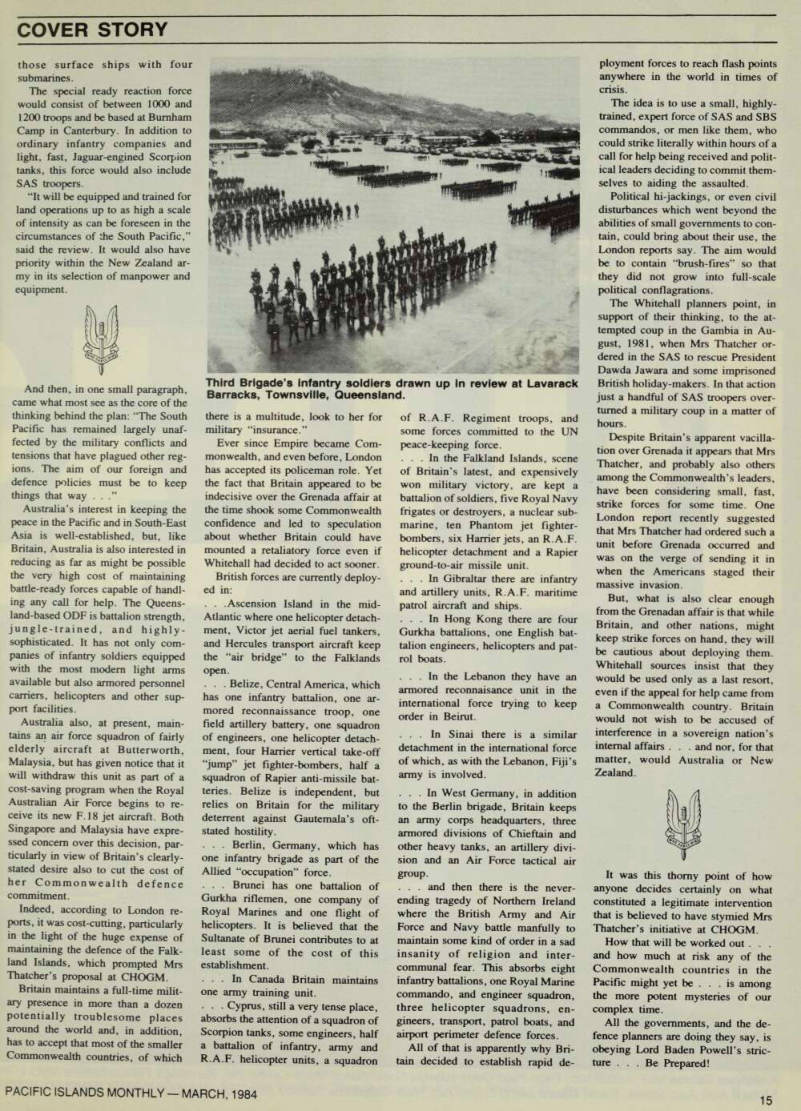
Australia’s interest in keeping the peace in the Pacific and in South-East Asia is well-established, but, like Britain, Australia is also interested in reducing as far as might be possible the very high cost of maintaining battle-ready forces capable of handl ing any call for help. The Queens land-based ODF is battalion strength,
jungle-trained, and highly
sophisticated. It has not only com panies of infantry soldiers equipped with the most modem light arms available but also armored personnel carriers, helicopters and other sup port facilities.
Australia also, at present, main tains an air force squadron of fairly elderly aircraft at Butterworth, Malaysia, but has given notice that it will withdraw this unit as part of a cost-saving program when the Royal Australian Air Force begins to re ceive its new F.lB jet aircraft. Both Singapore and Malaysia have expre ssed concern over this decision, par ticularly in view of Britain’s clearly stated desire also to cut the cost of her Commonwealth defence commitment.
Indeed, according to London re ports, it was cost-cutting, particularly in the light of the huge expense of maintaining the defence of the Falk land Islands, which prompted Mrs Thatcher’s proposal at CHOGM.
Britain maintains a full-time milit ary presence in more than a dozen potentially troublesome places around the world and, in addition, has to accept that most of the smaller Commonwealth countries, of which
there is a multitude, look to her for
military “insurance.”
Ever since Empire became Com monwealth, and even before, London has accepted its policeman role. Yet the fact that Britain appeared to be indecisive over the Grenada affair at the time shook some Commonwealth confidence and led to speculation about whether Britain could have mounted a retaliatory force even if Whitehall had decided to act sooner.
British forces are currently deploy ed in: . . .Ascension Island in the mid- Atlantic where one helicopter detach ment, Victor jet aerial fuel tankers, and Hercules transport aircraft keep the “air bridge” to the Falklands open.
Belize, Central America, which has one infantry battalion, one ar mored reconnaissance troop, one field artillery battery, one squadron of engineers, one helicopter detach ment, four Harrier vertical take-off “jump” jet fighter-bombers, half a squadron of Rapier anti-missile bat teries. Belize is independent, but relies on Britain for the military deterrent against Gautemala’s oft
stated hostility.
. . . Berlin, Germany, which has one infantry brigade as part of the Allied “occupation” force. . Brunei has one battalion of Gurkha riflemen, one company of Royal Marines and one flight of helicopters. It is believed that the Sultanate of Brunei contributes to at least some of the cost of this establishment. ... In Canada Britain maintains one army training unit. . . . Cyprus, still a very tense place, absorbs the attention of a squadron of Scorpion tanks, some engineers, half a battalion of infantry, army and R.A.F. helicopter units, a squadron
of R.A.F. Regiment troops, and some forces committed to the UN
peace-keeping force.
. . . In the Falkland Islands, scene of Britain’s latest, and expensively won military victory, are kept a battalion of soldiers, five Royal Navy frigates or destroyers, a nuclear sub marine, ten Phantom jet fighter bombers, six Harrier jets, an R.A.F. helicopter detachment and a Rapier ground-to-air missile unit. ... In Gibraltar there are infantry and artillery units, R.A.F. maritime patrol aircraft and ships. ... In Hong Kong there are four Gurkha battalions, one English bat talion engineers, helicopters and pat rol boats. ... In the Lebanon they have an armored reconnaisance unit in the international force trying to keep order in Beirut. ... In Sinai there is a similar detachment in the international force of which, as with the Lebanon, Fiji’s army is involved. ... In West Germany, in addition to the Berlin brigade, Britain keeps an army corps headquarters, three armored divisions of Chieftain and other heavy tanks, an artillery divi sion and an Air Force tactical air group. . . . and then there is the never ending tragedy of Northern Ireland where the British Army and Air Force and Navy battle manfully to maintain some kind of order in a sad insanity of religion and inter communal fear. This absorbs eight infantry battalions, one Royal Marine commando, and engineer squadron, three helicopter squadrons, en gineers, transport, patrol boats, and airport perimeter defence forces.
All of that is apparently why Bri tain decided to establish rapid de
ployment forces to reach flash points anywhere in the world in times of crisis.
The idea is to use a small, highly trained, expert force of SAS and SBS commandos, or men like them, who could strike literally within hours of a call for help being received and polit ical leaders deciding to commit them selves to aiding the assaulted.
Political hi-jackings, or even civil disturbances which went beyond the abilities of small governments to con tain, could bring about their use, the London reports say. The aim would be to contain “brush-fires” so that they did not grow into full-scale political conflagrations.
The Whitehall planners point, in support of their thinking, to the at tempted coup in the Gambia in Au gust, 1981, when Mrs Thatcher or dered in the SAS to rescue President Dawda Jawara and some imprisoned British holiday-makers. In that action just a handful of SAS troopers over turned a military coup in a matter of hours.
Despite Britain’s apparent vacilla tion over Grenada it appears that Mrs Thatcher, and probably also others among the Commonwealth’s leaders, have been considering small, fast, strike forces for some time. One London report recently suggested that Mrs Thatcher had ordered such a unit before Grenada occurred and was on the verge of sending it in when the Americans staged their massive invasion.
But, what is also clear enough from the Grenadan affair is that while Britain, and other nations, might keep strike forces on hand, they will be cautious about deploying them.
Whitehall sources insist that they would be used only as a last resort, even if the appeal for help came from a Commonwealth country. Britain would not wish to be accused of interference in a sovereign nation’s internal affairs . . . and nor, for that matter, would Australia or New Zealand.
It was this thorny point of how anyone decides certainly on what constituted a legitimate intervention that is believed to have stymied Mrs Thatcher’s initiative at CHOGM.
How that will be worked out . . . and how much at risk any of the Commonwealth countries in the Pacific might yet be . . .is among the more potent mysteries of our complex time.
All the governments, and the de fence planners are doing they say, is obeying Lord Baden Powell’s stric ture ... Be Prepared!
Third Brigade’s infantry soldiers drawn up in review at Lavarack Barracks, Townsville, Queensland.