Pacific Tourism
pp. 9-55 · Read in the full issue

The Promise And The Pitfalls
The Pacific is the last great tourist paradise left unspoiled on earth. In a world increasingly beset by evil and by violence tourists are looking ever more longingly at the tranquillity and, perhaps above all, the personal security offered by the Pacific.
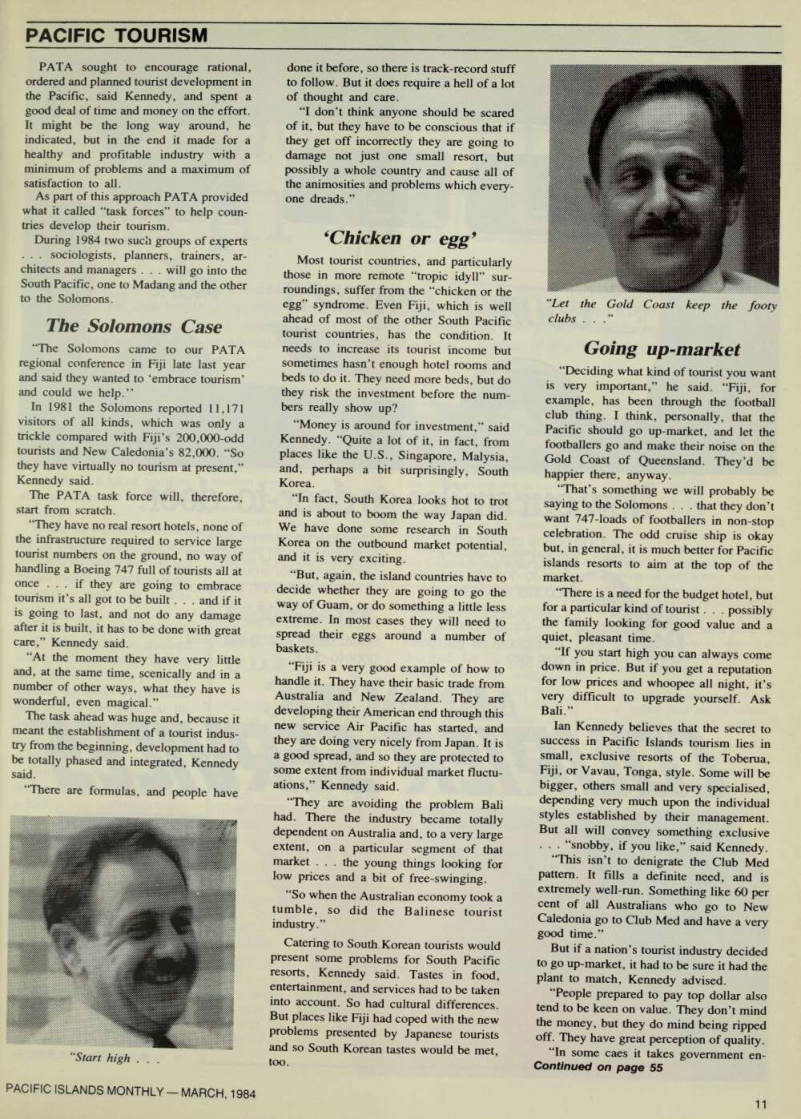
With a scenario like that there ought to be a dollar or two to be made by the judicious from the discerning. There is, says lan Kennedy, Director, South Pacific, for the Pacific Area Travel Association (PATA). But, he advises in this exclusive interview with PIM, governments and entrepreneurs must take care, and plan.
The key word is planning . . . total planning of industry development. No country, and particularly not a small country with a population vulnerable to cultural upheaval, can now afford to get into tourism without having a very good idea of how it is to be handled, and what its effects are going to be.
PATA is more conscious than most of the problems caused by over-development and too-rapid development. It’s no good for the host country, no good for the visitor, and therefore no good to the industry.”
The halcyon days when some destinations reported tourism growth rates ranging up to 15 per cent annually, and sometimes more, are now over, he said. “Even if all of the current optimism in Australia and the U.S. about a return to prosperity and high growth turns out to be correct, I doubt that we will see expansion of the Pacific tourist industry exceeding eight per cent a year, and even that is going to be good going.
Too fast is bad,” Kennedy said. “I don’t think anyone would want to see another Guam, or even another Waikiki, in the South Pacific.
You cannot dump thousands of people on somewhere like Samoa, for example, without proper facilities and services.
And you cannot establish the right facilities, and all the necessary ancillary services, with just the wave of a wand.
“You look at Western Samoa planning to build an airstrip big enough to handle Boeing 747 jumbos and you have to wonder about the awesome ramifications of such a decision.
They’re really monumental and could have effects extending decades into the future.”
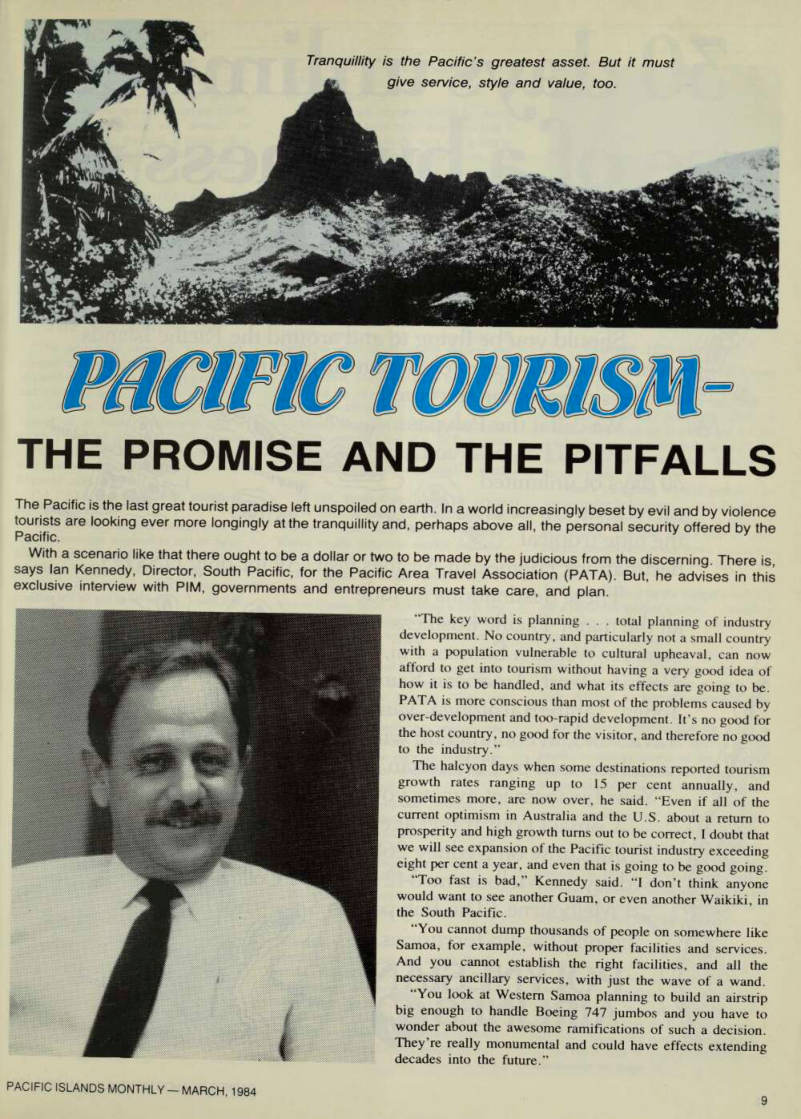
Tranquillity is the Pacific’s greatest asset. But it must give service , style and value, too.
PAT A sought to encourage rational, ordered and planned tourist development in the Pacific, said Kennedy, and spent a good deal of time and money on the effort.
It might be the long way around, he indicated, but in the end it made for a
healthy and profitable industry with a
minimum of problems and a maximum of satisfaction to all.
As part of this approach PATA provided what it called “task forces” to help coun tries develop their tourism.
During 1984 two such groups of experts . . . sociologists, planners, trainers, ar chitects and managers . . . will go into the South Pacific, one to Madang and the other to the Solomons.
The Solomons Case
“The Solomons came to our PATA regional conference in Fiji late last year and said they wanted to ‘embrace tourism’ and could we help.”
In 1981 the Solomons reported 11,171 visitors of all kinds, which was only a trickle compared with Fiji’s 200,000-odd tourists and New Caledonia’s 82,000. “So they have virtually no tourism at present,”
Kennedy said.
The PATA task force will, therefore, start from scratch.
“They have no real resort hotels, none of the infrastructure required to service large tourist numbers on the ground, no way of handling a Boeing 747 full of tourists all at once ... if they are going to embrace tourism it’s all got to be built . . . and if it is going to last, and not do any damage after it is built, it has to be done with great care,” Kennedy said.
“At the moment they have very little and, at the same time, scenically and in a number of other ways, what they have is wonderful, even magical.”
The task ahead was huge and, because it meant the establishment of a tourist indus try from the beginning, development had to
be totally phased and integrated, Kennedy
said.
“There are formulas, and people have
done it before, so there is track-record stuff to follow. But it does require a hell of a lot of thought and care.
“I don’t think anyone should be scared of it, but they have to be conscious that if they get off incorrectly they are going to damage not just one small resort, but possibly a whole country and cause all of the animosities and problems which every one dreads.”
‘Chicken or egg *
Most tourist countries, and particularly those in more remote “tropic idyll” sur roundings, suffer from the “chicken or the egg” syndrome. Even Fiji, which is well ahead of most of the other South Pacific tourist countries, has the condition. It needs to increase its tourist income but sometimes hasn’t enough hotel rooms and beds to do it. They need more beds, but do they risk the investment before the num bers really show up?
“Money is around for investment,” said Kennedy. “Quite a lot of it, in fact, from places like the U.S., Singapore, Malysia, and, perhaps a bit surprisingly, South Korea.
“In fact. South Korea looks hot to trot and is about to boom the way Japan did.
We have done some research in South Korea on the outbound market potential, and it is very exciting.
“But, again, the island countries have to decide whether they are going to go the way of Guam, or do something a little less extreme. In most cases they will need to spread their eggs around a number of baskets.
“Fiji is a very good example of how to handle it. They have their basic trade from Australia and New Zealand. They are developing their American end through this new service Air Pacific has started, and they are doing very nicely from Japan. It is a good spread, and so they are protected to some extent from individual market fluctu ations,” Kennedy said.
“They are avoiding the problem Bali had. There the industry became totally dependent on Australia and, to a very large extent, on a particular segment of that market ... the young things looking for low prices and a bit of free-swinging.
“So when the Australian economy took a tumble, so did the Balinese tourist
industry.”
Catering to South Korean tourists would present some problems for South Pacific resorts, Kennedy said. Tastes in food, entertainment, and services had to be taken into account. So had cultural differences.
But places like Fiji had coped with the new problems presented by Japanese tourists and so South Korean tastes would be met, too.
Going up-market
“Deciding what kind of tourist you want is very important,” he said. “Fiji, for example, has been through the football club thing. I think, personally, that the Pacific should go up-market, and let the footballers go and make their noise on the Gold Coast of Queensland. They’d be happier there, anyway.
“That’s something we will probably be saying to the Solomons .. . that they don’t want 747-loads of footballers in non-stop celebration. The odd cruise ship is okay but, in general, it is much better for Pacific islands resorts to aim at the top of the market.
“There is a need for the budget hotel, but for a particular kind of tourist. . . possibly the family looking for good value and a quiet, pleasant time.
“If you start high you can always come down in price. But if you get a reputation for low prices and whoopee all night, it’s very difficult to upgrade yourself. Ask Bali.” lan Kennedy believes that the secret to success in Pacific Islands tourism lies in small, exclusive resorts of the Toberua, Fiji, or Vavau, Tonga, style. Some will be bigger, others small and very specialised, depending very much upon the individual styles established by their management.
But all will convey something exclusive . . . “snobby, if you like,” said Kennedy.
“This isn’t to denigrate the Club Med pattern. It fills a definite need, and is extremely well-run. Something like 60 per cent of all Australians who go to New Caledonia go to Club Med and have a very good time.”
But if a nation’s tourist industry decided to go up-market, it had to be sure it had the plant to match, Kennedy advised.
“People prepared to pay top dollar also tend to be keen on value. They don’t mind the money, but they do mind being ripped off. They have great perception of quality.
“In some caes it takes government en-
Continued on page 55
“Start high . . .
“Let the Gold Coast keep the footy clubs ...”
couragement to get operators to see the sort of thing which is needed.
Management is all
“But, in the end, it is management which decides it all . . . how a resort is operated, how the staff handles its job, and the customers; all the many very delicate fac tors which contribute to a feeling of sat sifaction in the mind of the tourist so that he will tell everyone back home how good it was and so he will keep on coming back.”
India, particularly, and also New Zea land, had done excellent work in making their own people, both inside and outside the industry, conscious of the value to the nation of tourism.
“At the next Fiji Tourism Convention we hope to have an expert from India speaking on this crucial aspect,” Kennedy said.
PAT A also had a standard kit for the Pacific on tourist awareness which set out what governments, the public and the tourist industry needed to know.
One of the problems of the Pacific lay in its distances and airline services, Kennedy said, although he believed that a more rational and integrated approach to the region’s problems was in process of
development.
“I am optimistic,” he said. “You have people like Ansett coming into the area very aggressively and you have develop
ments like the seat-sharing between Qantas and Air Pacific.
“The South Pacific has gone through a very interesting era since the arrival of the Boeing 747,” Kennedy said.
“Previous aircraft, like the DC-8 and 707, had to stage through places like Fiji.
Then came the 747 which could over-fly the islands and go direct from North America to Australia and New Zealand.”
Islands-Oz-NZ
“For most tourists, Australia and New Zealand are the magnets which bring them to the South Pacific. That is why it is important to see the island countries and Australia and New Zealand as part of a whole . . . they are complementary. Each can serve the other if they approach the business with that understanding in mind.
“So, while the 747 s still mostly fly overhead, we are beginning to see the advent of a more professional approach to route development. Better inter-island ser vices are being introduced, using more suitable aircraft, and there is less competi tion purely on price. Airlines cannot be expected to operate loss-making services unless it is done for a reason and with the understanding and agreement of the gov ernments involved. [Air Pacific is probably an example of this latter philosophy. Their management has said it was less concerned in launching their Project America with profits on the airline than with increasing the national income from tourists. Thus, while Air Pacific has just reported a loss of $6
million for the last financial year ($lOO,OOO less than the previous year) Fiji is understood to be more than satisfied with the growth achieved in high-spending tour ist business from North America. 1 “Overall it looks pretty good,” said Kennedy. “There are problems, and there will be hiccoughs, but in general I am very optimistic about the Pacific.
‘ Stay different .. .’
“There are great differences in the de gree of development and professionalism.
Fiji is well ahead. Tahiti, New Caledonia and the Cook Islands have all been at it for some time. Vanuatu is very much a com petitor. Samoa has problems, the Sol omons really have yet to get going, and apart from Madang, Papua New Guinea is also yet to decide what it wants to do.
“There are differences of sophistication which make some difficulties, and yet, they are also very much a plus. The primitive nature of some of the areas provides perhaps their greatest attraction.
“But where you have an unsophisticated area you also have great vulnerability, which gets back to what I was saying about the enormous need for careful, intelligent and far-sighted planning.”
“I would hate to see something like Queensland’s Gold Coast in the Pacific.
The islands just couldn’t afford it. It would
destroy them.
“But there’s no need for that. They will do better by being different, by specialising and, I think, by going up-market and choosing their markets very carefully.”