A tough testing time
p. 13 · Read in the full issue
Fiji
A tough testing time for economy and political system
Barely a soul in Fiji, with the possible exception of some union leaders, does not appreciate how difficult an economic year 1984 will be for their country.
In common with several other Pacific Island nations the com bined effects of cyclone and drought in 1983 set up a financial chain reaction which some ex pect will take at least a full 12 months, and probably more, to work through.
Adding to this is an atmos phere of political unease . . . tempers were frayed and patience sorely tried during the long and unhappy Royal Commission into the 1982 general election, and feelings among political leaders since then have been fractious.
This culminated, in the final days of December, in a walk-out from Parliament of the almost entirely Indian opposition, the National Federation Party, on an issue which, in easier times, might never have arisen ... the authority of the Speaker, Tomasi Vakatora, to require the Leader of the Opposition, Jai Ram Re ddy, to observe the custom of the House by standing when addres sing the Chair.
One Hong Kong entrepreneur, visiting Fiji on a regional tour devoted to finding new places to invest the money he wished to remove from his home colony, was heard to say: “Fiji cannot truly claim political stability until the Opposition party has not only won an election, but been al
lowed by all citizens to govern.”
Then he went on his way.
Be that view as it may, most objective observers of Fiji be lieve it remains a good place in which to invest, and are still reasonably confident that, de spite alarums such as Decem ber’s pettishness in the House, the country is big enough and stable enough (and perhaps scared enough of the consequ ences of a serious inter-racial mistake), to go on being stable and progressive.
Yet on both grounds, econom ics and politics, 1984 will be a very testing year.
Cyclone Oscar, which hit last April, was vastly more damaging than the run-of-the-mill cyclones which all Pacific islands have long since learned to endure.
Oscar not only hit the sugar, but it flattened the tourist industry on the western Division coast as no cyclone had done before.
The inevitable publicity, most of it fuelled by interviews with over-excited tourists keen to exp lain their heroism in the face of appalling danger, not only brought visits to a complete stop at the time, but has continued to damage Fiji as a destination, although the tourist industry plant is now completely rebuilt and, indeed, upgraded.
Tourism lately surpassed sugar as Fiji’s prime source of income.
The $4O million insurance payout for the cyclone damage provided a badly-needed injec tion of spending money and, for a time, trade picked up handily, particularly in the building and associated industries which had been seriously depressed. But all of that is now spent, unemploy ment is again very high and growing, and prospects are gloomy for many workers.
For the first time in its history the Fiji Sugar Corporation is budgeting a loss for 1984, the direct product of the disastrous drought of 1983 and also the very large amounts spent in the last few years in updating plant to cope with expected record crops.
Many lay-offs have exacerbated the overall decline in employ ment and also damaged general retail trade in sugar areas.
As it is, Fiji’s income from sugar in 1984 is not expected to rise over $9O million, which re presents a drop of more than 40 per cent in the national income from that vital source.
The national airline, Air Pacif ic, has gambled a good deal, for Fiji if not directly for itself, upon the success of its Project Ameri ca, a relatively ambitious scheme for a company of Air Pacific’s size. This provides a three-times a-week service between Nadi and Honolulu, flying a wet-leased DC-10 using Western Airlines flight crew and male and female Air Pacific cabin crew.
At $398 (Fiji currency) round trip, Nadi-Honolulu, a trip to and from Suva thrown in free, the fare is attractive, if not exactly
profit-oriented for Air Pacific.
The airline expects to lose at least a couple of million dollars running Project America in the first year but, given only even reasonable loadings, and an aver age spending of $7OO per tourist per visit, it could net Fiji the best part of $2O million additional foreign revenue, and provide de sperately needed extra employment.
But a rise in unemployment and, indeed, a rise in tourist derived income, is dependent up on further investment in the in dustry. And here, while the pic ture is not exactly throbbing with life, it is a good deal more healthy in prospect than anything else in the country.
Three major hotel develop ments are in train, two on islands offshore from Nadi/Lautoka and the third on one of the most attractive beaches on Viti Levu’s western coast.
Elsewhere the picture is mur ky. Manufacturing shows only moderate promise, even with the very practical aid of SP ARTEC A giving Fiji, among Forum Island nations, very generous duty-free access to Australia and New Zealand.
Most companies are very short of cash and are carrying very heavy debt ... a perennial problem in Fiji where business practices generally owe more to Bombay than to Sydney. This also hinders development and
flexibility.
Yet with all its current, in herited, and forseen problems, Fiji remains one of the most promising of the Pacific’s na tions. It is already embracing sophisticated industrial and business techniques and, though yet cautiously, is beginning to compete for business in quite tough export markets.
It has so far enjoyed very conservative and wise manage ment of its finances under the direction of Finance Minister Charles Walker. He resigned last December for personal reasons which remain unexplained. But even without him, there should be little or no change in estab lished monetary policies.
Given that, some sound over seas investments and a reason ably smooth political climate, Fiji should survive 1984 some what battered, but unbowed.
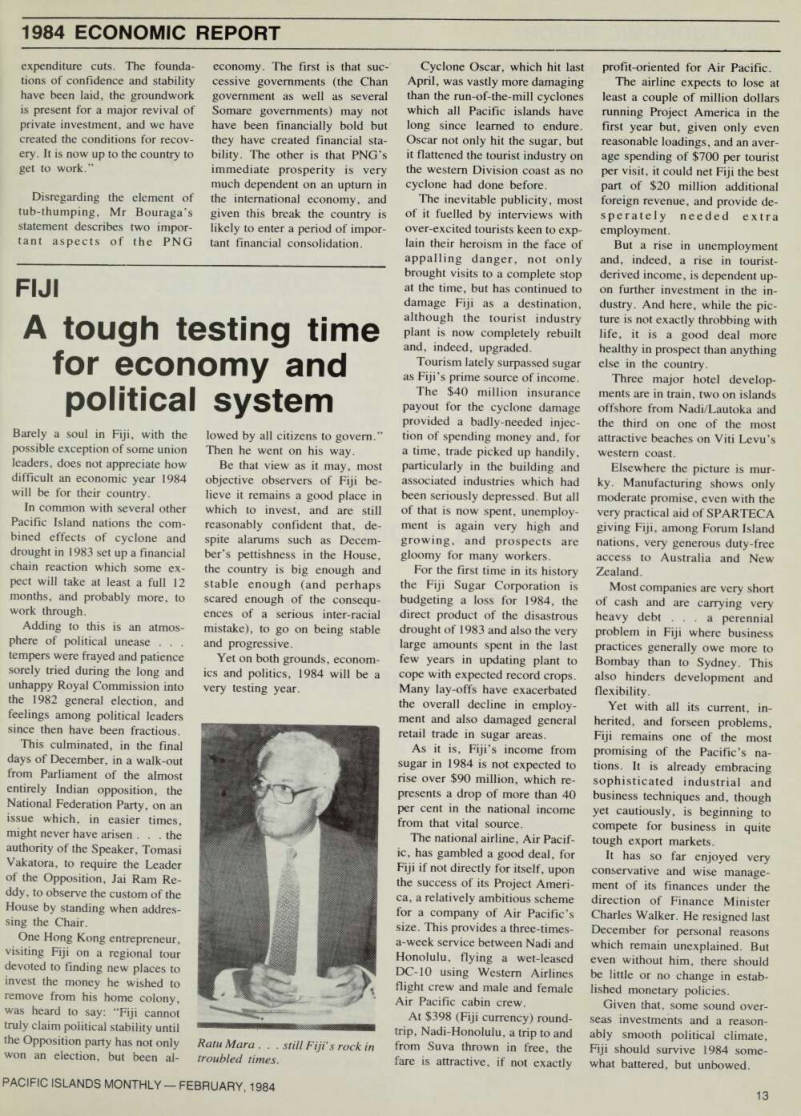
Ratu Mara . . . still Fiji’s rock in troubled times.