Tough Times, But
pp. 9-11 · Read in the full issue
1984 Economic Report
Light Ahead
The American economy is back in gear. In Australia bankers are cautious, but optimism ishigh. Butwhat of the Pacific, which traditionally lags 12 months behind its rim-neighbors in reaction to world-wide economic trends? In the following pages PIM looks at the prospects.
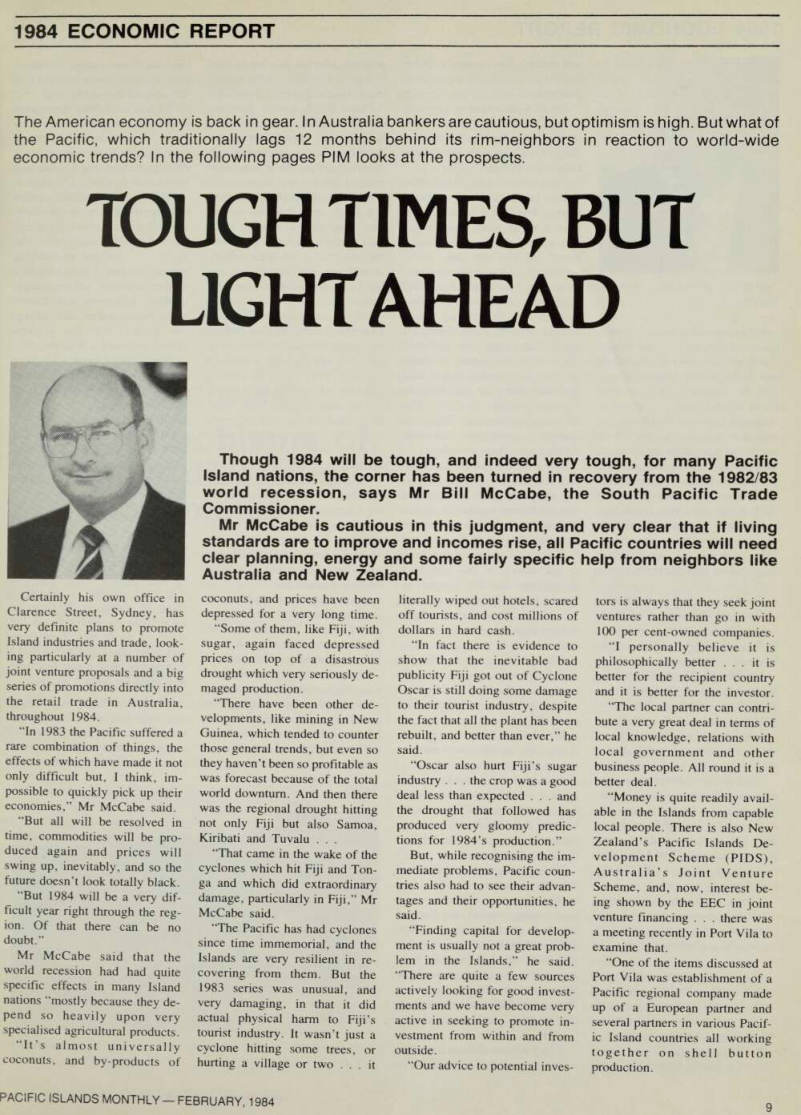
Though 1984 will be tough, and indeed very tough, for many Pacific Island nations, the corner has been turned in recovery from the 1982/83 world recession, says Mr Bill McCabe, the South Pacific Trade Commissioner.
Mr McCabe is cautious in this judgment, and very clear that if living standards are to improve and incomes rise, all Pacific countries will need clear planning, energy and some fairly specific help from neighbors like Australia and New Zealand.
Certainly his own office in Clarence Street, Sydney, has very definite plans to promote Island industries and trade, look ing particularly at a number of joint venture proposals and a big series of promotions directly into the retail trade in Australia, throughout 1984.
“In 1983 the Pacific suffered a rare combination of things, the effects of which have made it not only difficult but, I think, im possible to quickly pick up their economies,” Mr McCabe said.
“But all will be resolved in time, commodities will be pro duced again and prices will swing up, inevitably, and so the future doesn’t look totally black.
“But 1984 will be a very dif ficult year right through the reg ion. Of that there can be no doubt.”
Mr McCabe said that the world recession had had quite specific effects in many Island nations “mostly because they de pend so heavily upon very specialised agricultural products.
“It’s almost universally coconuts, and by-products of
coconuts, and prices have been depressed for a very long time.
“Some of them, like Fiji, with sugar, again faced depressed prices on top of a disastrous drought which very seriously de maged production.
“There have been other de velopments, like mining in New Guinea, which tended to counter those general trends, but even so they haven’t been so profitable as was forecast because of the total world downturn. And then there was the regional drought hitting not only Fiji but also Samoa, Kiribati and Tuvalu . . .
“That came in the wake of the cyclones which hit Fiji and Ton ga and which did extraordinary damage, particularly in Fiji,” Mr McCabe said.
“The Pacific has had cyclones since time immemorial, and the Islands are very resilient in re covering from them. But the 1983 series was unusual, and very damaging, in that it did actual physical harm to Fiji’s tourist industry. It wasn’t just a cyclone hitting some trees, or hurting a village or two ... it
literally wiped out hotels, scared off tourists, and cost millions of dollars in hard cash.
“In fact there is evidence to show that the inevitable bad publicity Fiji got out of Cyclone Oscar is still doing some damage to their tourist industry, despite the fact that all the plant has been rebuilt, and better than ever,” he said.
“Oscar also hurt Fiji’s sugar industry . . . the crop was a good deal less than expected . . . and the drought that followed has produced very gloomy predic tions for 1984’s production.”
But, while recognising the im mediate problems, Pacific coun tries also had to see their advan tages and their opportunities, he said.
“Finding capital for develop ment is usually not a great prob lem in the Islands,” he said.
“There are quite a few sources actively looking for good invest ments and we have become very active in seeking to promote in vestment from within and from outside.
“Our advice to potential inves
tors is always that they seek joint ventures rather than go in with 100 per cent-owned companies.
“I personally believe it is philosophically better ... it is better for the recipient country and it is better for the investor.
“The local partner can contri bute a very great deal in terms of local knowledge, relations with local government and other business people. All round it is a better deal.
“Money is quite readily avail
able in the Islands from capable local people. There is also New Zealand’s Pacific Islands De velopment Scheme (PIDS), Australia’s Joint Venture Scheme, and, now, interest be ing shown by the EEC in joint venture financing . . . there was a meeting recently in Port Vila to examine that.
“One of the items discussed at Port Vila was establishment of a Pacific regional company made up of a European partner and several partners in various Pacif ic Island countries all working together on shell button production.
“It is intended to be a total export company . . . the island countries will provide the shell and make button blanks. These will be collected at a central point and finished . . . there is already a factory at Port Vila . . . and the French partner will undertake to market the product.
Each of the separate joint venture companies would a shareholder in the Port Vila factory.
“I’m not sure how far it has gone, but it is a very interesting concept with a lot of promise; a first in terms of international cooperation at a business level.
“There are many multi nationals operating in the Pacif ic,” he said, “almost all of them foreign-owned. This would be a first genuinely Pacific multi
national company.”
Mr McCabe concedes that in almost all cases in the Pacific one is dealing with fairly low tech nology, very closely allied to primary products. “Nor do I en
visage the early advent of high
tech companies in the region.
“But we are observing an in creasing interest in putting indus tries into the Pacific which do involve high, or higher, technol ogy. I’m not talking about com puter manufacture, but I am talk ing about things like boat
building and equipping.
“There is already a quite sub stantial engineering base in some of the countries and examples of successful exploitation of them,” he said.
Fiji was, of course, well ahead in this area with quite sophis ticated establishments operating
in the engineering, ship-repair,
computing, printing, construc
tion and other fields and was already a Pacific centre for such
activities. But some smaller countries were also making progress.
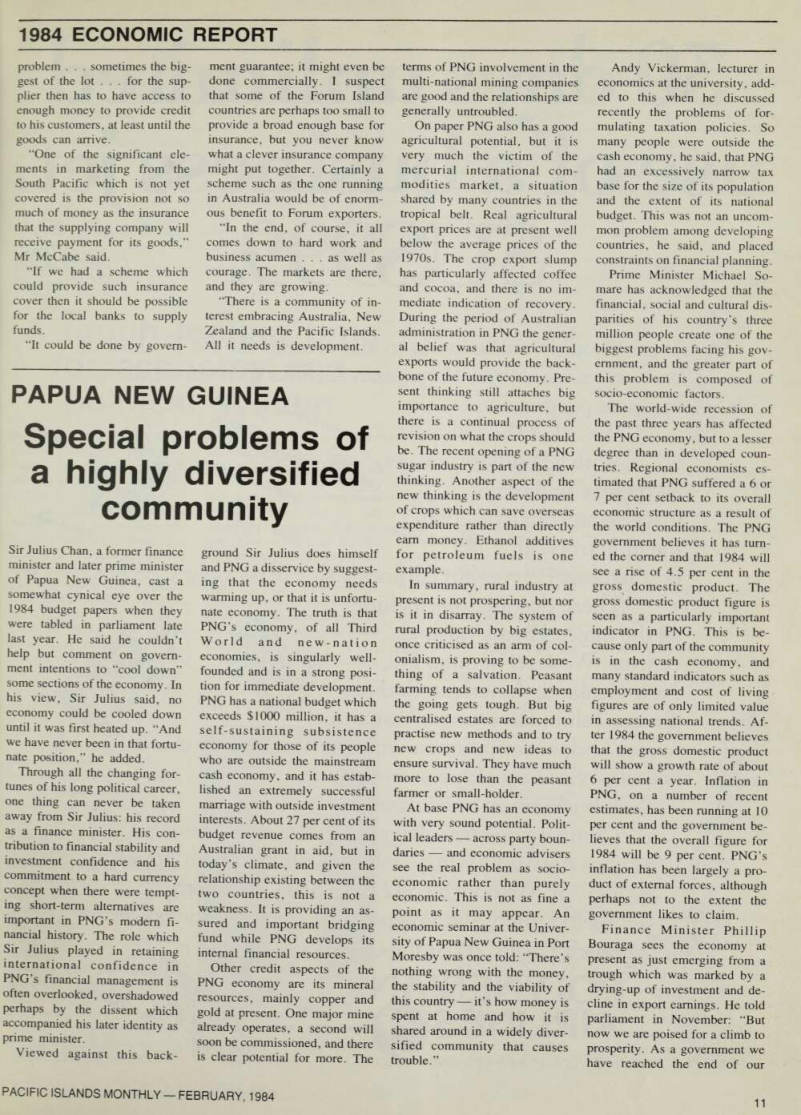
Mr McCabe cited as example the success of Scan Tonga, which
is building hydraulic trench
diggers in Nuku’alofa and selling them very widely.
“It’s often suggested that Pacific Islands workers are over relaxed and that it is impossible to achieve the same productivity as you can get in temperate coun tries,” Mr McCabe said.
“That’s just not so. In some cases it’s been proved conclu
sively that productivity is higher
in the Islands than, in say, Aust ralia or New Zealand. There’s a factory in Tonga, for instance, where they are making footballs at a rate ten per cent higher than the same firm can get from its factory in New Zealand. The knitware factory in Tonga is
similarly productive, and the
product quality is excellent.
“So I wonder how much of this alleged low productivity is the result of poor management and indifferent equipment rather than any lack of energy or dedi cation on the part of the workers.
“I’m not suggesting that there is not active in the Islands a philosophy that life should be lived ... I totally agree with that . . . but it’s always better to look at facts than listen to myths,” he said.
Given, then, that the Pacific did offer opportunities to the canny and forward-looking in vestor, what areas should be
probed?
Mr McCabe believes the field is as wide as an entrepreneur’s vision and drive can make it.
“But there is one very great point I would put forward and that involves quality,” he said. ”1 believe the Islands will do far better if they aim for higher quality rather than lower price.
“In so many cases, and for a variety of reasons, involving at titudes of mind, scale of market and distance from it, the Pacific countries cannot compete with Asia, and probably never will be able to do so. I believe the best way to overcome that problem is to ensure that the product is of top quality. Sell at the top end of the market rather than the bottom.
“They also need input from the customer . . . that’s a universal
principle whether it is the Islands selling to Australia, or the Japan ese selling to America,” he said.
“Here in Australia you see really very close liaison between Japanese car manufacturers and their Australian distributors, all aimed at getting the product pre
cisely right for the buyer.
“So Forum Island manufactur ers should seek help and advice from their clients here in Aust ralia, or New Zealand, or where ver they wish to trade. They should not feel patronised; it’s the way international business is done.
“We at the South Pacific Trade Commission can, and do, help in providing that sort of close con tact. We offer a wide variety of services, even down to sending
samples of goods to possible
buyers and sending their reac tions back to the makers, even before he comes down to make contact himself and sign a contract.
“In fact it is possible, although possibly not utterly desirable, for the Commission to do just about everything except sign the final contract. We have much wider ranging powers and broader sup port than, say, an Australian trade commissioner.
Do Island manufacturers have to overcome any special pre judice against their products on
grounds that they come from
relatively unsophisticated areas?
“I don’t think so,” Mr McCabe said. “It’s perhaps an indication of the level of knowledge which exists among Australian buyers, but I have found good acceptance of Island products here.”
What of SPARTECA’s effec
tiveness? Some Island business men claim it isn’t doing what
they hoped it would?
“SPARTECA has been suc cessful in statistical terms,” he said. “There has been quite a significant increase in sales since its introduction. It’s not success ful in every individual case.
“But let me say this . . . I’ve been saying it now for 10 years, so if I’m accused of preaching the same old gospel, then I’m guilty . . . assisted access to a market, or duty-free access to a market, will not sell one single product. Somebody still has to come down and do the selling.
The product still has to have appeal and find a buyfcr.
“Personally I think a lot more could have been sold even before SPARTECA and I am certain a lot more can now be sold with SPARTECA in place.
“After all, under SPARTECA something like 98 per cent of the
entire Australian import product
list is opened without duty to the Pacific Forum countries.
“But the biggest problem is convincing manufacturers that they can do it, and that problem is not confined to the Islands. It exists in Australia, too. Certainly it is more difficult to sell some thing to someone 2000 miles away than to someone up the street. It needs more hard work and more plannings and it looks frightening. But it can be done, and must be done,” he said.
“And even when you’ve found a market and the products are rolling out to ready buyers,
you’ve probably still got prob
lems, because success can be a
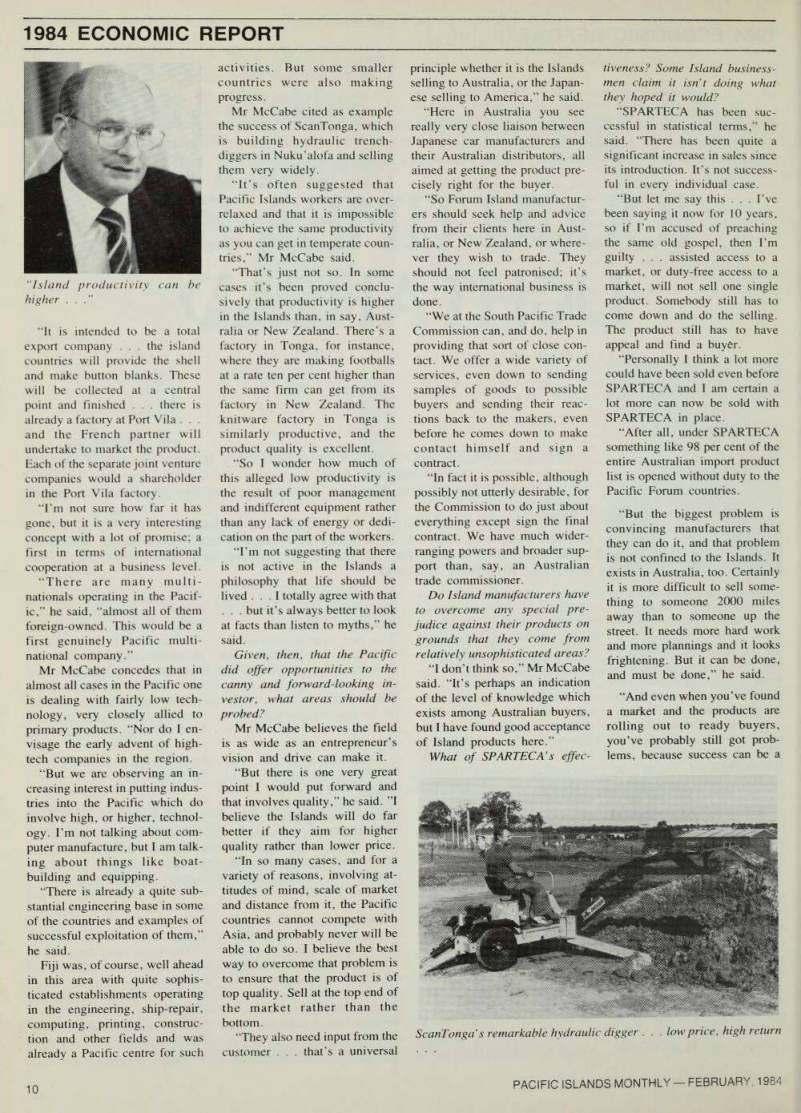
“Island productivity can be higher . . .”
ScanTonga ’s remarkable hydraulic digger . . . low price, high return
problem . . . sometimes the big gest of the lot . . . for the sup plier then has to have access to enough money to provide credit to his customers, at least until the goods can arrive.
“One of the significant ele ments in marketing from the South Pacific which is not yet covered is the provision not so much of money as the insurance that the supplying company will receive payment for its goods,”
Mr McCabe said.
“If we had a scheme which could provide such insurance cover then it should be possible for the local banks to supply funds.
“It could be done by govern
ment guarantee; it might even be done commercially. I suspect that some of the Forum Island countries are perhaps too small to provide a broad enough base for insurance, but you never know what a clever insurance company
might put together. Certainly a
scheme such as the one running in Australia would be of enorm ous benefit to Forum exporters.
“In the end, of course, it all comes down to hard work and business acumen ... as well as courage. The markets are there,
and they are growing.
“There is a community of in terest embracing Australia, New Zealand and the Pacific Islands.
All it needs is development.