The political testament of
p. 39 · Read in the full issue
Political Currents
The political testament of John French Teariki
True Polynesian farmer that he was, the late Tahitian political leader John French Teariki never had much time for city life, worldly European ways, or the trappings of power. Nor was he a very talkative person, and if he replied at all to the questions of inquisitive Popaa journalists and writers, it was only very briefly and strictly in monosyllables.
The interview printed here is therefore a unique document, for in it not only does Teariki speak at length, he also for once opens his heart.
The person who succeeded in winning his confi dence and esteem was the Danish anti-nuclear cam paigner and writer Martine Pétrod, who used French for the tape-recorded talk.
Though the interview (shortened here for reasons of space) was given in 1981, it is the last summing-up of his lifelong struggle that we have from Teariki, and so constitutes a sort of political testament. The tone is sombre throughout, as if he was already beginning to feel that he was nearing the end of the road.
Bengt Danielsson.
JT: At the time of the establish ment of the CEP (Centre d’Ex périmentation du Pacifique, the French nuclear testing station) in our country, I was a member of the Territorial Assembly and I am still a member today.
My party was against CEP’s establishment, because we had read in newspapers and books that nuclear tests are not a good
thing for the people. That’s why
I began to fight against the estab lishment of CEP. They told us that it would bring a lot of money to the people. In the beginning, when the centre was being built, many people were employed on the building sites and here in Papeete. At that time everybody who was capable of working was brought from the islands. In that way, the copra they used to make did not get made any more.
MP: That’s one of the effects of CEP’s establishment. Is there also evidence of consequences in
respect to health standards and environment?
JT: Unfortunately, yes. We hear a lot of people talk about leukaemia and cancer. People talk a lot about it and I often hear: this person died of cancer, that person died of leukaemia.
There is one thing I regret and that is that the hospital has not kept statistics of how many have died of leukaemia and cancer, which year, etc. We have asked the hospital to give us these statistics, but we have never re ceived any. I believe that the French Government is respons ible for this, the reason being that the population should not know that too many people are dying of leukaemia or cancer.
MP; We read in the book “Moruroa, mon amour” that the French Government has used its own methods to suppress and annul decisions and requests made by the Territorial
Assembly.
JT: The government has done everything in its power to pre vent the outside world from knowing that the local au thorities, the Territorial Assem bly, were against the nuclear tests. They have done everything to hide this fact, and they have succeeded extremely well.
MP: Up to 1976-1977 there was a strong resistance here, but now it seems like people don’t talk about the tests any more.
JT; They carry out under ground tests now. The tests were cairied out in the atmosphere before, which was much more dangerous. There isn’t so much talk about it now, but we still fear them. We are always afraid of these tests.
MP: Are you warned before a nuclear test is carried out?
JT: They warned us before.
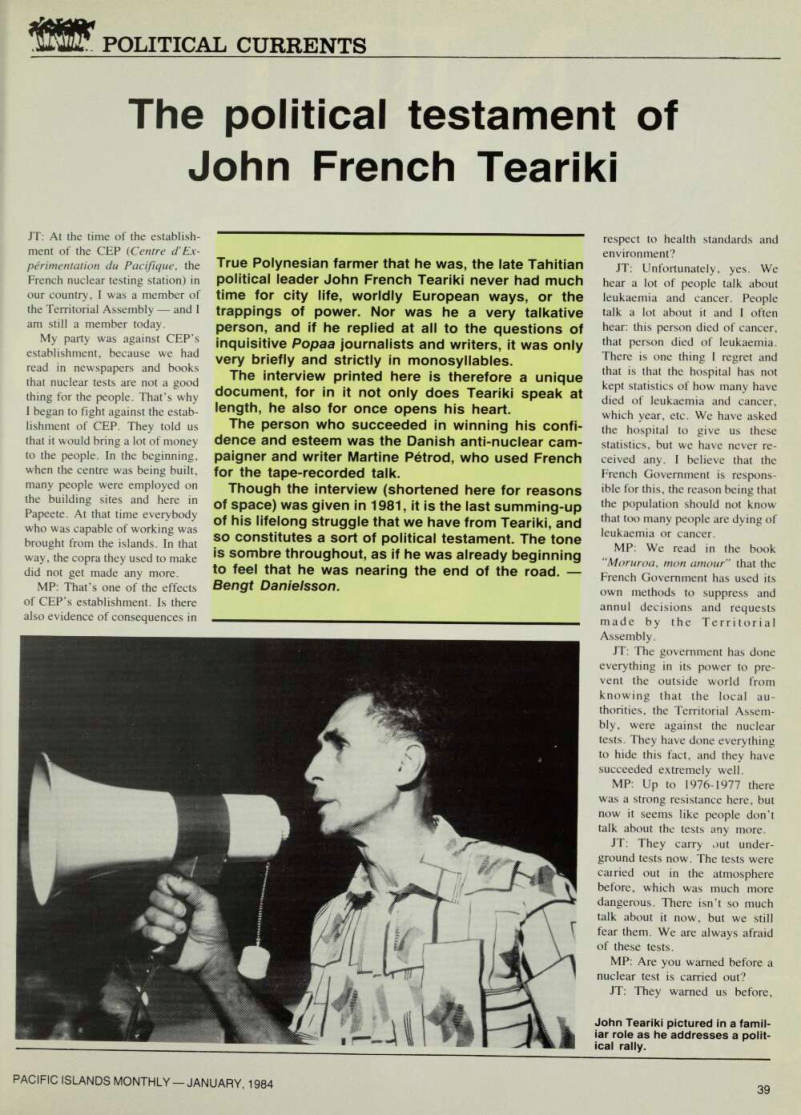
John Teariki pictured in a famil iar role as he addresses a polit
ical rally.