Wide-ranging reflections of
pp. 35-37 · Read in the full issue

Micronesia
Wide-ranging reflections of Father Hezel
Reflections on Micronesia: Collected Papers of Father Francis X. Bezel, S. J. Publish ed by the Center for Asian and Pacific Studies, in collaboration with the Social science Research Institute, University of Hawaii, Manoa, Honolulu, Hawaii.
Working Paper Series, Pacific Islands Studies, 1983. No charge.
Father Francis X. Bezel, S. J., has been writing about Mic ronesia and its problems since the late 19605, when he took up residence in Truk. It is a fact of life for a person who has lived in Micronesia as long as he has that researchers and visitors regard him as an expert in whatever field of inquiry they happen to be pursuing as they pass through the islands looking for information.
Unlike most of them, Father Bezel has in fact come to be an expert in a number of dissimilar fields, ranging from history (his strong point) to anthropology, from suicide among Microne sians (to which he devotes most of his time at present) to educa tion. He achieved this position as a result of both personal interest and the demands made upon him by his Jesuit Superiors, who in
sisted that he be involved in Xavier High School and in local community concerns.
Reflections on Micronesia wit nesses to his facility in diversity.
Its 18 essays span the years 1968-80 and fall into the three broad categories of education (seven essays), economics (six) and miscellaneous topics (five).
Twelve of the essays have been published before. Since only se ven of them have statistics or footnotes, this collection makes for easy reading for those who want to follow the course of development in Micronesian education and economics, espe cially for the decade before the July 1978 plebiscite, when the various groups in the Marshalls and Carolines voted either to join a Federated States of Micronesia (Kosrae, Ponape, Truk and Yap joined) or to drop out (Palau and the Marshalls dropped out); 16 of the 18 essays were written before this crucial vote.
By and large, Fr Bezel’s es says are reflections upon the character of the social changes occurring in Micronesia after the U.S. substantially increased the amount of money it gave to the islands (which it still administers for the United Nations as the
Trust Territory of the Pacific Islands) in the early 19605, and then substantially reduced the amount of money but not the number of federal programs in the mid-19705. It should be re marked, however, that the level of U.S. aid to the islands before the early 1960 s had already been high relative to what other met ropolitan countries were spend ing on their Pacific territories.
Xavier High School on the island of Moen overlooks the Truk Lagoon from a hilltop.
From an office in a former Japan ese communications station, Fr Bezel has written about and con sidered the matters dealt with in these essays. But Xavier has not been an ivory tower for him, since Fr Bezel has kept abreast of the latest economic and educa tional theories affecting Mic ronesians, and he has delved more deeply into some contem porary social issues than anyone else. At the same time, he has kept free of the tendency Grim-
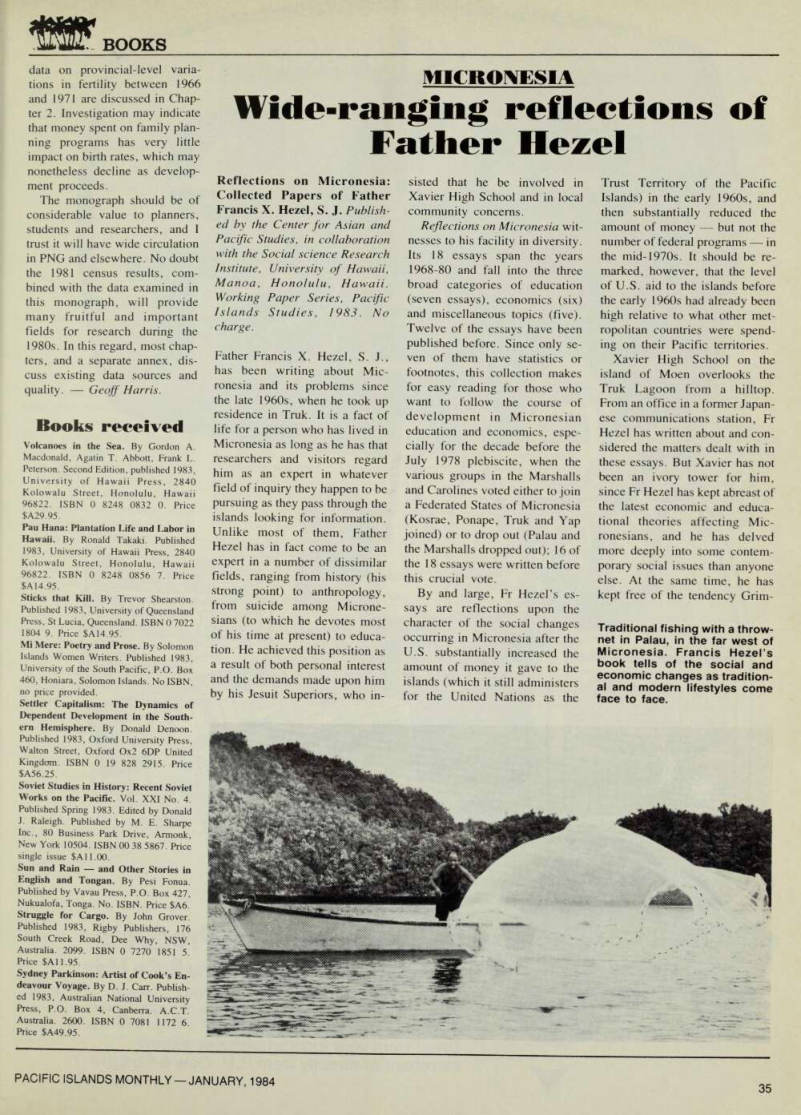
Traditional fishing with a throw net in Palau, in the far west of Micronesia. Francis Hezel’s book tells of the social and economic changes as tradition al and modern lifestyles come face to face.
ble warned researchers about many years ago; “There is a mortal difference of spirit bet ween genuine research and pry ing. The danger is, the genuine thing can deteriorate by such subtle and unconscious stages into mere over-curiosity that a bona fide student may find him self poised on the very brink of fiddling before he wakes up to the horrid change that has gone on inside him.” As he reveals, (A Pattern of Islands, pi 52), Grimble nearly made this mis take himself.
Fr Hezel’s six essays on Mic ronesian economics (Nos. 1,5, 11, 13, 17,-18; these are num bered in the collection) are gen erally the least satisfying ones here. The Micronesian economy has aroused pessimism in Ameri cans who have had to try to develop it since World War 11. Fr Hezel recognises the need for solid economic productivity (Nos. 11, 17), but he makes no particular suggestions about the methods to be used to this end in Micronesia. Presumably, such productivity would have to rely on agricultural and maritime in dustries and those other busines ses that grow up in their wake.
For tropical countries around the world (including those in the Pacific), Princeton economist W.
A. Lewis says (in his The Evolu tion of the International Econom ic Order) economic prosperity must follow the road of agricul tural self-sufficiency, then ag ricultural surpluses followed by industrialisation. But can Mic ronesians even become self sufficient in the first place, given present population growth, espe cially if it is not eased by emigra tion to the U.S.?
Fr Hezel properly decries the lessening of social co-operation and community spirit brought on by increased federal aid and programs; then, there is the prob lem of the “hidden costs” of aid, mainly in the maintenance of equipment and buildings once they are in the islands (No. 13).
These are two matters to which officials must be increasingly sensitive if they are to control social changes.
For Fr Hezel, the first step towards a solution to economic troubles lies in a spirit of self reliance (Nos. 5, 17). He some-
how sees the sale of rights (such as military denial and use rights) and service industries (tourism) as vitiating this spirit; “The three political entities presently negotiating with the U.S. . . . are on the verge of confirming once and for all the service economy patterns that they have begun under colonial rule. In doing so, they are effectively ruling out the option of any sig nificant growth in economic pro ductivity not for lack of money, but for lack of motiva tion” (pi4B). I would argue that sale of rights and service indus tries are not a colonial legacy but conform to pre-colonial features of Micronesian societies; I would add that, if enough money is earned in these ways, it could, for all we know, not end motiva tion but perhaps redirect it into other channels, say along the lines of a cultural renaissance.
We’ll have to wait and see.
The seven education essays (Nos. 2,4, 7-10,16) overlap with the economic ones to a certain extent in that the “investment in man theory of education” in volves both topics (No. 18). As it now stands, such investment in man (understood to mean Mic ronesian students) has brought about a situation in which there is no longer sufficient employment for high school and college graduates in the islands. As of 1978, Trukese graduates had not been leaving Truk for elsewhere (No. 16), but that could change if
federal aid dropped below a cer tain level without any corres ponding upswing in the domestic economy. With some degree of concern, Fr Hezel also sees pri vate school enrolments declining for the foreseeable future (No. 2) and the dislocation of values be cause of the American education given to children in public schools (Nos. 4,7).
In the other education essays, he discusses education theories (No. 8), and he faults the Educa tion for Self-Government groups for not stimulating lively public debate on issues involved in the political agreements being voted upon and worked out between the U.S. and the various Mic ronesian entities (No. 10).
In the miscellaneous group are five essays dealing with these topics: anthropologists and Mic ronesian research (No. 14); suicide (No. 12); political status talks up to the time of the July 1978 plebiscite (No. 15); com munity support of the Catholic Church (No. 3); and a disturbing, yet simple, tale (perhaps forecast is a better word) of the loss of all traditional values and customs (No. 6).
Although the various Microne sian political entities (the Com monwealth of the Northern Marianas, the Republic of Belau, the Republic of the Marshalls, and the Federated States of Mic ronesia) have already entered a period of internal self government, the economic and
educational issues Fr Hezel tack les in these essays will persist, and his statements should contri bute to the debate on how to come to terms with them.
Professor Robert C. Kiste, di rector of the Pacific Islands Study Program at the University of Hawaii, Manoa, deserves credit for this collection of es says, which was published with the assistance of the Social Sci ence Research Institute, UH, as the first publication in the “Working Paper Series” of Pacific Islands Studies. Fr Bezel’s First Taint of Civiliza tion, a pre-colonial history of the Carolines and Marshalls, is to be the first publication in the Pacific Islands Monograph Series of Pacific Islands Studies; it was due out in late 1983 from the University of Hawaii Press.
Copies of Reflections on Mic ronesia may be obtained free of charge by writing to Professor Robert Kiste, Pacific Islands Studies Program, Center for Asian and Pacific Studies, Un iversity of Hawaii, Honolulu, HI
96822.
M. L. Berg.
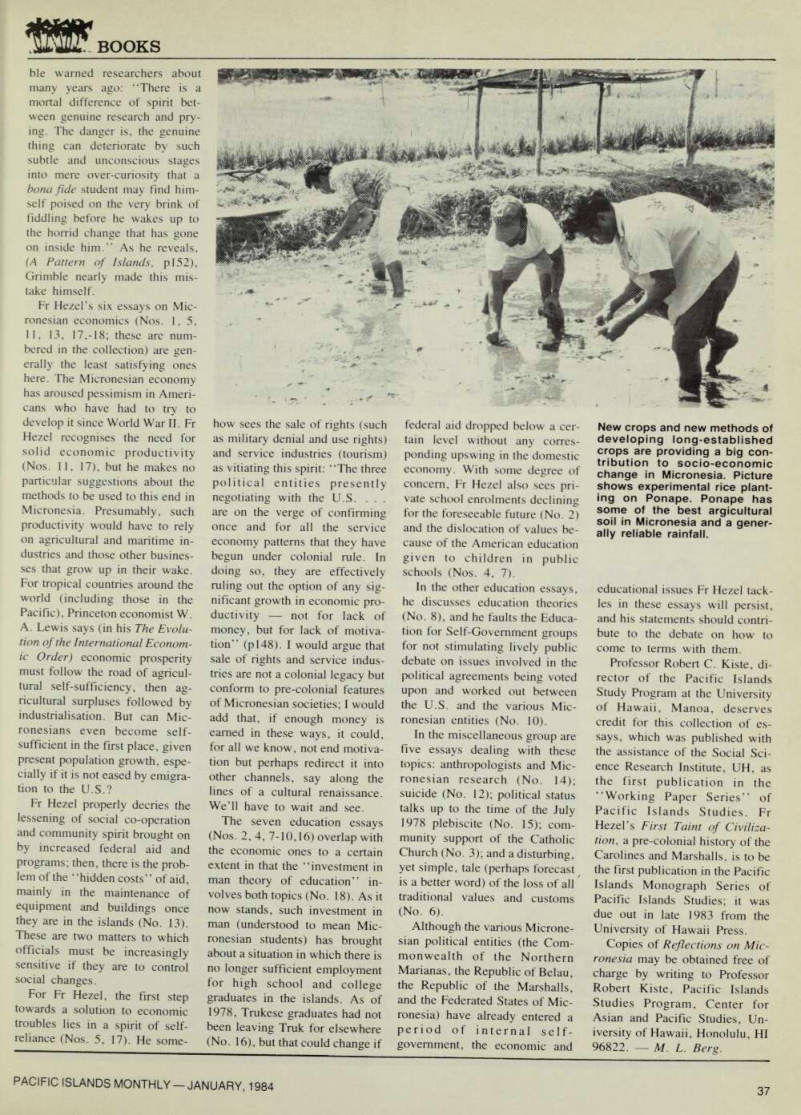
New crops and new methods of developing long-established crops are providing a big con tribution to socio-economic change in Micronesia. Picture shows experimental rice plant ing on Ponape. Ponape has some of the best argicultural soil in Micronesia and a gener ally reliable rainfall.