Floyd’s Fearless
p. 14 · Read in the full issue
The Month
Floyd’s Fearless Forecast for ’84
Predictions are the stuff of fools or gamblers, and a good journal ist should be neither. But fate tempts us all, even the most cautious of columnists. So herewith is Floyd’s Fearless Forecast for Micronesia.
Most important, 1984 will be the year America’s long trustee ship is finally terminated at least in most of Micronesia. By November or December, the U.S. Congress should have had enough time to approve the free association compacts with the Marshall Islands and the Federated States of Micronesia.
Palau is another matter, more of which in a moment.
Assuming President Ronald Reagan is re-elected and at this early stage, with the Ameri can economy shifting into high gear, that must be considered likely termination by the end of the year seems quite possible.
If a Democratic administration comes to power the situation could change dramatically. But that must be counted as a long shot and, after all, this is prediction time.
Congress will act favorably because it has no other option.
U.S. strategic interests are well protected by free association, perhaps too much so in some cases. And certainly in the Northern Marianas, which will become a U.S. commonwealth, the people welcome full Ameri can citizenship with open arms.
In addition, Micronesians have in plebiscites made it clear that either free association or commonwealth statuses are the relationships of choice. It would be hard for senators or congress men to vote against the “will of the people”.
What of the United Nations, which has ostensible oversight of the Trust Territory? In reality, the U.N. has been a symbolic lord of the Micronesian realm; the decisions that count have always been made in Washing ton. So it seems likely that the United States will opt to present the U.N. with a termination pac kage that has been, in effect.
signed, sealed and delivered.
Given a probable veto by the Soviet Union of the post trusteeship arrangements in the Security Council (under which the Trust Territory of the Pacific Islands falls), the Reagan ad ministration (or any other for that matter) would avoid that body. A more reasonable course would have Washington tell either the General Assembly or the Trus teeship Council that the U.S. was ending its administration in ac cordance with the trusteeship ag reement, and with the wishes of the Micronesian people and leave it at that.
The question of Palau may take longer to answer. Two fac tors are influencing the outcome
of the political and constitutional stalemate in those islands.
One, perhaps the most impor tant, is the second presidential elections scheduled for this com ing November. This is the vote that counts and for the past two years local forces have been realigning themselves for the contest. Palauans are pragmatic in their politics; they know that
regardless of the group’s political
relationship with the United States, they have to live on a day-to-day basis with their elect ed leadership. Far better to be on the winning side than wait
another four years to return from the political hinterlands.
Because of this, the free as sociation compact has become a pawn in the “larger” local polit ical scene. Factions and influen tial individuals have supported, and opposed, free association primarily as a means to further their personal or group political goals. There has been an unfortu nate lack of broad-based debate on the issues of nationalism.
The second major factor in fluencing events in Palau is the “nuclear issue”. Resolution of the difference between the com pact and Palau’s constitution is primarily a political issue: it has been clear from the beginning that the reality of the situation demands a pragmatic answer rather than one based on con stitutional or legal niceties.
That is why renewed negotia tions between Palau and the Un ited States took place in Hawaii in mid-December. At press time, the following was evident: a new compact will emerge from the process, one based on the “old” compact but with enough
changes to (one hopes) satisfy
the many constituencies in Palau.
It is notable that the Palauan
delegation included nearly every
faction from the group.
What U.S. Ambassador Fred Zeder has essentially told the Palauans is that they must either put up with broad-based ag reement on the new relationship or shut up and accept the
reality of a continuing trusteeship
administration solely for Palau into the indefinite future.
What has become of the nuc lear problem is unclear at press time. Some sources say the U.S.
has dropped its military require
ments completely, but that seems unlikely. Others say the Palauans would agree to a U.S. military training presence as called for in the original compact, but for more than the SUSI billion over 50 years that had been agreed upon. That seems quite likely from the Palauan perspective, but while some increase may be forthcoming, it is hard to see how the United States could ag ree to a radical jump in funding levels for Palau.
How long will this all take?
If all goes well, both sides could complete their differences
by early this year. That would give time for the holding of a new referendum. It is clear another vote would have to take place, but would likely require only a simple majority and have none of the trick questions that caused such problems last February.
A less optimistic but still real istic prediction is that Palau will be on track by the end of August or perhaps by early September, just in time for the local elec tions. Such a timetable allows the local politicos to try to claim credit for “saving” free associa tion and the big bucks that are a part of the agreement.
In any case it would be quite surprising if Palau’s problems dragged on through 1984. It is not in Palau’s favor for the un certainties to continue foreign governments, which are being courted for additional aid, are uncomfortable at the seemingly endless squabbling. And when the Palauans see their Microne sian brethren beginning to reap the financial benefits of free as sociation, they will want their piece of the pie, too.
Such predictions, of course, come with no guarantees. But the odds would seen to favor the outcomes described here. In both cases general trusteeship is sues and specific Palauan ques tions it is really nothing more than predicting the certain out come. The major disagreement comes on timing and on that score, only time will tell.
Floyd K. Takeuchi.
Notes from the North Floyd K.
Takeuchi on Micronesia
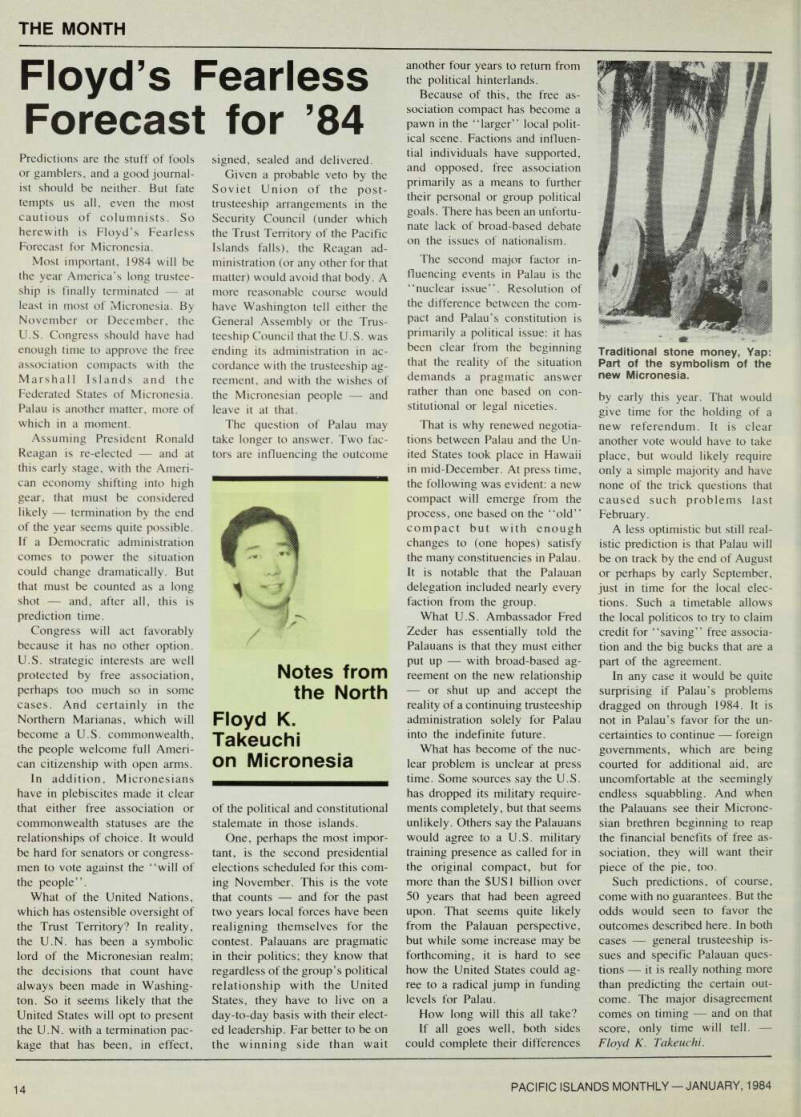
Traditional stone money, Yap: Part of the symbolism of the new Micronesia.