Pacific: Know
pp. 7-9 · Read in the full issue
Letters
The French Pacific: Know the facts?
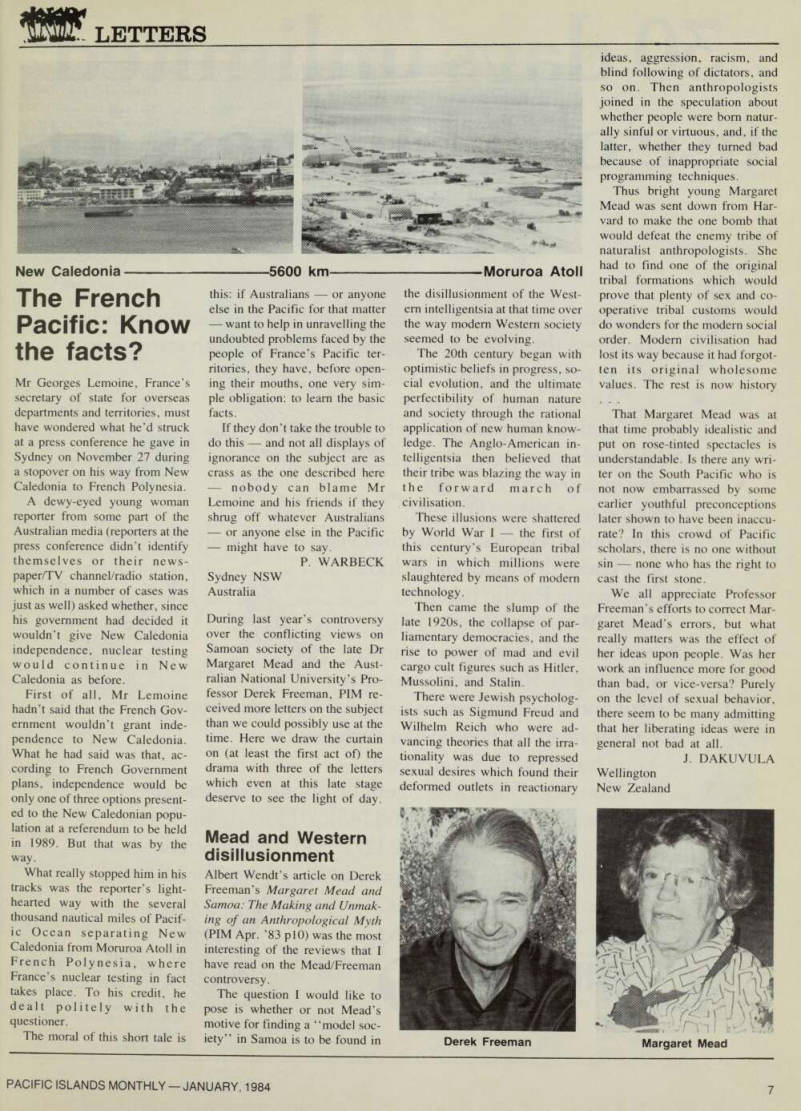
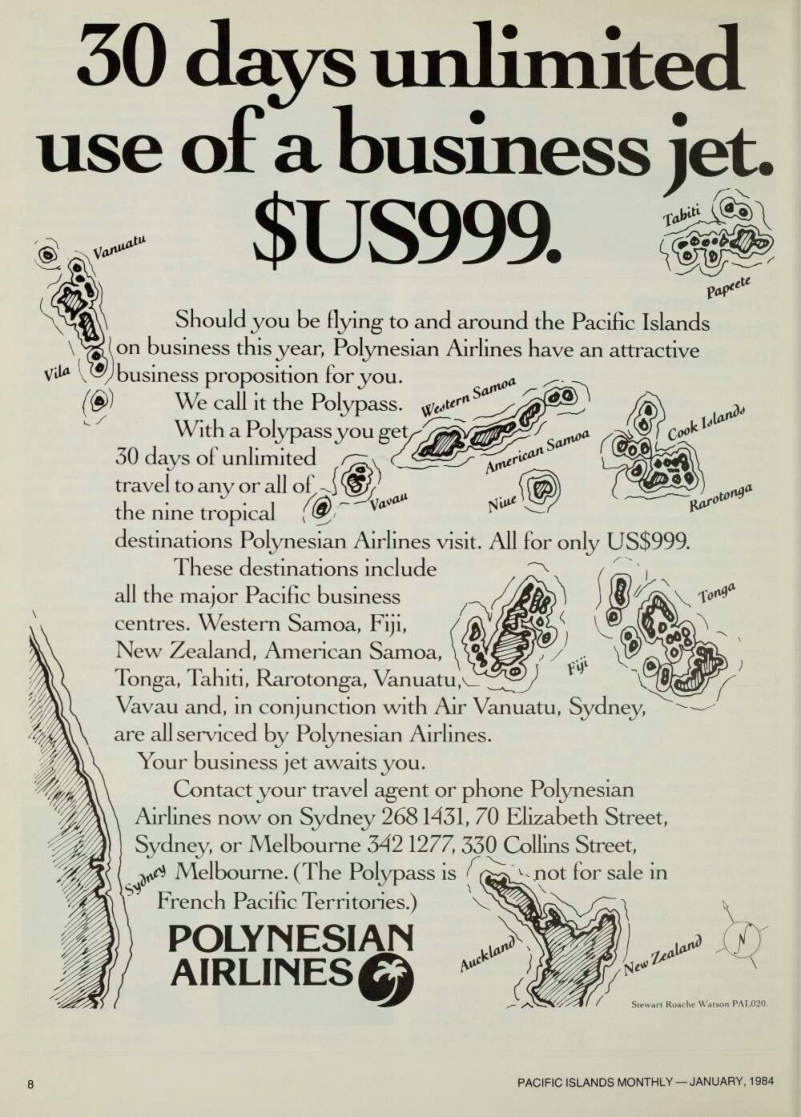
New Caledonia
-5600 km
Moruroa Atoll
Mr Georges Lemoine, France’s secretary of state for overseas departments and territories, must have wondered what he’d struck at a press conference he gave in Sydney on November 27 during a stopover on his way from New Caledonia to French Polynesia.
A dewy-eyed young woman reporter from some part of the Australian media (reporters at the press conference didn’t identify themselves or their news paper/TV channel/radio station, which in a number of cases was just as well) asked whether, since his government had decided it wouldn’t give New Caledonia independence, nuclear testing would continue in New Caledonia as before.
First of all, Mr Lemoine hadn’t said that the French Gov ernment wouldn’t grant inde pendence to New Caledonia.
What he had said was that, ac cording to French Government plans, independence would be only one of three options present ed to the New Caledonian popu lation at a referendum to be held in 1989. But that was by the way.
What really stopped him in his tracks was the reporter’s light hearted way with the several thousand nautical miles of Pacif ic Ocean separating New Caledonia from Moruroa Atoll in French Polynesia, where France’s nuclear testing in fact takes place. To his credit, he dealt politely with the questioner.
The moral of this short tale is
this: if Australians or anyone else in the Pacific for that matter want to help in unravelling the undoubted problems faced by the people of France’s Pacific ter ritories, they have, before open ing their mouths, one very sim ple obligation; to leam the basic facts.
If they don’t take the trouble to do this and not all displays of ignorance on the subject are as crass as the one described here nobody can blame Mr Lemoine and his friends if they shrug off whatever Australians or anyone else in the Pacific might have to say.
P. Warbeck
Sydney NSW Australia During last year’s controversy over the conflicting views on Samoan society of the late Dr Margaret Mead and the Aust ralian National University’s Pro fessor Derek Freeman, PIM re ceived more letters on the subject than we could possibly use at the time. Here we draw the curtain on (at least the first act of) the drama with three of the letters which even at this late stage deserve to see the light of day.
Mead and Western
disillusionment
Albert Wendt’s article on Derek Freeman’s Margaret Mead and Samoa: The Making and Unmak ing of an Anthropological Myth (PIM Apr. ’B3 plO) was the most interesting of the reviews that I have read on the Mead/Freeman controversy.
The question I would like to pose is whether or not Mead’s motive for finding a “model soc iety’’ in Samoa is to be found in
the disillusionment of the West ern intelligentsia at that time over the way modem Western society seemed to be evolving.
The 20th century began with optimistic beliefs in progress, so cial evolution, and the ultimate perfectibility of human nature and society through the rational application of new human know ledge. The Anglo-American in telligentsia then believed that their tribe was blazing the way in the forward march of civilisation.
These illusions were shattered by World War I the first of this century’s European tribal wars in which millions were slaughtered by means of modern
technology.
Then came the slump of the late 19205, the collapse of par liamentary democracies, and the rise to power of mad and evil cargo cult figures such as Hitler, Mussolini, and Stalin.
There were Jewish psycholog ists such as Sigmund Freud and Wilhelm Reich who were ad vancing theories that all the irra tionality was due to repressed sexual desires which found their deformed outlets in reactionary
ideas, aggression, racism, and blind following of dictators, and so on. Then anthropologists joined in the speculation about whether people were bom natur ally sinful or virtuous, and, if the latter, whether they turned bad because of inappropriate social programming techniques.
Thus bright young Margaret Mead was sent down from Har vard to make the one bomb that would defeat the enemy tribe of naturalist anthropologists. She had to find one of the original tribal formations which would prove that plenty of sex and co operative tribal customs would do wonders for the modern social order. Modem civilisation had lost its way because it had forgot ten its original wholesome values. The rest is now history That Margaret Mead was at that time probably idealistic and put on rose-tinted spectacles is understandable. Is there any wri ter on the South Pacific who is not now embarrassed by some earlier youthful preconceptions later shown to have been inaccu rate? In this crowd of Pacific scholars, there is no one without sin none who has the right to cast the first stone.
We all appreciate Professor Freeman’s efforts to correct Mar garet Mead’s errors, but what really matters was the effect of her ideas upon people. Was her work an influence more for good than bad, or vice-versa? Purely on the level of sexual behavior, there seem to be many admitting that her liberating ideas were in general not bad at all.
J. Dakuvula
Wellington New Zealand
Derek Freeman
Margaret Mead
Recollections of a
Samoan student
I read Margaret Mead’s Coming of Age in Samoa several times before and during my time as a student at Portland State Univer sity in Portland, Oregon, from 1974-78. As a Samoan, I failed to find much, if any, validity in it.
But my American social psychology lecturer seemed to take great delight in talking to us about the book. He went even beyond what Mead had written: he talked about Samoa as a “free love” society, where people could make love not only under the coconut palms but wherever they felt like it; masturbation, he said, was a universal habit and could be indulged in on any social occasion, including chief ly council meetings.
When we were a few minutes into his first lecture, I either had to interrupt or leave the class. I interrupted. I said I was only one of many Samoans who had read the book, and had found that what was in it was just about 100 per cent news to me. It consisted mainly, I said, of children’s jokes, swallowed by the gullible Mead.
In the upshot, arising from a review I wrote at my lectur er’s request of Mead’s book, in which I disagreed with about 85 per cent of what she’d said, I was given a “D” grade. My lecturer said that Coming of Age in Samoa had been closely studied and thoroughly inves tigated by many professional re
viewers (sociologists,
psychologists, anthropologists,
and others in the area of social science) before it was published.
Therefore my review had to get a low mark.
Just as my lecturer gave me an inferior grade, Margaret Mead and her backers depicted all of us Samoans as inferior. That’s unfair!
Falani A. Peters
Seattle Washington
Usa
Flapper Margaret
vs. Derek the Punk?
With regard to the Freeman/Mead controversy, perhaps it is part of the negativism, if not the nihil ism, of the times that a book such
as Freeman’s which sides with nature rather than nurture should receive such wide publicity: Mead’s flapper being confronted by Freeman’s punk. In a world of flux, a “runaway world”, as Leach called it a few years ago in his Reith lectures, people seem to be looking not for their poten tialities, but to know their limita tions. Freeman’s work is meticulous, and well-written, if pompous in places, but it is ultimately a counsel of despair.
Mead was a voice of optimism of the Depression ’3os, and Freeman could well become the prophet of doom for the atomic threatened and unemployment ridden ’Bos, reciting the genetic message he found writ on the open walls of Samoan fale.
Both Mead and Freeman end their books by appealing to choice. For Mead, this choice is from the demonstrated human potential of the diversity of hu man cultural forms; for Freeman, it is choice within the limitations of a theoretical “open program” (p 298), which is supposed to be a part of all living things.
It is a contract of choice simi lar to the stereotypic choice of fered by parents to their
offspring.
If Mead was, as Time magazine described her, the cosy ‘‘mother to the world”, is Freeman aspiring to become its austere father?
Grant Mccall
Sydney NSW Australia
Ronald Titcombe’s
Kapel Pacifico
Reading in the Sydney paper The Sun-Herald of November 27 ab out a remarkable character named Ronald Mervyn Tit combe, former Royal Australian Navy officer and underwater div ing specialist, I noticed that one of his numerous ill-starred business enterprises was a Syd ney company, Kapel Pacifico, which had planned an Australia- Chile shipping service back in 1981.
The company’s name “rang a bell with me” as the saying goes, and I consulted my file of PIM for that year. Sure enough, in the “Pacific Report” department in the December 1981 issue of the magazine I came across the head line “Australia-Chile Cargo Ser vice Reopened?” over the fol lowing report; At press time it was still unclear whether a service designed to end an eight-year freeze on shipping con tacts between Australia and Chile would actually get under way. A company known as Kapel Pacifico (KP) Pty. Ltd. planned to inaugurate the service in mid November using the 16,250-tonne German-registered vessel, MV Luise Bornhofen. Ac cording to plans, the vessel, with 245-container capacity, was to oper ate a two-month turn-around service
between east coast Australian ports and Pacific-coast South American countries such as Peru and Chile. But whether Australian maritime trade unions’ politically-based opposition to contacts with junta-ruled Chile had been effectively overcome was un clear. A trade union source contacted by PIM said the Luise Bornholfen had arrived in Sydney from Canada with a cargo of paper, had then come under a new charter, and was, at the time of the interview, at the Victorian port of Geelong loading cargo, all of which was marked as destined for Peru. Another shipping source out side the union movement suggested that the ship would not be making the trans-Pacific journey because there was not enough cargo on offer to make it economic. The source claimed that only about 1000 tonnes of cargo was available.
That was the last I ever heard of Kapel Pacifico, until The Sun- Herald report I’ve mentioned, which also said that Titcombe had “business problems in New South Wales, and is under inves tigation by the NSW Corporate Affairs Commission”.
Other collapsed enterprises of Titcombe’s include two English based ones, Arunta International (formed to provide services for the offshore oil industry), and a consortium set up to save the Norton Villiers Triumph motor
bike industry.
All told, if Mr Titcombe’s general credibility is of the same order as that he has won for himself as a businessman, it seems that we can pretty well write off the new book which is the reason for the international attention he has been attracting over recent weeks.
For Mr Titcombe was the source of the information pro vided to British journalist and author Anthony Grey for his book The Prime Minister Was a Spy. The book claims that the late Australian Prime Minister Harold Holt was a longtime agent of Chinese intelligence and, according to Titcombe/- Grey, he did not drown off a Victorian beach in December 1967 as the whole world has believed until now, but was plucked out of the water by a Chinese submarine, and spirited off to China.
A. Blackstock
Melbourne Vic.
Australia
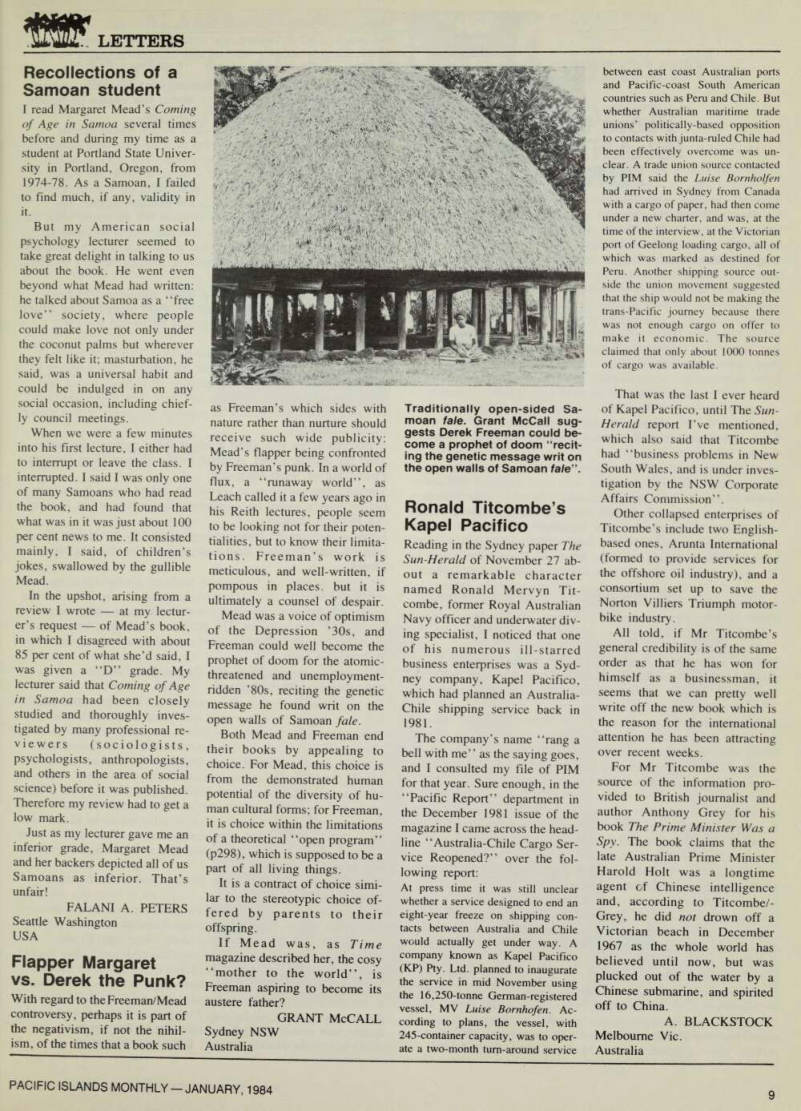
Traditionally open-sided Sa moan fate. Grant McCall sug gests Derek Freeman could be come a prophet of doom “recit ing the genetic message writ on the open walls of Samoan fale".