Mirror image change of government
pp. 51-52 · Read in the full issue
Political Currents
Mirror image change of government in the Cook Islands
The government which emerged from the Cook Is lands’ November 2 election is a kind of mirror image of the one installed in April. That government was a Cook Islands Party government with a 13-11 majority.
The new government is a Democratic Party one with a 13-11 majority. TREVOR CLARKE reports from Rarotonga.
In an extraordinarily close result, the Democratic Party (DP) under the leadership of Sir Tom Davis won the Cook Islands general election on November 2 with a margin of 13 seats to 11 over the Cook Islands Party (CIP). This was an exact reversal of the March 30 general election, won by the CIP by the same margin of 13-11.
The second general election for 1983 resulted from the defec tion of CIP Cabinet Minister Tupui Henry (son of the late Albert Henry) from the party founded by his father, leaving a hung parliament (PIM Oct. pi 9).
Tupui Henry contested the November elections under the banner of a new party, the Cook Islands Party for Alliance (CI PA). Seven CIPA candidates stood. All were soundly trounc ed, including Tupui Henry him self, who lost the seat he had held for 17 years for the island of Mauke.
The election result was stun ningly close. A mere handful of
votes made the difference bet ween winning and losing govern ment. Sir Tom Davis regained the seat he lost at the March election with a margin of only five votes. Former DP Cabinet Minister Tangata Simiona re tained his seat also by five votes.
DP member for Matavera Wil liam Cowan had his previously comfortable margin trimmed to 11. On the other hand, two CIP candidates also won their seats by margins of only 11.
The pre-election campaigns were even more low-key than for the March elections. Indeed, to some extent the parties approach ed the November poll as a mere extension of the March one. The CIP published no new manifesto, maintaining that its policies had not changed in the intervening months.
Few issues surfaced, and those that did appeared to give the CIP a firm edge. One was stability of government, another was ministerial travel overseas.
After the initial trauma caused by the defection of Tupui Henry, Geoffrey Henry held his CIP team together impressively. Be fore the general election was called, if Tupui Henry had brought with him to his proposed coalition with the DP just one other CIP member, the rewards of government would have been theirs. But the ranks of the CIP held. Geoffrey Henry was able to enter the November election with the CIP a stable, united team.
On the other hand, immediate ly before the close of nomina tions a major row erupted in the
DP. As Sir Tom Davis had lost his seat in the March election, Vincent Ingram was elected lead er of the opposition. Sir Tom was appointed without challenge to lead the DP in the November election campaign, but he feared that at some time in the future, should the DP win the election, there would be a challenge to his leadership from Ingram. Sir Tom tried to circumvent this potential problem by influencing the Nikao-Panama branch committee of the DP to appoint a candidate other than Vincent Ingram. Sir Tom was supported in his move by former deputy prime minister Pupuke Robati, and senior DP candidates laveta Short (also par ty president) and Norman George. The group was labelled locally the “Gang of Four”. At one stage Sir Tom unilaterally announced that he had dismissed Vincent Ingram from the DP.
But the Nikao-Panama branch committee stood firm and insist ed on Vincent Ingram as the candidate for its constituency.
Ingram went on to win his seat comfortably for the DP.
The row grew even more in tense when it spread to the neigh boring constituency of Ruaau.
Harry Napa, the sitting DP mem ber, was a strong supporter of Vincent Ingram. He and former Unity candidate Tauei Solomo na, now a DP supporter, were the likely nominees for the DP can didacy. Sir Tom publicly endors ed Tauei Solomona. An election within the Ruaau branch of the DP voted narrowly in favor of Harry Napa. Tauei Solomona
claimed irregularities and with the tacit support of the DP hierar chy, insisted on pursuing his nomination. The dispute was not resolved, with the result that both men stood as DP candidates, splitting the DP vote, and mak ing a gift of a safe DP seat to the
Cip.
The cost of travel overseas by DP Ministers during their term of office had been an important factor in the March election. The CIP had obtained access to full details of this expenditure while it was in government. The party was thus able to highlight the expenditure of particular indi viduals on particular occasions, and sought to establish the matter as an election issue. The DP countered this line of attack with some success by publishing de tails of achievements in overseas aid obtained from such travel.
The March election had em phasised the basic importance of village-level politics and village level communication. “National issues” therefore were matters of
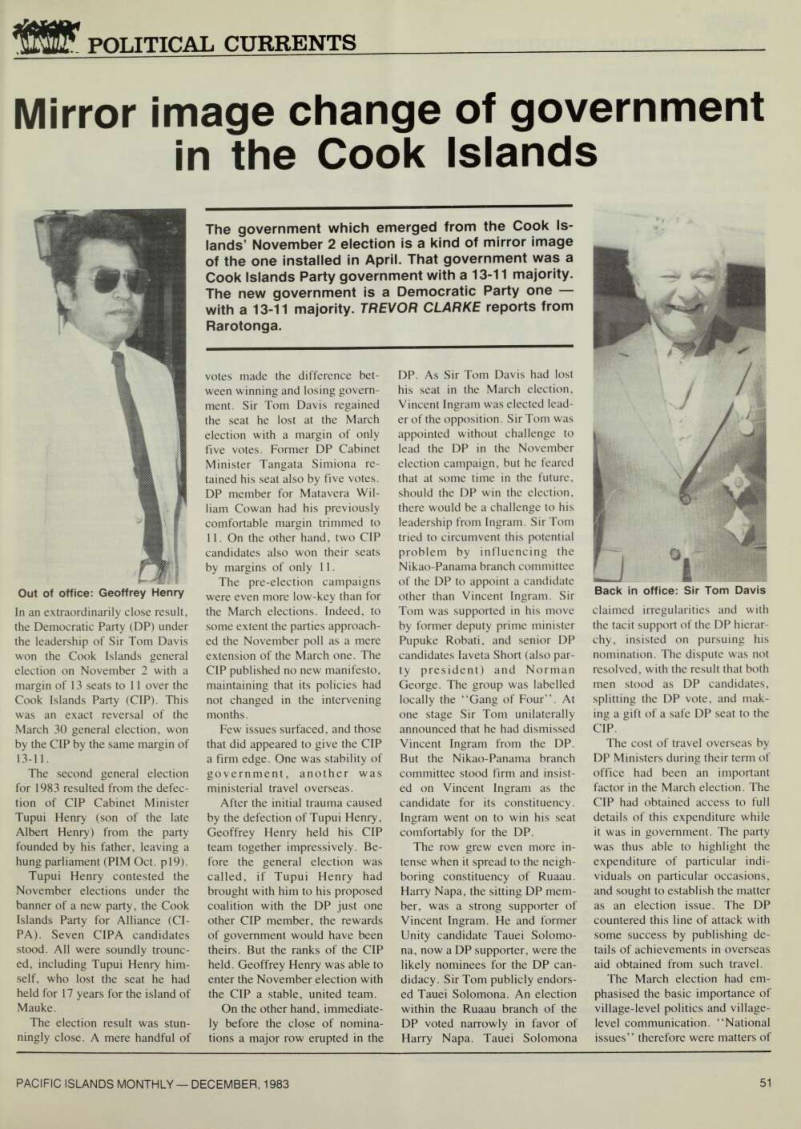
Out of office; Geoffrey Henry
Back in office: Sir Tom Davis
only incidental effect. Most cam paigning was thus being done at the village level, with little na tional campaigning. This con tributed to the apparently low key nature of the election.
The turnout at the polls again reflected the enthusiasm Cook Islanders have for their politics: 93.4 per cent of registered elec tors voted, with the lowest par ticipation again being in the overseas constituency (81.25 per cent).
Several seats changed sides in the election but none was a real surprise. Teariki Matenga (DP) regained the Titikaveka seat he lost to Matapo (now deceased) in March, defeating Matapo’s son, former Police Inspector Tiki Matapo. Mitiaro went to the new CIP member Ngatapuna David, the ageing Tiki Tetava (DP) be ing defeated by 11 votes. The able and respected George Ellis (CIP), deputy prime minister since March, lost his seat of Manihiki to new member Ben Toma (DP).
By far the biggest swing in any constituency was recorded in the overseas constituency, where DP candidate laveta Arthur soundly defeated sitting member, and the Cook Islands first woman
Cabinet minister, Fanaura Kings tone. Superior organisation of the DP in New Zealand signific antly increased the registration of its eligible supporters, while Mrs Kingstone spent most of the pre election period away from New Zealand. Mrs Kingstone dropped a mere 4.78 per cent on her March vote but laveta Arthur increased his by 89 per cent to give him victory by 119 votes.
The popular vote again showed that there is virtually nothing between the two main parties. The CIP polled 48.3 per cent of the vote overall; the DP 46.6 per cent, but if the votes of the second DP candidate for Ruaau (Solomona) are added the DP polled 48.5 per cent. Actual votes cast for the nine seats in Rarotonga were: DP (including Solomona) 2183, CIP 2180.
A feature of the election was the total eclipse of those who sought to become a third party holding the balance of power. In addition to Tupui Henry’s CIPA which failed badly, the Unity Movement of Dr Joe Williams fared even worse. In the March election, Unity contested 19 of the 24 seats. In this one it had only three candidates, with one of those withdrawing before election day. Both candidates who stood polled poorly.
With the position between DP and CIP so close it may be argued that a third candidate tak ing any votes at all may influence the outcome of an election. For
example, Mrs Louise Graham, sister of Tupui Henry, took seven votes as CIPA candidate in the constituency where Sir Tom Davis won by five. But apart from all this, it is crystal clear that the voters of the Cook Is lands totally reject the third party concept.
The closeness of the result immediately forced a closing of ranks in the DP. The Cook Is lands News published a front page photograph on November 4 showing Sir Tom Davis and Vin cent Ingram embracing at a vic tory celebration. Sir Tom an nounced that his Cabinet would be the same as before. This in cludes Mr Ingram. Absent from the Cabinet line-up will be laveta Short who again failed to recover his seat. His likely replacement will be Teariki Matenga of Titikaveka, or possibly Norman George of Atiu.
The CIP government installed in April with a 13-11 majority lasted just four months. The likelihood of the new DP govern ment, which has the same major ity, serving out its full five-year term cannot be regarded as great.
Trevor Clarke in Rarotonga.
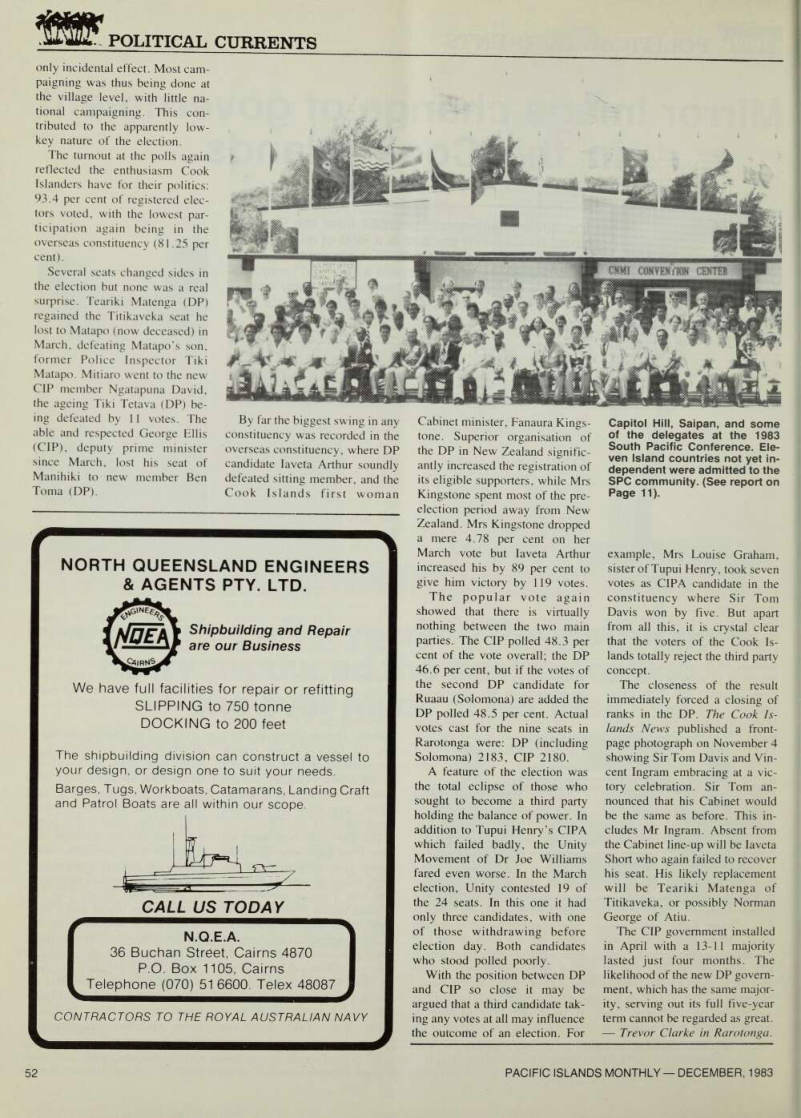
Capitol Hill, Saipan, and some of the delegates at the 1983 South Pacific Conference. Ele ven Island countries not yet in dependent were admitted to the SPC community. (See report on
Page 11).