‘the people’
Letters
Role of
in Samoa
In criticising my article on Dr Solf (PIM Jul p 52), Peter Hem penstall (PIM Sep p 7) maintains that Samoans were not politically disorganised in those days, and that “the people” played an ac tive role in “the creation of colo nial Samoa.”
This was not so. Functioning under the ali (chiefly) system, Samoans enjoyed many benefits, but a political voice was not one of them. They had no say in decisions of state, but were use ful as “cannon fodder” to defend or extend the interests of various warring chiefs.
This is not a “presumption” of a “casual observer” but a state ment of fact. “The people” had no negotiating power with the German administration, or with the chiefs themselves except in extreme circumstances. We are not discussing a democracy here, despite the claims of vari ous Samoan upper-class intellec tuals and politicians.
As far as the suggestion of Samoan leaders bringing pre ssure to bear on the German administration is concerned, this is just wishful thinking. Lauaki, as powerful a man as he was, was simply removed when he flexed his muscles, and no resist ance was offered. Solf was so successful as an authoritarian be cause he fitted himself into an authoritarian system.
It was exactly because the Samoans divided themselves along clan lines that they were weak, disorganised, and vulner able to exploitation. It is mere romanticism to suggest that “the people” were given a hand (by the Germans or the chiefs) in steering their own destiny, or that they had some kind of vote or veto power, or that they were partners in political planning.
They were not then and are not now.
Finally, the chiefs involved in the 1906 land reform were those Fono Faipule members hand picked by Solf himself, not the traditional Tumua and Pule, whom Solf had come to distrust and had summarily disbanded.
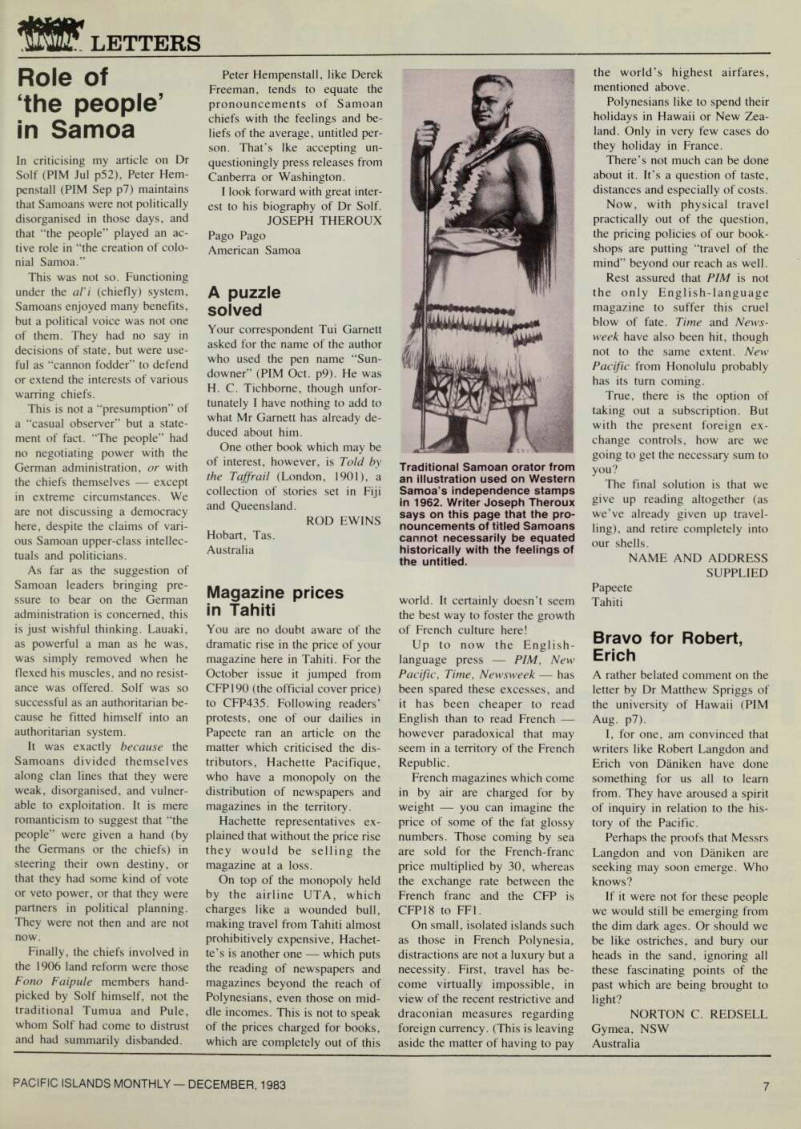
Peter Hempenstall, like Derek Freeman, tends to equate the pronouncements of Samoan chiefs with the feelings and be liefs of the average, untitled per son. That’s Ike accepting un questioningly press releases from Canberra or Washington.
I look forward with great inter est to his biography of Dr Solf.
Joseph Theroux
Pago Pago American Samoa
A puzzle
solved
Your correspondent Tui Garnett asked for the name of the author who used the pen name “Sun downer” (PIM Oct. p 9). He was H. C. Tichbome, though unfor tunately I have nothing to add to what Mr Garnett has already de duced about him.
One other book which may be of interest, however, is Told by the Tajfrail (London, 1901), a collection of stories set in Fiji and Queensland.
Rod Ewins
Hobart, Tas.
Australia
Magazine prices
in Tahiti
You are no doubt aware of the dramatic rise in the price of your magazine here in Tahiti. For the October issue it jumped from CFP 190 (the official cover price) to CFP43S. Following readers’ protests, one of our dailies in Papeete ran an article on the matter which criticised the dis tributors, Hachette Pacifique, who have a monopoly on the distribution of newspapers and magazines in the territory.
Hachette representatives ex plained that without the price rise they would be selling the magazine at a loss.
On top of the monopoly held by the airline UTA, which charges like a wounded bull, making travel from Tahiti almost prohibitively expensive, Hachet te’s is another one which puts the reading of newspapers and magazines beyond the reach of Polynesians, even those on mid dle incomes. This is not to speak of the prices charged for books, which are completely out of this
world. It certainly doesn’t seem the best way to foster the growth of French culture here!
Up to now the English language press PIM, New Pacific, Time, Newsweek has been spared these excesses, and it has been cheaper to read English than to read French however paradoxical that may seem in a territory of the French
Republic.
French magazines which come in by air are charged for by weight you can imagine the price of some of the fat glossy numbers. Those coming by sea are sold for the French-franc price multiplied by 30, whereas the exchange rate between the French franc and the CFP is
Cfpib To Ffi.
On small, isolated islands such as those in French Polynesia, distractions are not a luxury but a necessity. First, travel has be come virtually impossible, in view of the recent restrictive and draconian measures regarding foreign currency. (This is leaving aside the matter of having to pay
the world’s highest airfares, mentioned above.
Polynesians like to spend their holidays in Hawaii or New Zea land. Only in very few cases do they holiday in France.
There’s not much can be done about it. It’s a question of taste, distances and especially of costs.
Now, with physical travel practically out of the question, the pricing policies of our book shops are putting “travel of the mind” beyond our reach as well.
Rest assured that PIM is not the only English-language magazine to suffer this cruel blow of fate. Time and News week have also been hit, though not to the same extent. New Pacific from Honolulu probably has its turn coming.
True, there is the option of taking out a subscription. But with the present foreign ex change controls, how are we going to get the necessary sum to you?
The final solution is that we give up reading altogether (as we’ve already given up travel ling), and retire completely into our shells.
Name And Address
Supplied
Papeete Tahiti
Bravo for Robert,
Erich
A rather belated comment on the letter by Dr Matthew Spriggs of the university of Hawaii (PIM Aug. p 7).
I, for one, am convinced that writers like Robert Langdon and Erich von Daniken have done something for us all to leam from. They have aroused a spirit of inquiry in relation to the his tory of the Pacific.
Perhaps the proofs that Messrs Langdon and von Daniken are seeking may soon emerge. Who knows?
If it were not for these people we would still be emerging from the dim dark ages. Or should we be like ostriches, and bury our heads in the sand, ignoring all these fascinating points of the past which are being brought to light?
Norton C. Redsell
Gymea, NSW Australia
Traditional Samoan orator from an illustration used on Western Samoa’s independence stamps in 1962. Writer Joseph Theroux says on this page that the pro nouncements of titled Samoans cannot necessarily be equated historically with the feelings of the untitled.