Busy yachting
pp. 65-70 · Read in the full issue
Yachts
scene at
Port Moresby
The Royal Papua Yacht Club in Port Moresby has been going through one of its busiest periods, with a growing interest in overseas links and with exten sions and improvements to the club’s services. In this second half of the year the club has seen a crowded time.
There were the South Pacific Hobie 16 championships for which the RPYC was host and there was widespread interest and activity at the end of the third Air Niugini Yacht Race from Caims on the north east Aust ralian coast to Port Moresby.
Papua New Guinea also had three yachts in this year’s Admir al’s Cup Di Hard, Too Im petuous and Sure Foot. The three were farewelled from the RPYC, adding to the busy events of the year. Papua New Guinea had a good run of success this year in the Sardinia Cup and the South ern Cross series and at one stage was holding third place in the World Ocean Racing
Championships.
This year, too, there was an unusually large number of cruis ing yachts taking advantage of the south-east trades and calling at Port Moresby and other PNG ports for varying periods. At the RPYC, space for visiting racing and cruising yachts was at a premium although construction continued on the new groyne which will greatly increase berth
ing space.
KAY BASON reports
from Port Moresby,
Papua New Guinea:
• ALCHERINGA. It was inspiring to meet Rudy and Olga Krause who’ve been cruising for the past 21 years. They have raised two daugh ters, survived hundreds of corres pondence lessons, covered tens of thousands of miles, including one circumnavigation, because they are a very “together” couple. All deci sions are jointly made and they never leave any harbor unless they both feel right about it.
They called into Port Moresby last year on their cruise to Solomon Is-
lands. An overnight stop in the Laughlan Islands extended into a week due to strong winds. They found these remote islands delightful and the locals very friendly.
Rudy and Olga compliment the
Royal Papua Yacht Club on its hos pitality. They say it is one of the friendliest and most helpful clubs in the world.
From Port Moresby Alcheringa
will sail to Thursday Island and cruise south to Caims. Eventually this boat will be sold, as Olga said: “It’s a big and empty boat without the girls on board.” • KIM. Skipper Claus Muhloff and crew Reinhard and Hoppel Hanisch all agree yacht delivery beats work ing ashore anytime. Their only com plaint is that they’re rushing.
They departed Whangarei in New Zealand and sailed to Port-Vila and Port Moresby. Their route will be Darwin, Indian Ocean, Red Sea, Greek Islands, Sicily, then enter the French canals through to the Rhine and Amsterdam. Claus has twice previously encountered the “Mighty Mistral” winds around the Mediter ranean and has great respect for their power. He sees good reason to keep on moving to clear that area.
Reinhard and Hoppel are consider ing more cruising when they can afford their own boat. Hoppel is very pleased to have learnt to navigate on this trip. Claus will fly back to New Zealand and collect Pegasus , his own yacht.
Kim is a 10-m steel chine ketch, very roomy and well designed for
maximum stowage. She was built in 1974 by Dijkstra in Amsterdam, and will have completed a circumnaviga tion before returning to her home port. • MATA MOANA. Was built by “Tonga” Bill Fehoko in Auckland.
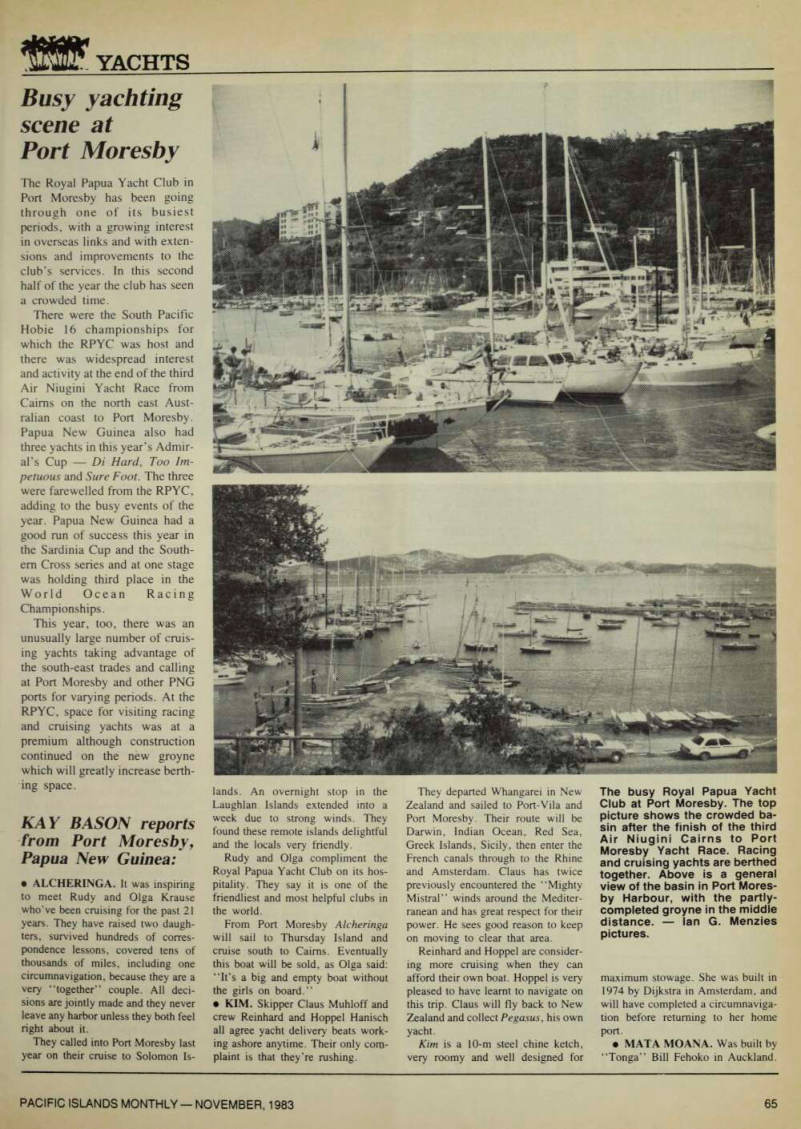
The busy Royal Papua Yacht Club at Port Moresby. The top picture shows the crowded ba sin after the finish of the third Air Niugini Cairns to Port Moresby Yacht Race. Racing and cruising yachts are berthed together. Above is a general view of the basin in Port Mores by Harbour, with the partly completed groyne in the middle distance. - lan G. Menzies pictures.
She’s a dainty 6-m marine ply sloop.
Launched in 1977, she carried Bill to Rarotonga and then Tahiti where sailor and sloop stayed for a year.
Back to Rarotonga, then on to New Zealand ports, Port-Vila, Australia, Solomon Islands, Caims, and finally Port Moresby. Quite a journey for a single-hander. He encountered the worst weather conditions around New Zealand, but after 24 days at sea still had eight gallons of water and plenty of food left.
Bill was ready to leave Port Moresby in May and had cleared customs but while doing last-minute shopping his wallet containing pass port and money was stolen. While waiting for new documents he’s been busy making beautiful scrimshaw, the ancient mariner’s art which he taught himself. At sea he has plenty of time for this work but is finding it difficult to procure whale’s teeth. He hopes one day to have better material on which to display his work than toilet-paper! Bill’s carvings and scrimshaw pay for his cruising. He certainly produces delightful work.
One day he would like to own a bigger boat but for now Mata Moana will cruise to Gove, Darwin and Bali.
The Indian Ocean will be a big trip in such a small boat, but Bill’s pro mised to let us know how he fares. • ONATU. The building of this 13m steel chine ketch was a family affair. Launched at Honfleur, on the Channel coast of France in 1975, she spent time under charter and was used as a sailing school in the Mediterranean.
The family enjoyed a cruise to the Caribbean so much they again set sail from France on a return trip. When Monsieur Delagneau had to return
because of business commitments, his son Mathieu sailed on through the Panama Canal into the Pacific with his girlfriend Monica Wildin.
Encountering Hurricane Fram two years ago on a passage from the Gambier group was quite horrific.
For three days they were battered by enormous seas. Under bare poles the mast was dipping into the sea and even the most efficient fiddle rails couldn’t contain books and gear.
What a relief it was for them to reach Tahiti and dry out.
Johan Olsson, a young Swedish traveller, joined Onatu in Port-Vila.
He has crewed on various yachts including Makaretu on a passage through the Philippines to Samarai in PNG. Port Moresby was a welcome sight after eight days of heavy weath er on passage from Vanuatu. They
are now awaiting a cruising permit
for Indonesia. If this is refused Onatu will sail to Caims and explore the Australian coast. • STARBOUND. Gordon and Nina Stuermer and son Ernie are here in Port Moresby on their second cir cumnavigation with their present crew. The Stuermers have been liv ing aboard Starbound since 1966 when they first fell in love with the boat and became her proud owners.
Built in New Jersey 1948-50, Star-
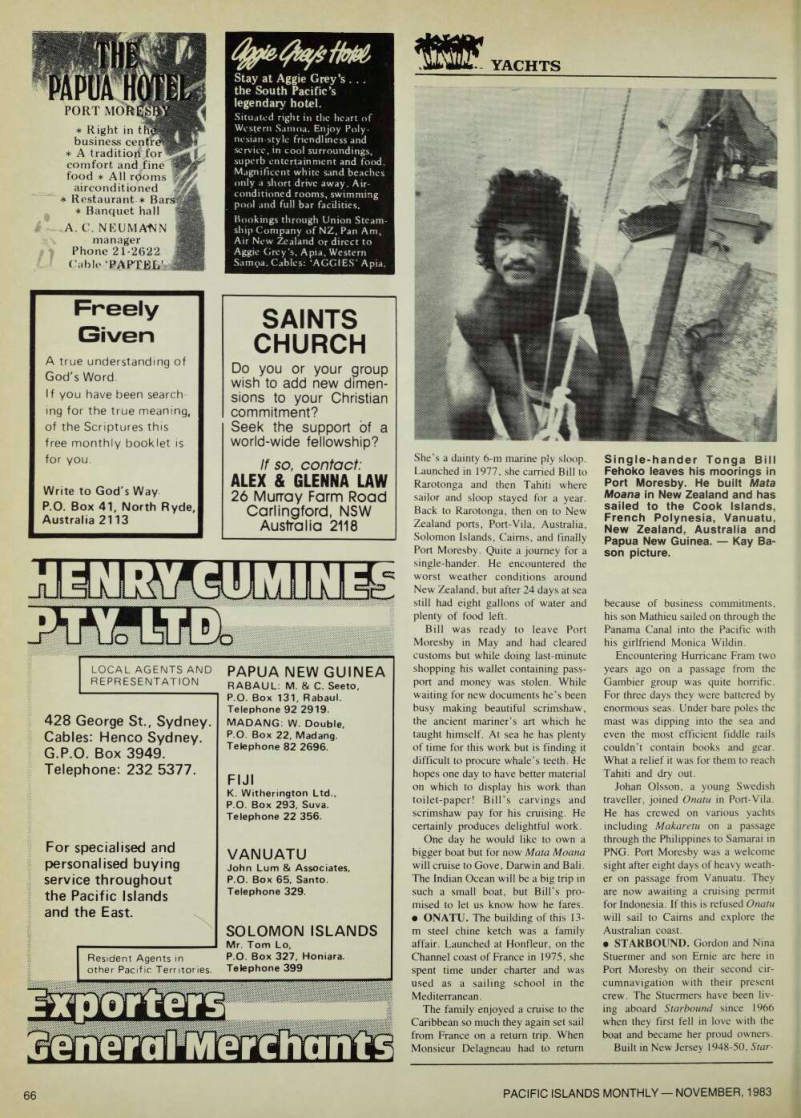
Single-hander Tonga Bill
Fehoko leaves his moorings in Port Moresby. He built Mata Moana in New Zealand and has sailed to the Cook Islands, French Polynesia, Vanuatu, New Zealand, Australia and
Papua New Guinea. - Kay Ba
son picture.
bound has 6-cm thick long leaf yel low pine over white oak frames doubled, 5-cm thick teak cabin tops and spruce spars. She’s 15-m on deck, 5-m beam, and 2-m draft. The bowsprit is 5.4-m long and she dis places 35 tons. An enlarged version of the famous Spray, she is a splen did gaff-rigged topsail ketch, carry ing a square yard on the main. Now 33 years old, she is a delight to behold. Her owners’ love and dedica tion are obvious in the high standard of maintenance.
Gordon considers they were much better prepared for their second cir cumnavigation, having learnt a lot from their previous experiences. He says maintenance and financing such a venture is really difficult without a regular income. Nina has seen many changes on this voyage, some not so
good. But she’s very pleased they’ve
visited this area of the Pacific. She
has especially enjoyed visiting
Vanuatu, Solomon Islands and Papua New Guinea. The Laughlan Islands enchanted the whole crew. Their son Ernie is a keen shell collector and biologist and has spent many hours exploring all the wonderful reefs they have encountered.
Nina and Gordon have written two excellent books: Starbound, which is a narrative of their early days and describes their first circumnaviga tion, and Deep Water Cruising, which is an ideal book for those venturing forth, containing lots of advice. Both books are available through the Dolphin Book Club. Af ter meeting these remarkable people one wants not only to read their books but also emulate their lifestyle.
The present crew sailing with the family are: Bruce Lloyd, who hails from Baltimore and is an old friend of Ernie’s. Lloyd joined the boat in 1976, helping out with maintenance and fitting out. When invited to join this trip he needed exactly two sec onds to decide. After two years he says that the world seems a much smaller place and he wants to keep on sailing.
Diana Mason grew up around the family as they were neighbors and a romance flourished between her and Ernie. She joined this cruise in Tahiti. Diana was most impressed with the unspoilt nature of the Laugh lan Islands and the warmth of the local people.
Starbound is awaiting a permit to cruise through Indonesian waters, and then onwards across the Indian Ocean. Nina is eager to return to South Africa, her favorite country.
She was captivated by the magnifi cent scenery and friendly people, and is looking forward to some warm reunions. They hope to be in the Caribbean in April and back in the States in early July.
Then it will be back home to Annapolis where Gordon will return to work for the U.S. Navy Depart ment as a naval architect, and Nina will resume work at the Naval Academy. They will continue to live aboard their beautiful home.
Lan G. Menzies, In
a delayed message
from Port Moresby,
Papua New Guinea,
reports:
• DUCHESS. She is one of those delightfully traditional, full-keeled, wooden yachts (complete with exter nal transom-mounted head), and was built in Costa Mesa, California, in 1957. Basically a Mason 30 design,
Above: Tonga Bill’s Mata Moa na ready to leave Port Moresby.
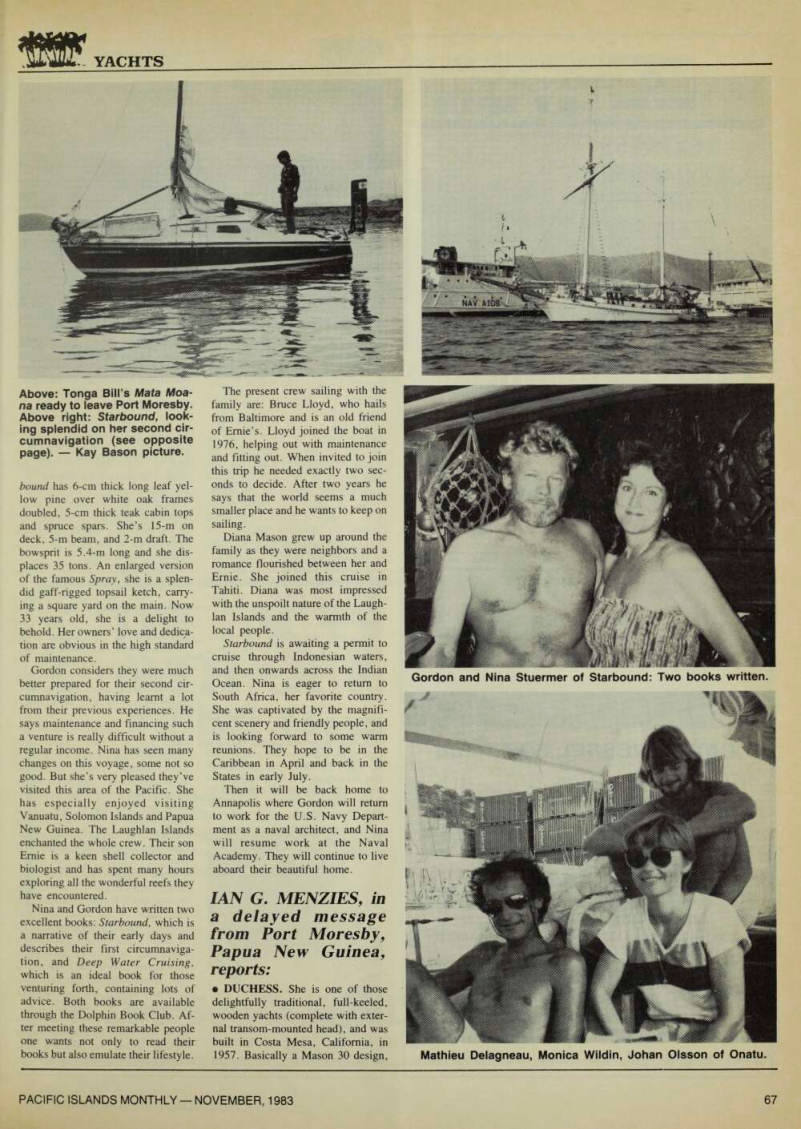
Above right: Starbound, look ing splendid on her second cir cumnavigation (see opposite page). - Kay Bason picture.
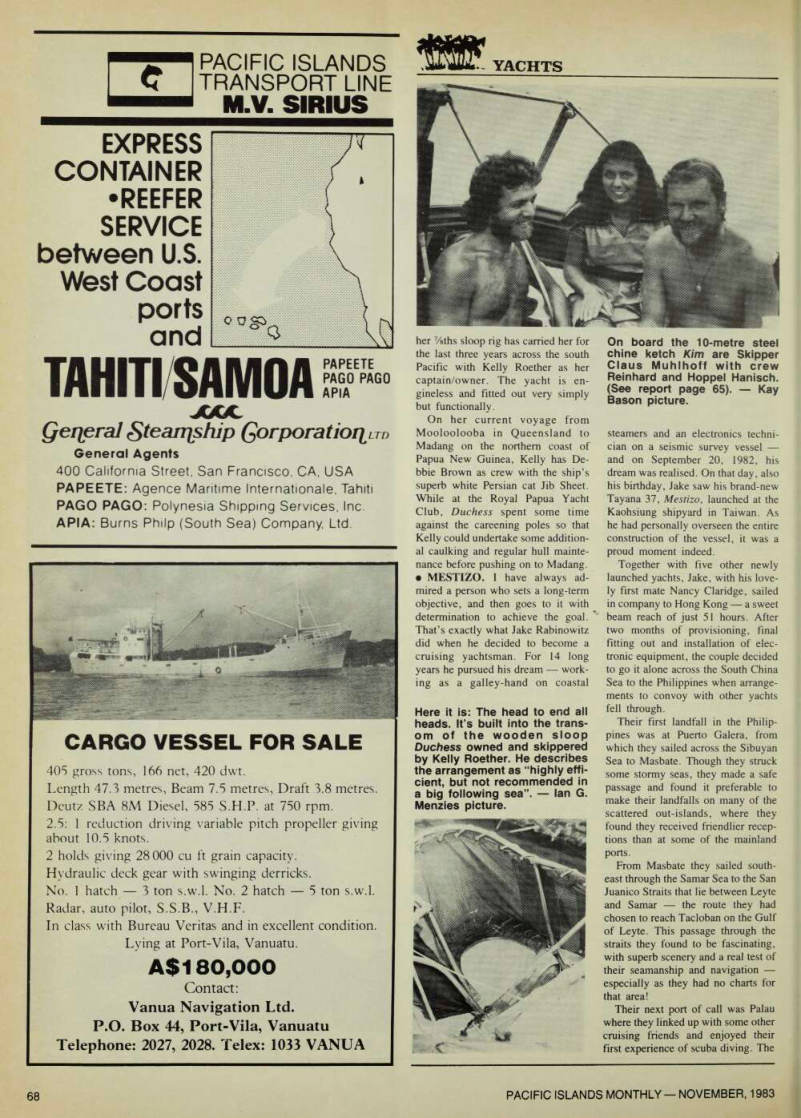
Gordon and Nina Stuermer of Starbound: Two books written.
Mathieu Delagneau, Monica Wildin, Johan Olsson of Onatu.
her 7 /Bths sloop rig has carried her for the last three years across the south Pacific with Kelly Roether as her captain/owner. The yacht is en gineless and fitted out very simply
but functionally.
On her current voyage from Mooloolooba in Queensland to Madang on the northern coast of Papua New Guinea, Kelly has De bbie Brown as crew with the ship’s superb white Persian cat Jib Sheet.
While at the Royal Papua Yacht Club, Duchess spent some time against the careening poles so that Kelly could undertake some addition al caulking and regular hull mainte nance before pushing on to Madang. • MESTIZO. I have always ad mired a person who sets a long-term objective, and then goes to it with determination to achieve the goal.
That’s exactly what Jake Rabinowitz did when he decided to become a cruising yachtsman. For 14 long years he pursued his dream work ing as a galley-hand on coastal
steamers and an electronics techni cian on a seismic survey vessel and on September 20, 1982, his dream was realised. On that day, also his birthday, Jake saw his brand-new Tayana 37, Mestizo, launched at the Kaohsiung shipyard in Taiwan. As he had personally overseen the entire construction of the vessel, it was a proud moment indeed.
Together with five other newly launched yachts, Jake, with his love
ly first mate Nancy Claridge, sailed
in company to Hong Kong a sweet beam reach of just 51 hours. After two months of provisioning, final fitting out and installation of elec tronic equipment, the couple decided to go it alone across the South China Sea to the Philippines when arrange ments to convoy with other yachts
fell through.
Their first landfall in the Philip pines was at Puerto Galera, from which they sailed across the Sibuyan Sea to Masbate. Though they struck some stormy seas, they made a safe passage and found it preferable to make their landfalls on many of the scattered out-islands, where they found they received friendlier recep tions than at some of the mainland ports.
From Masbate they sailed south east through the Samar Sea to the San Juanico Straits that lie between Leyte and Samar the route they had chosen to reach Tacloban on the Gulf of Leyte. This passage through the straits they found to be fascinating, with superb scenery and a real test of their seamanship and navigation especially as they had no charts for that area!
Their next port of call was Palau where they linked up with some other cruising friends and enjoyed their first experience of scuba diving. The
On board the 10-metre steel chine ketch Kim are Skipper Claus Muhlhoff with crew Reinhard and Hoppel Hanisch. (See report page 65). Kay Bason picture.
Here it is: The head to end all heads. It’s built into the trans om of the wooden sloop Duchess owned and skippered by Kelly Roether. He describes the arrangement as “highly effi cient, but not recommended in a big following sea”. - lan G.
Menzies picture.
beautiful Hermit Islands, with its wild deer and ruined German castle (that’s a story in itself), was their next stop-over. Jake and Nancy were fascinated by the sheer artistry in the construction of the bamboo and palm-leafed homes of the villagers on the island, who still maintain a small copra plantation established in the early days of German colonisation.
Mestizo’s port of entry into PNG was Madang, where the couple de cided to pursue their new interest in diving, and completed a full certifi cation course at the local Melanesian Dive Centre. From Madang they beat up the west coast of New Britain to Rabaul, where they were forced to extend their stay when Jake badly gashed his foot while climbing The Mother, one of the mountains that overlook the town.
The couple then decided to head for Caims via Rossel Island in the Louisiade Archipelago, but severe weather conditions in the Coral Sea forced them to heave-to for three days. As there appeared to be no likelihood of any early improvement in the weather they decided to run before the strong southeast trades into Port Moresby.
From Port Moresby, Jake and Nancy were to make passage for Thursday Island and Darwin, where the couple hope to stop for a while and replenish their cruising funds. • WANDERER IV. Known to liter
ally thousands of cruising enthusiasts world-wide through the wanderings and writings of Susan and Eric His cock. Wanderer IV is now under the proud ownership of Pam and Stuart Clay of Taurange, New Zealand. The 15 m steel ketch was acquired by the Clays in June ’Bl when the Hiscocks decided to design and build a smaller vessel.
Pam and Stuart Clay have them selves been cruising for more than 10 years in their 11 m sloop Gambol.
After completing a circumnavigation between 1973-79, they decided to “go ashore”, but it did no last long and they started to refit Gambol for yet another extended cruise. It was then they heard that Wanderer IV was on the market, and as they really wanted a vessel in which they could undertake charters, and which would meet survey requirements. Wanderer IV seemed the ideal solution.
The Clays have made very few changes to the vessel a couple of extra bunks up forward, and the
original kerosene refrigerator has
been replaced with an electric fridge and deep freeze. Stuart has also installed a Honeywell 240 volt inver ter (AC), which has proved a real boon as it allows him to use both his normal domestic and commerical tools and appliances. All in all. Wan derer IV still retains the charm and dignity of her classic design, and the immaculate condition in which she is
The sloop Duchess on the careening poles at Port Moresby before sailing to Madang on the PNG north coast.
maintained is a credit to Pam and Stuart.
From New Zealand, Pam and Stuart sailed to Port Moresby via Vanuatu. The couple said that the vessel proved to be extremely sea kindly and they were able to average 180 miles per day with just mainsail and a poled-out staysail. A few close encounters with schools of migratory whales made them extremely grateful that their vessel is made of steel.
Next time they say they will heave-to and let the whales have right of way.
From Port Moresby, Wanderer IV was to head across the Indian Ocean via Darwin, and round the Cape of Good Hope to be based next year in the Caribbean for both crewed and bareboat charters. • CARINA. Now in their tenth year of living aboard, including three years in the West Indies, the cruising
life-style obviously agrees with
Stephen Crow and Sara Ackley of Carina. They began this particular cruise in their new 14 m GRP Cal 2- 46 from Fort Lauderdale, Florida, in October ’BO with their cat April and poodle Noel.
Their leisurely passage across the Pacific included 12 months in French Polynesian waters in fact, Stephen’s log contains such detailed information and superb diagrams of their various anchorages, that it would be an invaluable cruising guide to other yachties.
Carina entered PNG waters via the Laughlan Islands an unspoilt and remote group which one hopes will always remain that way. With favor able winds they sailed to Port Mores by via Samarai and secured a protect ed mooring at the RPYC. The couple then flew to Mt Hagen in the New Guinea Highlands to view the color ful two-yearly cultural show a cool and pleasant change from ship board life.
As Stephen has now owned or built seven cruising yachts, he had some interesting comments to make on designing and fitting out vessels for long-distance cruising. He felt that a first priority was to standardise on-board equipment as much as poss ible. For example, all pressure and bilge pumps should be of the same brand with 3 /4-inch couplings and fittings to allow complete inter changeability. On water pressurisa tion, he had found that the demand for salt water for rinsing and wash ing-down, both in the galley and on deck, was of higher priority than that for fresh water. Simple header tanks and foot pumps could quite easily deliver fresh water to the galley and shower.
For years Stephen has been trying to overcome the problem of propeller drag, which can be quite consider able on larger yachts. He now recom mends the installation of a cockpit controlled variable pitch propeller
preferably two-bladed so that it can be aligned with the deadwood. This system does away with the need for a transmission in itself quite often the source of breakdowns.
With a considerable amount of sophisticated electronic and radio equipment on board, Stephen finds that he spends much time on mainte nance, but as he has a technical background it becomes more of a hobby than a chore. As a keen ham radio operator (WA2 CPX) he also broadcasts a daily weather net on 14.327 and provides weatherfax if desired.
Sara and Stephen intended to spend only a short period in Port Moresby and then head for Darwin on their continued cirumnavigation, but unfortunately Stephen contracted dengue fever so their stay at the RPYC was somewhat prolonged. • KARANA. A 14 m Formosan sloop owned by Shirlie and Hugh Richardson, Karana has “gone fin ish” from the RPYC to the Darwin Yacht club. Both Shirlie and Hugh, who had been in PNG for over 23 years, will be sadly missed from the local scene Hugh as the licensee of the RPYC and a former commo dore, and Shirlie for her involvement in the social activities of the club and her work as club secretary for the last two years.
Karana was always a hot favorite in the local “A” class races, and also
competed successfully in several of the Air Niugini Caims-Port Moresby yacht races. Whenever the family was able to get together over the school holidays, the Richardsons would be off and cruising around the PNG coastline.
We wish the Richardson family and Karana all the best in their new home Darwin Yacht Club is fortu nate indeed to have gained a family of such dedicated yachting enthusiasts.
The Tayana 37 Mestizo leaves Madang In Papua New Guinea.