back from the brink
p. 63 · Read in the full issue
How the Flying Kiwi came back from the brink
“Can a country of three million people afford to run an around the-world airline? A year ago many New Zealanders were sure it could not.”
So says New Zealand corres pondent of The Sydney Morning Herald, John MacDonald, in a report outlining the factors in the recent history of Air New Zea land which have caused most of those doubting New Zealanders to change their minds.
But first he describes the events which gave rise to their doubts in the first place. • Back in 1977 the New Zea land Government decided to merge the international carrier Air New Zealand with the dom
estic National Airways Corpora
tion. The merged airline was known as Air New Zealand. It was, says MacDonald, “a badly timed move, hurriedly put to gether, leaving a legacy of bit terness between the two groups.”
He adds: “The balance sheets
have never managed to conceal that the domestic side continued to make profits while the intema tional side lost money
increasingly.”
• In 1979 nearly all the air line’s international services were halted for 23 days when the Americans grounded the DC-10 after an American Airlines crash. • Later in the same year, on November 28, Air New Zealand had its own catastrophe on Mt Erebus in Antarctica. This was followed by a long-running scan dal over alleged bad airline prac tices, and charges of a top-level “cover-up” by the airline over the causes of the Mt Erebus disaster. • In 1981-82, the airline lost $9O million, almost all of it on its international services. This brought total losses over three years to $l7O million.
The turn-around came in 1982-83, with the announcement of a profit of $33 million. The key factor in the change, accord ing to MacDonald, was “good old-fashioned surgery and self
discipline”.
• First there were changes at the top. With the retirement of former chief executive Morrie
Davis, the airline brought in a newcomer to the airline industry, Norman Geary, 43, to replace him. Another newcomer, Bob Owens, 60, became chairman.
MacDonald writes: “These two were opposites. Geary, a sharp, cool, incisive man, and Owens, a loud, bluff character, well-suited to thumping tables in
Wellington.”
• In senior management, where formerly there were four tiers, now there are two. Mac- Donald observes: “The new mood was symbolised by remov ing from the executive floor not only the pot plants and mahogany panels, but also the managers, who were sent to their respective departments.” A sys tem of route managers was set up, with each one personally accountable for the performance of the route concerned. “Where results were not achieved, faces
quickly changed.”
• The airline has reduced staff from 8700 to 6900 over the past 18 months, getting to within 300 of a target figure of 6600. This has been achieved without en forced redundancies. • In a major coup on a depre-
ssed market, the airline suc ceeded in disposing of its former fleet of seven DC-10s, greatly facilitating the change-over to Boeing 7475, which offer nine per cent better economy for each passenger flown. • By late 1982, individual productivity of airline staff had risen by nearly a third, morale had greatly improved, and in dustrial stoppages had declined. • Indicative of its new confi dence, the airline has extended its Los Angeles service over the Arctic to London, made addi tions to its Tokyo service, and introduced new Australian ser vices to Adelaide and Hobart. • The 1982-83 profit was largely due to an estimated $7O million profit made on the sale of the DC-10s. The airline still lost about $32 million on its interna tional services. But Messrs Geary and Owens are confident this shortfall will be made up by the end of this year.
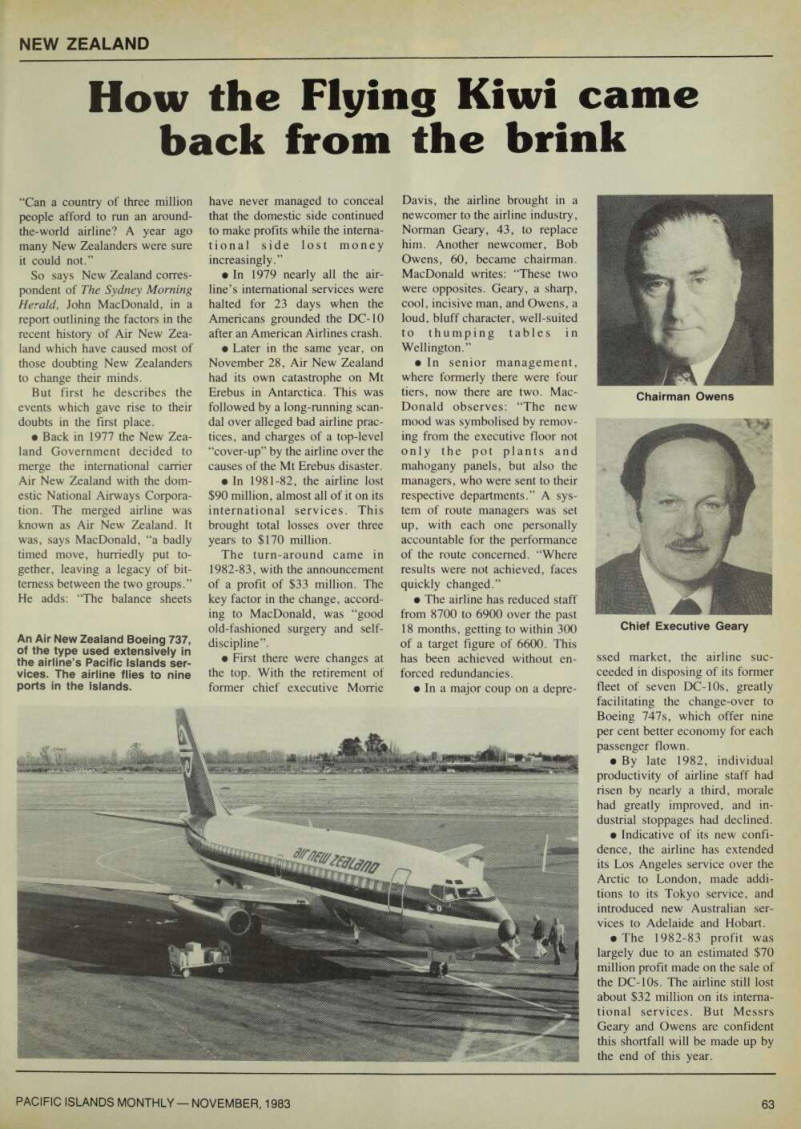
An Air New Zealand Boeing 737, of the type used extensively in the airline’s Pacific Islands ser vices. The airline flies to nine ports in the Islands.
Chairman Owens
Chief Executive Geary